
Self-Consciousness Scale (SCS) Test
How the Scales are Structured
Who Usually Takes This Test?
See How You Compare
Below is a preview of how scores are typically distributed across each scale.
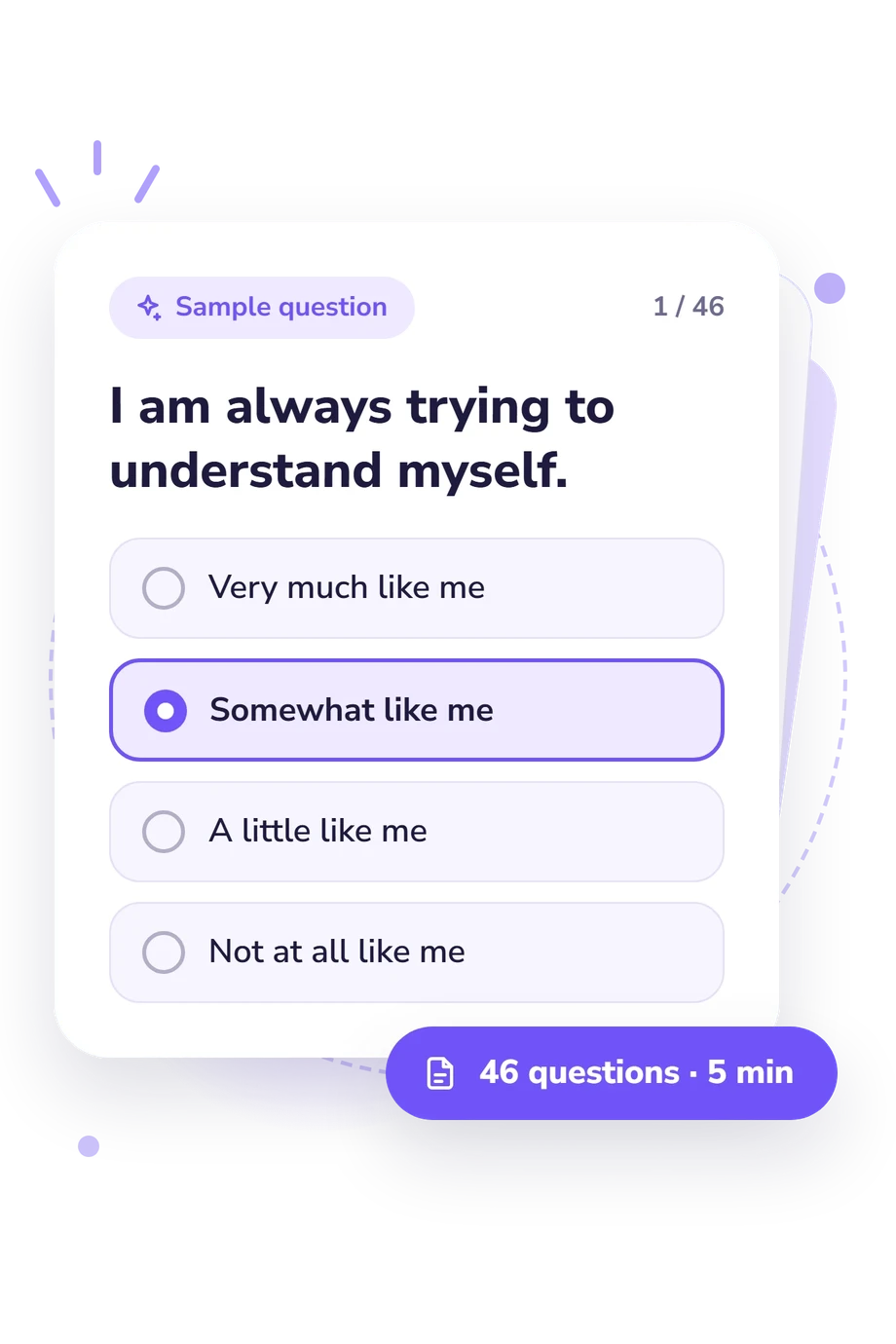
Example Questions From the Test
- Very much like me
- Somewhat like me
- A little like me
- Not at all like me
- Very much like me
- To some extent like me
- Somewhat like me
- Not at all like me
- Very much like me
- Somewhat like me
- A little like me
- Not at all like me
Self-Consciousness Scale (SCS) Test - Description and methodology of the test
People who want to understand how self-focused attention shapes everyday choices, interactions, or comfort in social situations may use the Self-Consciousness Scale (SCS) Test to organize their experiences into a clearer profile. This self-consciousness questionnaire can help readers decide which situations deserve closer reflection and identify patterns they may want to explore further.
What This Assessment Explores
The questionnaire examines self-focused attention in two related directions. One concerns awareness of how a person looks and behaves around others, including embarrassment, concern about impressions, and nervousness in groups. The other concerns private experience, such as moods, thoughts, motives, bodily state, and attempts to understand one’s actions. Together, public and private self-consciousness show where attention is directed, without treating self-focus as inherently healthy or unhealthy.
This self-consciousness assessment gives each dimension a separate level within its own result band. The result is organized through these scales:
- Public Self-Consciousness and Social Anxiety (0-33) reflects concern about how one appears to others; Low 0-8, Moderate 9-21, and High 22-33 mark outward concern and social unease.
- Private Self-Consciousness (0-36) reflects introspection and awareness of feelings, thoughts, and physical state; Low 0-13, Moderate 14-25, and High 26-36 mark internal attention.
Methodology and Scientific Basis
Each item is a self-report statement answered on four options from "very much like me" to "not at all like me." The content covers impression management, observation by others, embarrassment, group unease, introspection, mood awareness, and mental processes. The questionnaire produces the two displayed scale scores; their ranges and result bands are shown, but the point allocation for individual responses is not specified.
The closest source is the Self-Consciousness Scale (Fenigstein et al., 1975), which separates public and private self-focused attention and links public self-consciousness with social evaluation. Scheier and Carver’s 1985 revision addressed general-population use; Carver and Glass’s 1976 study examined discriminant validity. This questionnaire is conceptually consistent with that tradition, but its online form is not thereby shown to share the published instruments’ items, norms, or validation results.
For interpretation, self-consciousness test results are descriptive summaries organized by the displayed bands rather than clinical cutoffs, and self-report can be affected by current mood, recent experiences, response bias, and limited self-knowledge; read the profile alongside personal context.
- Fenigstein, A., Scheier, M. F., & Buss, A. H. (1975). Public and private self-consciousness: Assessment and theory. Journal of Consulting and Clinical Psychology, 43(4), 522-527. 10.1037/h0076760
- Scheier, M. F., & Carver, C. S. (1985). The Self-Consciousness Scale: A Revised Version for Use with General Populations. Journal of Applied Social Psychology, 15(8), 687-699. 10.1111/j.1559-1816.1985.tb02268.x
- Carver, C. S., & Glass, D. C. (1976). The self-consciousness scale: A discriminant validity study. Journal of Personality Assessment, 40(2), 169-172. 10.1207/s15327752jpa4002_8
Updated: