
Oxford Happiness Questionnaire (OHQ) Test
How the Scales are Structured
Who Usually Takes This Test?
See How You Compare
Below is a preview of how scores are typically distributed across each scale.
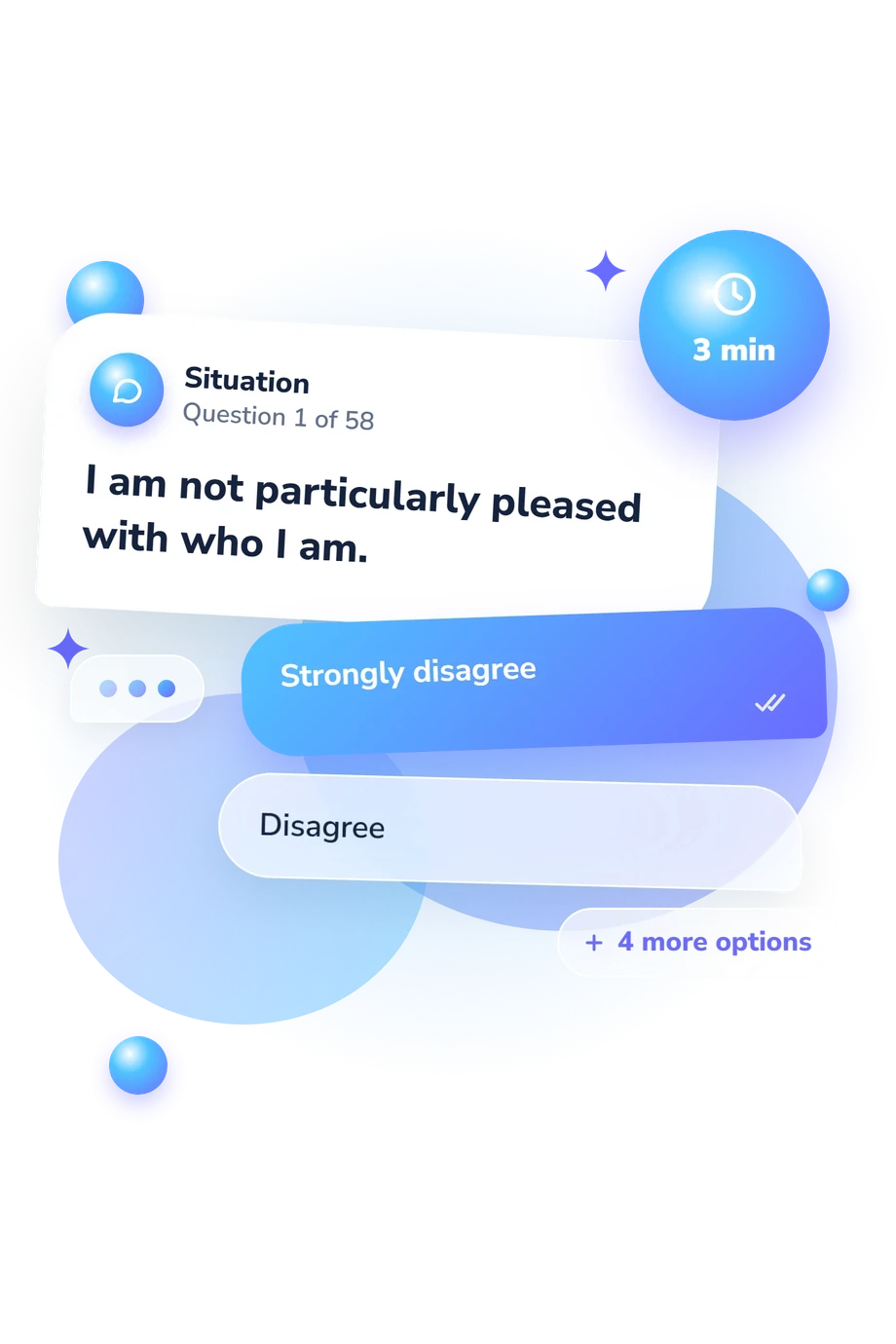
Example Questions From the Test
- Strongly disagree
- Disagree
- Slightly disagree
- Slightly agree
- Agree
- Strongly agree
- Strongly disagree
- Disagree
- Somewhat disagree
- Somewhat agree
- Agree
- Strongly agree
- Strongly disagree
- Disagree
- Somewhat disagree
- Somewhat agree
- Agree
- Completely agree
Oxford Happiness Questionnaire (OHQ) Test - Description and methodology of the test
People who want a structured pause to examine how they experience their lives may use the Oxford Happiness Questionnaire (OHQ) Test to explore everyday well-being. As a subjective well-being questionnaire, it suits anyone reflecting on everyday satisfaction, optimism, social warmth, energy, and purpose. The result can highlight a broad pattern of perceived happiness, while leaving room for context, change, and personal interpretation.
What This Assessment Explores
Rather than isolating one mood, the questionnaire samples perceived well-being through statements about self-satisfaction, relationships, enjoyment, optimism, purpose, energy, confidence, and personal control. Positive and negative wording invites the respondent to consider what is present and what may be lacking, making the exercise a practical happiness assessment.
The result is expressed as one overall scale, the Oxford Happiness Scale (29-174), with Lower happiness (29-105), Moderate happiness (106-141), and Higher happiness (142-174). The band summarizes a reported pattern.
The statements cover these connected themes:
- Self-satisfaction shows how positively you view yourself and your life.
- Social warmth and enjoyment show access to connection, pleasure, and laughter.
- Outlook and purpose show how hopeful and meaningful life feels.
- Energy and agency show vitality, engagement, capability, and perceived control.
Methodology and Evidence Base
Each statement uses a six-point agreement response, ranging from strong disagreement to strong agreement, with some wording framed positively and some negatively. The questionnaire reports one overall result on the displayed scale, and its range and bands describe levels of reported happiness.
The questionnaire is conceptually consistent with the published Oxford Happiness Questionnaire by Hills and Argyle (2002), a self-report instrument for subjective well-being. Robbins, Francis, and Edwards (2010) examined its internal consistency and construct validity in undergraduates, while Kashdan (2004) discussed problems in treating happiness as a single, simple attribute. Those studies do not establish norms or validation for this online presentation.
For an online happiness questionnaire, the band is not a diagnostic category, and current mood, recent events, self-awareness, and candor can shape responses. Broad statements about purpose, control, or enjoyment may also be interpreted differently from one situation to another. Compare the band with your circumstances and longer-term patterns to identify which experiences most influence your responses.
- Hills, P., & Argyle, M. (2002). The Oxford Happiness Questionnaire: A compact scale for the measurement of psychological well-being. Personality and Individual Differences, 33(7), 1073–1082. 10.1016/S0191-8869(01)00213-6
- Robbins, M., Francis, L. J., & Edwards, B. (2010). Happiness as stable extraversion: Internal consistency reliability and construct validity of the Oxford Happiness Questionnaire among undergraduate students. Current Psychology, 29(2), 89–94. 10.1007/s12144-010-9076-8
- Kashdan, T. B. (2004). The assessment of subjective well-being (issues raised by the Oxford Happiness Questionnaire). Personality and Individual Differences, 36(5), 1225–1232. 10.1016/S0191-8869(03)00213-7
Updated: