Freudly+971 508685814hello@freudly.ai
Freudly
the riasec model

Professional Personality Type Assessment Test
Take the online Professional Personality Type Assessment Test - AI psychologist FreudlyYou can take Professional Personality Type Assessment Testhere. Online version of a simple and accurate psychological test with interpretation.en
In 6 minutes, discover which career interest type best fits you based on the activities you enjoy. Quick, clear results guide next steps for school planning, counseling, or workshops.
Start Online Test
Questions: 306 minutes
08:30
October 2, 2025
October 2, 2025
Material has been updated
October 2, 2025
Material has been published
17,982 views
1,958 completions
1,525 likes
Verified by Daniel Hall
Psychologist with 25 years of experience
Share
Scale Explorer

How the Scales are Structured

example score
3/10
Office Type (O) (OT)
Measures preference for structured, accurate, and punctual office-style work focused on organizing and processing information within clear rules.
Low office orientation
Moderate office orientation
High office orientation
04: Low office orientation | 57: Moderate office orientation | 810: High office orientation
A score of 3 indicates a low preference for routine, rule-based information organization and a weaker pull toward conventional office-type tasks.
example score
7/10
Entrepreneurial: P (EP)
Measures preference for enterprising activities such as leadership, management, persuasion, and independent decision-making.
Low
Moderate
High
04: Low | 57: Moderate | 810: High
A score of 7 indicates a moderate enterprising orientation, suggesting you often enjoy taking initiative and influencing outcomes but this is not your strongest dominant tendency.
example score
5/10
Social (S) (S)
Measures preference for people-focused activities such as helping, teaching, counseling, and collaborative interaction.
Low
Moderate
High
04: Low | 57: Moderate | 810: High
A score of 5 indicates a moderate social orientation, suggesting some interest and comfort in people-centered roles without it being a dominant preference.
example score
2/10
Artistic (A) (A)
Measures preference for creative, original, and flexible activities over structured, regulated work.
Low
Moderate
High
04: Low | 57: Moderate | 810: High
A score of 2 falls in the Low range, suggesting creative and unconventional activities are less central in your current preferences compared with more structured or practical tasks.
example score
8/10
Intellectual (I) (I)
Measures how strongly a person prefers analytical, independent thinking and research-oriented activities over more entrepreneurial, persuasion-focused tasks.
Low
Moderate
High
04: Low | 57: Moderate | 810: High
A score of 8 falls in the High range, suggesting a pronounced preference for analysis, ideas, and independent problem-solving in learning or work activities.
example score
5/10
Realistic (R) (R)
Measures preference for practical, hands-on activities involving tools, technology, and concrete tasks.
Low
Moderate
High
04: Low | 57: Moderate | 810: High
A score of 5 indicates a moderate Realistic orientation, suggesting some comfort with structured, practical tasks alongside interest in other activity types.
Start Online Test
just completed the test
DATA-BASED USER COHORTS

Who Usually Takes This Test?

Undecided high school students
46%OF USERS
Teens who are choosing a future direction and want a quick, clear hint about which types of work suit them best.
Students picking electives
31%OF USERS
Teenagers selecting профильные classes, clubs, or exam subjects to match their interests and strengths.
Career counselors and teachers
23%OF USERS
Adults running career guidance sessions who use a short tool to map students to practical career pathways.
BASED ON AGGREGATED, ANONYMIZED DATA FROM TENS OF THOUSANDS OF FREUDLY USERS.
Benchmarking

See How You Compare

Once you complete the test, your results are compared with real-world data from people in your country.
Below is a preview of how scores are typically distributed across each scale.
Office: O (OO)
Office: O (OO)
Average
5.5
Normal range
3.87.1
min.
0
max.
10
This curve shows how scores are typically distributed.
Once you complete the test, your result will appear on the scale so you can see how you compare.
Entrepreneurial: P (EP)
Average
7.3
Normal range
5.88.8
min.
0
max.
10
This curve shows how scores are typically distributed.
Once you complete the test, your result will appear on the scale so you can see how you compare.
Social: S (SS)
Social: S (SS)
Average
5.6
Normal range
4.27
min.
0
max.
10
This curve shows how scores are typically distributed.
Once you complete the test, your result will appear on the scale so you can see how you compare.
Artistic: A (AA)
Artistic: A (AA)
Average
5.6
Normal range
4.36.9
min.
0
max.
10
This curve shows how scores are typically distributed.
Once you complete the test, your result will appear on the scale so you can see how you compare.
Intellectual: And (IA)
Average
6.5
Normal range
4.88.1
min.
0
max.
10
This curve shows how scores are typically distributed.
Once you complete the test, your result will appear on the scale so you can see how you compare.
Realistic: R (RR)
Realistic: R (RR)
Average
7.5
Normal range
6.28.8
min.
0
max.
10
This curve shows how scores are typically distributed.
Once you complete the test, your result will appear on the scale so you can see how you compare.
Featured On
SAMPLE QUESTIONS

Example Questions From the Test

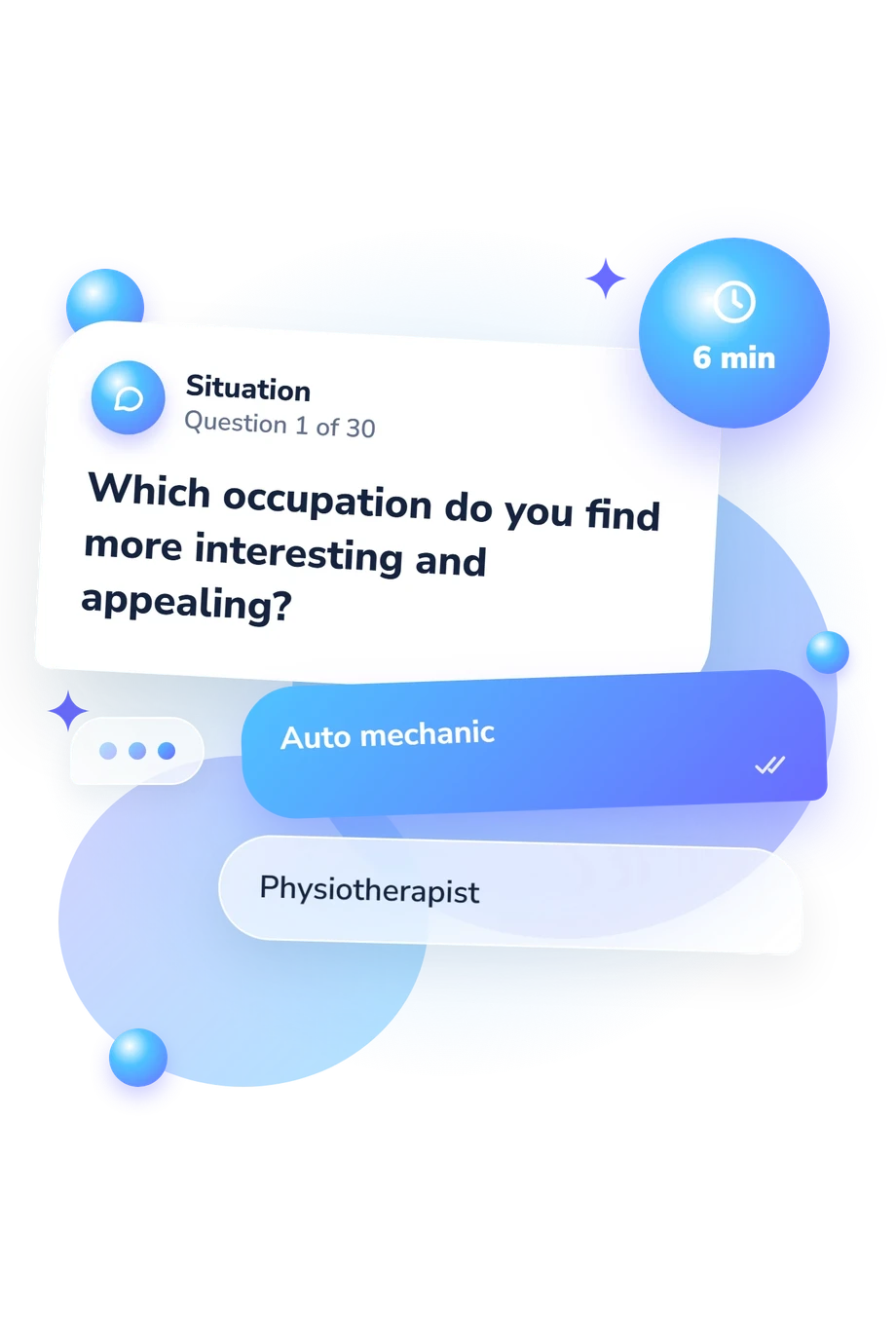
    • Auto mechanic
    • Physiotherapist
    • Information security specialist
    • Logistics specialist
    • Driver
    • Cashier
WHAT THE TEST MEASURES
About This Assessment
Definition of Professional Personality Type Test

Professional Personality Type Assessment Test - Symptoms and Signs

the riasec model
professional type
career guidance
personality type

This brief self-report measure is designed to support career exploration by identifying patterns of vocational interests. The Professional Personality Type Assessment is based on the RIASEC framework originally described by John L. Holland.

It consists of 30 items and typically takes about 6 minutes to complete. Respondents rate their interest in a range of activities, and responses are summarized into six interest domains (Realistic, Investigative, Artistic, Social, Enterprising, and Conventional) to inform discussion of preferences and potential fit with educational or occupational environments.

Results from the Professional Personality Type Assessment are intended for guidance and counseling contexts and should be interpreted in conjunction with clinical judgment and other relevant information (e.g., academic history, values, and opportunities).

Author: John L. Holland
Literature: Holland, J. L. Making vocational choices: A theory of vocational personalities and work environments. Psychological Assessment Resources. 1997.
Popular tests
Comments
Leave a Comment