
Help Motivation Scale Test
How the Scales are Structured
Who Usually Takes This Test?
See How You Compare
Below is a preview of how scores are typically distributed across each scale.
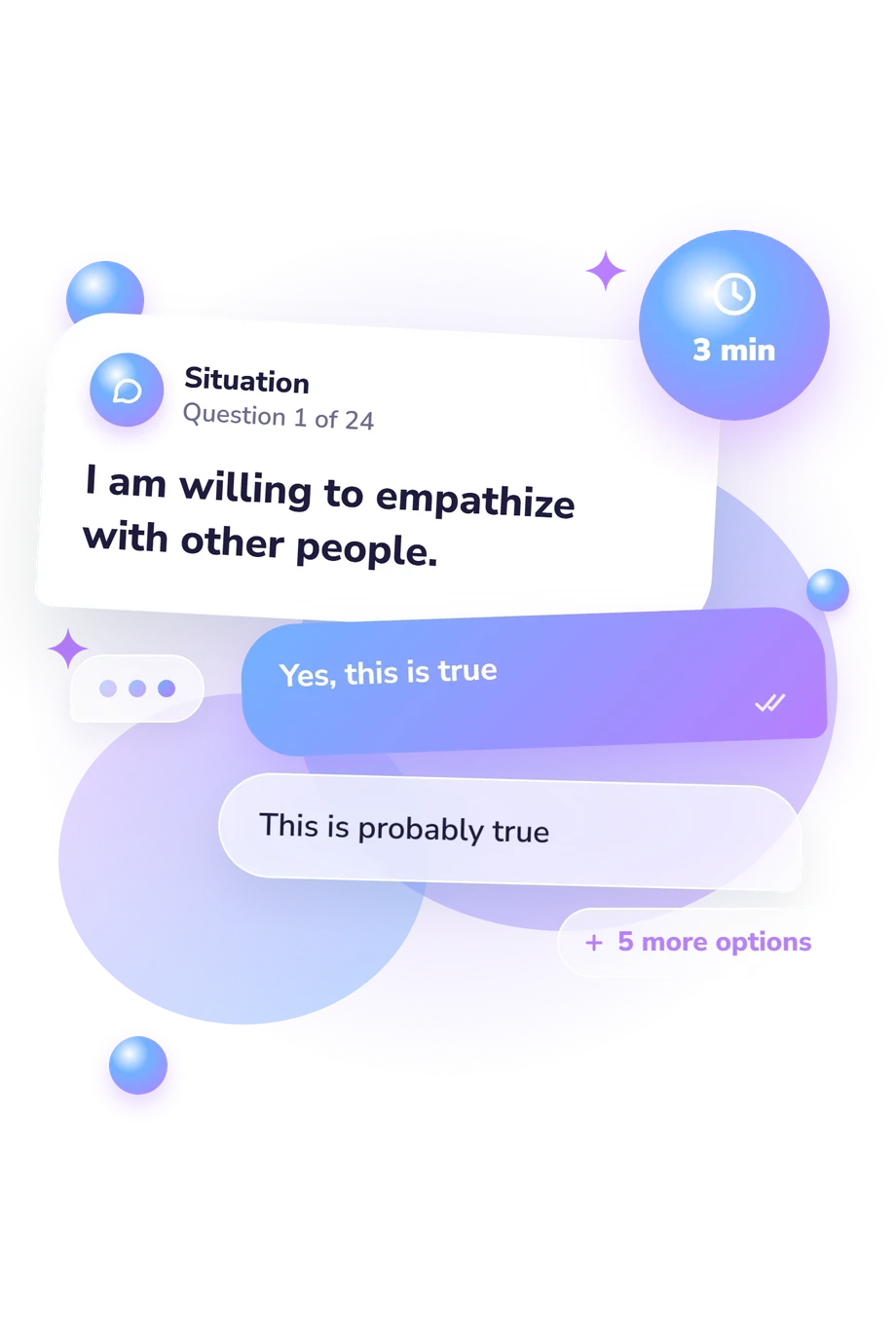
Example Questions From the Test
- Yes, this is true
- Probably so
- This is more true than false
- It is hard for me to answer definitively
- This is more false than true
- Probably not
- No, this is not true
- Yes, true
- Probably true
- More true than not true
- Hard to say for sure
- More not true than true
- Probably not true
- No, not true
- Yes, this is true
- Probably true
- This is more true than not true
- I find it difficult to give a definite answer
- This is more not true than true
- Probably not true
- No, this is not true
Help Motivation Scale Test - Description and methodology of the test
People who notice ambivalence, emotional tiredness, or limits around helping can use this questionnaire to examine what may be shaping those reactions. The Help Motivation Scale Test considers how empathy, personal worries, perceived ability, and attitudes toward helping shape responses in demanding interpersonal situations. As a help motivation assessment, it gives a current indication of how readily support is available when helping feels natural, difficult, selective, or emotionally tiring.
What This Assessment Explores
Questions examine motivation to help others: empathy, sharing good fortune, noticing likeable qualities, ability to assist, and deciding when refusal is appropriate. They also address worry, irritation, and reluctance to help disliked or dependent people.
The result describes present willingness, not a permanent identity. A high score suggests helping is more available now; a low score may indicate weaker desire to help, but not intent to cause harm or expectation of help from others.
Results use one scale, Help Motivation (0-72), with Low (0-24), Moderate (25-48), and High (49-72) bands. It measures motivation to help, not a fixed label. These themes are:
- Empathy shows attention to another person’s experience.
- Helping confidence reflects perceived ability to support.
- Positive regard captures appreciation of others’ qualities and happiness.
- Boundaries show how help is balanced with limits and refusal.
Methodology and Evidence Base
The 12 items are self-report statements answered on seven graded choices from clear truth or agreement to clear falsity or disagreement, with a midpoint for uncertainty. They combine readiness to help with worry, irritation, selective helping, and refusal. Because some statements describe difficulty rather than willingness, the item-to-point conversion is not documented.
The questionnaire is conceptually consistent with the Help Motivation Questionnaire by Nartova-Bochaver, published in 1992, but it is not presented as an adaptation of that published study. Ilyin’s theory treats motives as tendencies shaped by circumstances, while Batson’s social-psychological work distinguishes altruistic helping motivation from self-focused motives, including expected reciprocity.
A help motivation self-assessment is most useful when interpreted in context. Stress, conflict, fatigue, recent chances to help, the relationship involved, honest self-report, and self-awareness can all influence responses.
No standardization, normative data, reliability estimate, or clinical use is documented for this online version. Its displayed categories are therefore best used to identify a current pattern for reflection, not as a standalone clinical judgment.
- Nartova-Bochaver, Sofya K. (1992). An Experimental Study of the Situational Variability of Help Motivation. Psychological Journal, 13(4), 15-23.
- Ilyin, Evgeny P. (2000). Motivation and Motives. Saint Petersburg: Piter.
- Batson, C. Daniel. (2014). The Altruism Question: Toward a Social-Psychological Answer. Psychology Press. 10.4324/9781315808048
Updated: