
Beliefs and Superstitions Questionnaire Test
How the Scales are Structured
Who Usually Takes This Test?
See How You Compare
Below is a preview of how scores are typically distributed across each scale.
Example Questions From the Test
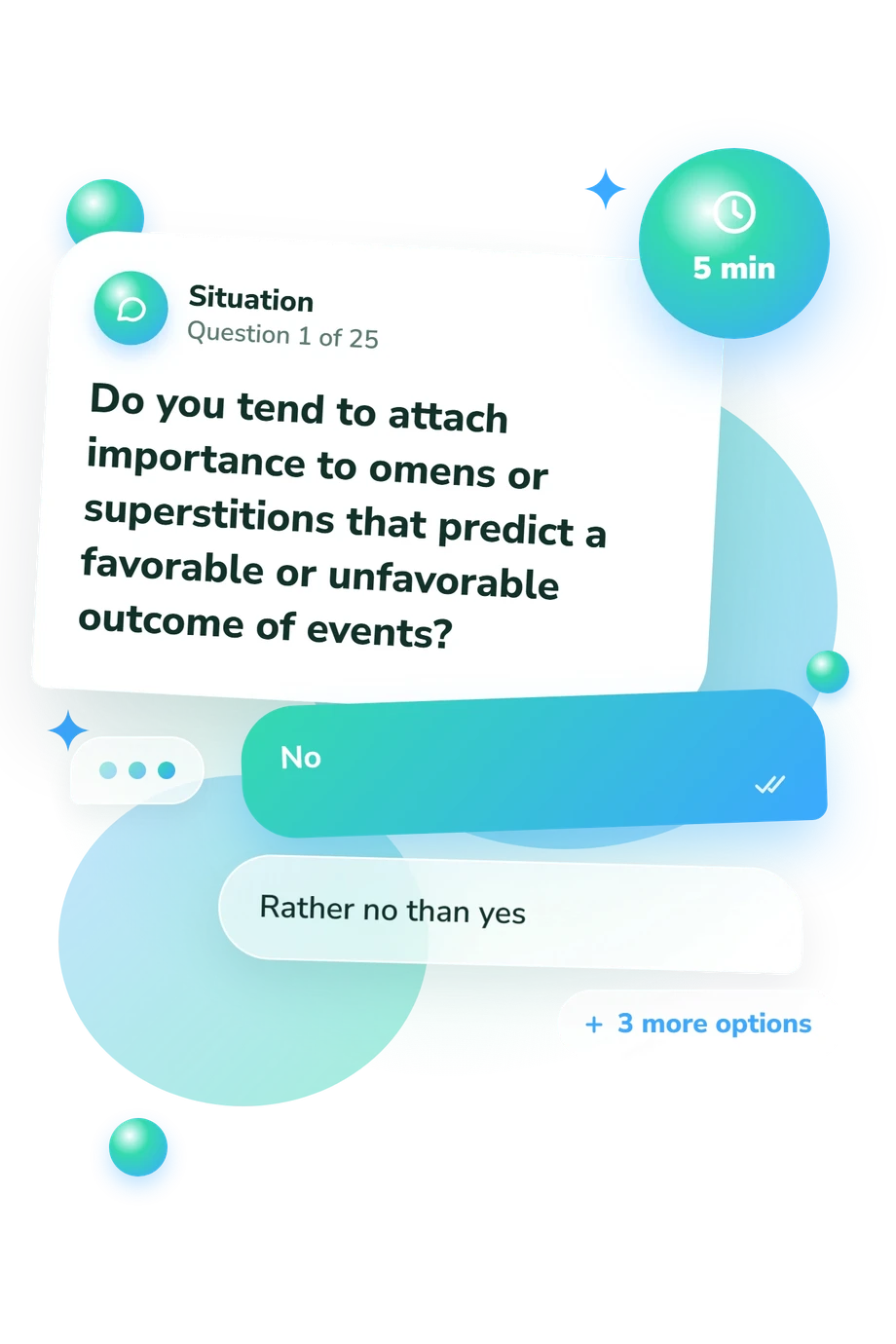
- No
- Rather no than yes
- I don't know
- Rather yes than no
- Yes
- No
- Probably no rather than yes
- I don't know
- Probably yes rather than no
- Yes
- No
- Probably not
- I don't know
- Probably yes
- Yes
Beliefs and Superstitions Questionnaire Test - Description and methodology of the test
People who want to examine how omens, rituals, fate, and supernatural explanations influence everyday choices may find the Beliefs and Superstitions Questionnaire Test useful. As a beliefs and superstitions questionnaire, it offers a structured profile of protective habits, perceived control, and magical explanations in ordinary decisions. Results can clarify whether these ideas mainly support confidence, reduce tension, guide choices, or explain setbacks.
What This Assessment Explores
These items examine omens, rituals, fate, supernatural claims, and magical explanations in everyday life. The result separates belief from use. As a superstition questionnaire, it distinguishes occasional customs from guiding beliefs.
The result profile includes:
- Active Use (0-100) measures tension-reducing ritual use: Low use 0-35; Moderate use 36-65; High use 66-100.
- Alternative Treatment (0-100) measures magical healing reliance: Low reliance 0-35; Moderate reliance 36-65; High reliance 66-100.
- Magical Forecasting (0-100) measures reliance on fate: Low reliance 0-35; Moderate reliance 36-65; High reliance 66-100.
- Magical Anxiety (0-100) measures fear of magical harm: Low 0-35; Moderate 36-65; High 66-100.
- Superstitiousness (0-100) measures the protective importance of omens: Low 0-35; Moderate 36-65; High 66-100.
- Overall Level of Prelogical Defense (0-100) measures anxiety-reducing magical defense: Low 0-35; Moderate 36-65; High 66-100.
Methodology and Scientific Basis
Most items use five response positions, moving from No through uncertainty to Yes; the final two use categorical choices about purposes and types of omens. The questionnaire’s presentation as a magical beliefs assessment keeps the focus on self-report rather than clinical classification.
Scoring converts responses into the displayed 0-100 reporting scales, but the questionnaire does not state that every answer contributes equally. Read the bands as descriptive levels within this instrument, not as universal cutoffs.
Conceptually, it is consistent with Questionnaire of Beliefs and Superstitions (Stoyanova, 2007). Stoyanova et al. (2000) and Abitov and Akbirova (2021) provide related context on psychological defense and the measurement of superstitiousness. This relationship identifies a compatible theoretical basis, not proof that the online version is a standardized adaptation with independent norms.
Self-report results can shift with current stress, cultural learning, memory, self-awareness, and pressure to answer acceptably. The profile is therefore best used to examine patterns and questions for further reflection, rather than to assign a diagnosis.
- Stoyanova, I. Ya., Semke, V. Ya., Bokhan, N. A., Oshayev, S. A., & Dobryanskaya, D. V. (2000). Beliefs and Superstitions as a Way of Psychological Defense in the Structure of a Harmonious Personality and in Mental Health Disturbances. Abstract presented at the 4th International Conference on Philosophy and Psychiatry, Florence, Italy, August 26-29, 2000.
- Stoyanova, I. Ya. (2007). Prelogical Formations in Norm and Pathology: Doctoral Dissertation in Psychology. Tomsk State University, Tomsk.
- Abitov, I. R., & Akbirova, R. R. (2021). Development of Superstitiousness Inventory. Psikhologicheskie Issledovaniya, 14(75), 1-19. 10.54359/ps.v14i75.145
Updated: