
Freudly+971 508685814hello@freudly.ai
Freudly
existential psychology

Professional Well-Being Assessment Test
Take the online Professional Well-Being Assessment Test - AI psychologist FreudlyYou can take Professional Well-Being Assessment Testhere. Online version of a simple and accurate psychological test with interpretation.en
Understand workplace well-being in 7 minutes, including satisfaction, meaning, and emotional energy on the job. Get clear results to spot burnout risk, strengthen engagement, and guide targeted support.
Start Online Test
Questions: 367 minutes
08:30
October 2, 2025
October 2, 2025
Material has been updated
October 2, 2025
Material has been published
22,292 views
2,460 completions
2,189 likes
Verified by Daniel Hall
Psychologist with 25 years of experience
Share
Scale Explorer

How the Scales are Structured

example score
15/30
Positive Relationships in the Team (PRitT)
Assesses the quality of interpersonal interactions and perceived support within the workplace team.
Low
Moderate
High
614: Low | 1522: Moderate | 2330: High
A score of 15 indicates a moderate level of positive workplace relationships, suggesting some supportive interactions alongside areas where connection and support could be strengthened.
example score
19/30
Professional Goals (PG)
Assesses how clearly a person defines and pursues professional plans and ambitions at work.
Unclear goals
Developing focus
Strong direction
614: Unclear goals | 1522: Developing focus | 2330: Strong direction
A score of 19 suggests a moderate level of professional goal focus, with some clear aims present but room to strengthen direction and consistency.
example score
21/30
Professional Growth (PG)
Professional Growth measures how actively a person develops job-related skills and expands professional competencies at work.
Low growth focus
Moderate growth focus
High growth focus
613: Low growth focus | 1422: Moderate growth focus | 2330: High growth focus
A score of 21 falls in the Moderate growth focus range, suggesting a generally steady effort to build skills and broaden competencies with room to increase development intensity.
example score
43/90
Professional Development (PD)
Professional Development measures motivation to learn, grow, and pursue new goals in one’s work role.
Low
Moderate
High
1841: Low | 4265: Moderate | 6690: High
A score of 43 falls in the Moderate range, suggesting a present but not consistently strong drive for professional growth and skill development at work.
example score
23/30
Satisfaction With Professional Achievements (SWPA)
Measures how satisfied a person feels with their professional achievements and work outcomes.
Low satisfaction
Moderate satisfaction
High satisfaction
614: Low satisfaction | 1522: Moderate satisfaction | 2330: High satisfaction
A score of 23 falls in the High satisfaction range, suggesting a generally positive evaluation of personal accomplishments at work.
example score
19/30
Satisfaction With Level of Competence (SWLoC)
Measures how satisfied a person feels with their professional knowledge, skills, and abilities at work.
Low
Moderate
High
613: Low | 1422: Moderate | 2330: High
A score of 19 falls in the Moderate range, suggesting generally adequate confidence in competence with some room for strengthening specific skills or mastery.
example score
33/60
Professional Self-Acceptance (PSA)
Measures how positively a person accepts themselves as a professional, including confidence in their qualities and the perceived significance of their work.
Low
Moderate
High
1227: Low | 2844: Moderate | 4560: High
A score of 33 falls in the Moderate range, suggesting a generally adequate professional self-view with some areas of self-doubt or unclear sense of professional significance.
example score
15/30
Autonomy in Professional Activity (AiPA)
Measures how independently a person can self-direct their work and make decisions in their professional role.
Low autonomy
Moderate autonomy
High autonomy
613: Low autonomy | 1422: Moderate autonomy | 2330: High autonomy
A score of 15 indicates moderate autonomy, suggesting some independence in organizing tasks and decisions while still relying on guidance or constraints in key areas.
example score
119/180
Professional Well-Being (PWB)
Measures overall satisfaction with professional activity and the sense of meaning and significance a person experiences in their work.
Low
Moderate
High
3683: Low | 84131: Moderate | 132180: High
A score of 119 falls in the Moderate range, suggesting generally stable professional well-being with some areas that may feel less aligned or consistently satisfying.
Start Online Test
just completed the test
DATA-BASED USER COHORTS

Who Usually Takes This Test?

HR and People Ops
41%OF USERS
They use it to monitor team well-being, spot burnout risks early, and evaluate the impact of workplace changes.
Team Leads and Managers
34%OF USERS
They take it to understand what drives or drains their team’s motivation and to adjust workload, support, and expectations.
Employees Under Strain
25%OF USERS
They use it to check their own work satisfaction, emotional resources, and sense of meaning when feeling stressed or stuck.
BASED ON AGGREGATED, ANONYMIZED DATA FROM TENS OF THOUSANDS OF FREUDLY USERS.
Benchmarking

See How You Compare

Once you complete the test, your results are compared with real-world data from people in your country.
Below is a preview of how scores are typically distributed across each scale.
Positive Relationships in the Workplace (PRitW)
Average
20.2
Normal range
16.124.2
min.
6
max.
30
This curve shows how scores are typically distributed.
Once you complete the test, your result will appear on the scale so you can see how you compare.
Professional Goals (PG)
Average
23.1
Normal range
1927.2
min.
6
max.
30
This curve shows how scores are typically distributed.
Once you complete the test, your result will appear on the scale so you can see how you compare.
Professional Growth (PG)
Average
19.6
Normal range
16.223
min.
6
max.
30
This curve shows how scores are typically distributed.
Once you complete the test, your result will appear on the scale so you can see how you compare.
Professional Development (PD)
Average
69.1
Normal range
56.481.7
min.
18
max.
90
This curve shows how scores are typically distributed.
Once you complete the test, your result will appear on the scale so you can see how you compare.
Satisfaction with professional achievements (Swpa)
Average
12.5
Normal range
8.616.5
min.
6
max.
30
This curve shows how scores are typically distributed.
Once you complete the test, your result will appear on the scale so you can see how you compare.
Satisfied with the level of competence (Swtloc)
Average
18.3
Normal range
14.921.7
min.
6
max.
30
This curve shows how scores are typically distributed.
Once you complete the test, your result will appear on the scale so you can see how you compare.
Professional Self-Acceptance (PS)
Average
31.7
Normal range
25.338.1
min.
12
max.
60
This curve shows how scores are typically distributed.
Once you complete the test, your result will appear on the scale so you can see how you compare.
Autonomy in professional activity (Aipa)
Average
12.9
Normal range
916.9
min.
6
max.
30
This curve shows how scores are typically distributed.
Once you complete the test, your result will appear on the scale so you can see how you compare.
Professional Well-being (PW)
Average
125.6
Normal range
103.6147.6
min.
36
max.
180
This curve shows how scores are typically distributed.
Once you complete the test, your result will appear on the scale so you can see how you compare.
Featured On
SAMPLE QUESTIONS

Example Questions From the Test

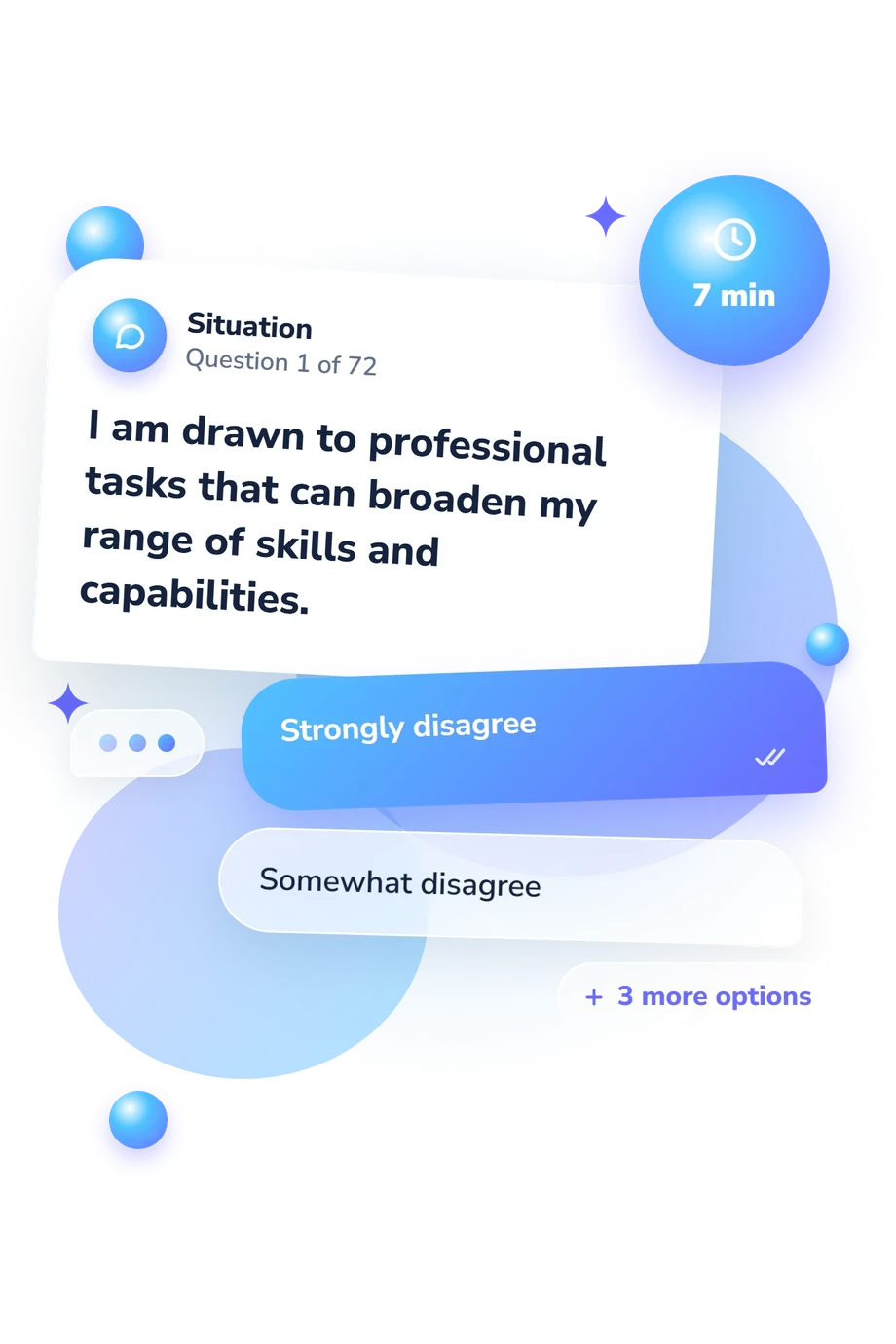
Please rate the extent to which you agree with the statements below regarding how you feel about yourself and your work. Select the response option that most accurately reflects your level of agreement with each statement, using the scale provided.
    • Strongly disagree
    • Somewhat disagree
    • Neither agree nor disagree
    • Somewhat agree
    • Strongly agree
    • Strongly disagree
    • Somewhat disagree
    • Neither agree nor disagree
    • Somewhat agree
    • Strongly agree
    • Strongly disagree
    • Somewhat disagree
    • Neither agree nor disagree
    • Somewhat agree
    • Strongly agree
WHAT THE TEST MEASURES
About This Assessment
Method for Assessing Professional Well-Being, MAPW Test

Professional Well-Being Assessment Test - Symptoms and Signs

existential psychology
arrange
job satisfaction

This measure is designed to evaluate perceived psychological well-being in the work context. The Professional Well-Being Assessment uses a structured self-report format to capture how individuals experience their work in terms of satisfaction, meaning, and perceived emotional resources.

The instrument consists of 36 items and typically takes about 7 minutes to complete. It may be used in organizational, clinical, or consulting settings to support monitoring of workforce well-being and to inform discussions about occupational stressors and support needs. Authors: Christina Maslach and Michael P. Leiter.

Results from the Professional Well-Being Assessment are intended to provide a standardized snapshot of current functioning at work and should be interpreted within the broader clinical and organizational context rather than as a standalone diagnostic determination.

Author: Christina Maslach, Michael P. Leiter
Literature: Edmondson, A. C. Psychological safety and learning behavior in work teams. Administrative Science Quarterly. 1999.; Diener, E., Suh, E. M., Lucas, R. E., & Smith, H. L. Subjective well-being: Three decades of progress. Psychological Bulletin. 1999.
Popular tests
Comments
Leave a Comment