
Freudly+971 508685814hello@freudly.ai
Freudly
spirituality

Spiritual Personality Questionnaire Test
Take the online Spiritual Personality Questionnaire Test - AI psychologist FreudlyYou can take Spiritual Personality Questionnaire Test here. Online version of a simple and accurate psychological test with interpretation.en
In six minutes, the Spiritual Personality Questionnaire Test uses 28 self-report questions to outline qualities such as truthfulness, compassion, responsibility, self-control, and wisdom. Your result offers a structured starting point for self-reflection on spiritual strengths and areas for personal growth.
Questions: 286 minutes
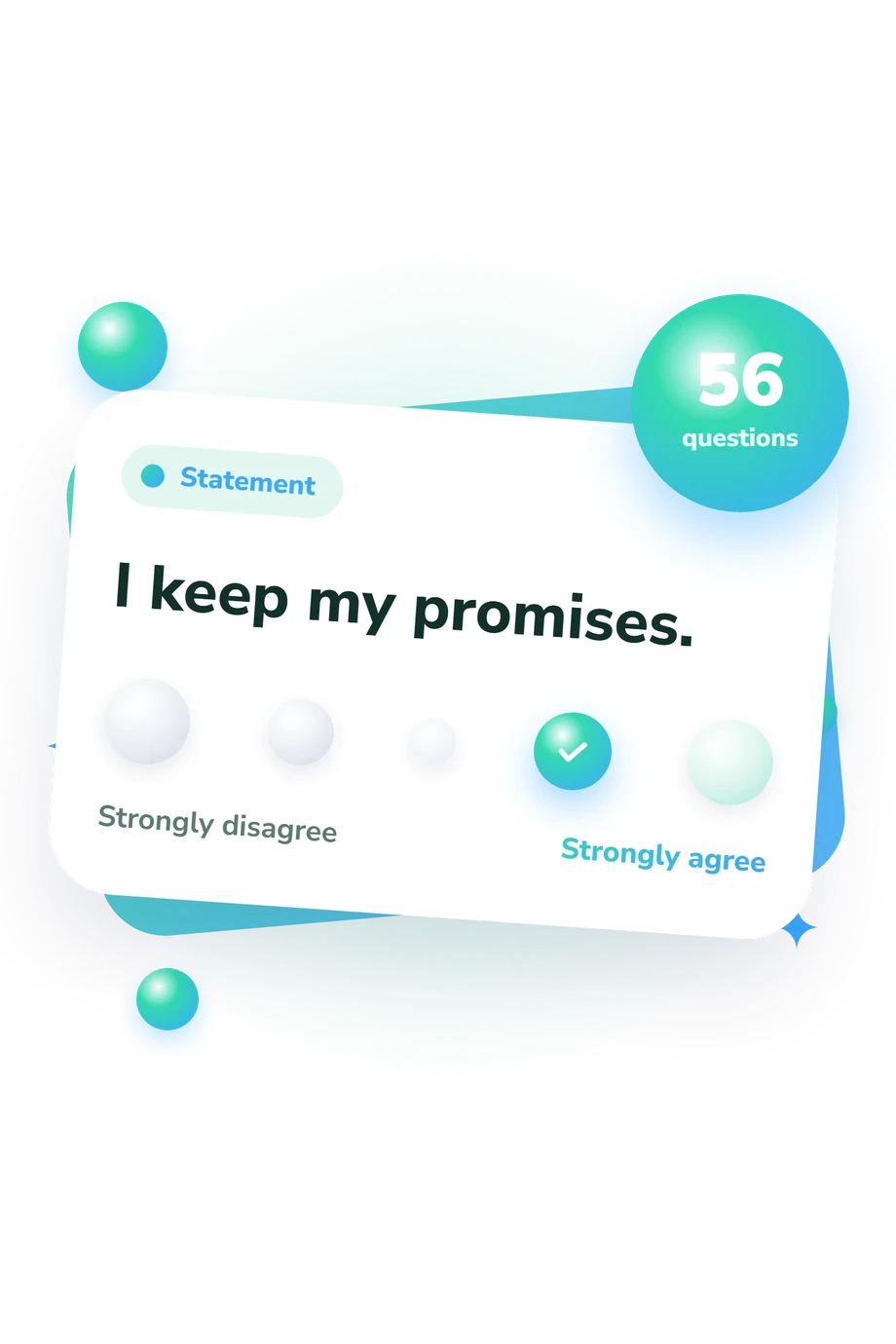
Spiritual Personality Questionnaire Test: agreement scale card
October 2, 2025October 2, 2025Material has been updatedOctober 2, 2025Material has been published
34,923 views
2,564 completions
2,030 likes
Daniel HallPsychologist · Test reviewer
2,030 likes
Scale Explorer

How the Scales are Structured

Truthfulness And ContentmentTAC
Measures honesty, a drive toward truth, and the tendency to notice positive aspects of life as indicators of secular spiritual fulfillment.
example score23/25
23/25Highexample score
5 – 15Lower
16 – 21Moderate
22 – 25High
A score of 23 falls in the High range, suggesting a strong orientation toward truthfulness and a generally satisfied, positively focused outlook associated with deeper spiritual fulfillment.
Relational SpiritualityRS
Measures sincerity, compassion, forgiveness, and commitment to justice in one’s relationships with others in a secular spiritual framework.
example score13/35
13/35Lowerexample score
7 – 25Lower
26 – 32Moderate
33 – 35High
A score of 13 falls in the Lower range, suggesting this relational spirituality is less consistently expressed in everyday interactions compared with higher scores.
Reliability And ResponsibilityRAR
Measures the tendency to keep commitments, act in line with moral ideals, and take responsibility for others as a component of secular spirituality.
example score16/20
16/20Moderateexample score
4 – 14Lower
15 – 18Moderate
19 – 20High
A score of 16 falls in the Moderate range, suggesting a generally reliable and responsible orientation that is present but not maximally pronounced.
Self-ControlSC
Measures the ability to self-regulate, stay calm, and maintain endurance in challenging situations as a secular spiritual quality.
example score10/25
10/25Lowexample score
5 – 14Low
15 – 21Moderate
22 – 25High
A score of 10 falls in the Low range, suggesting self-regulation and calm endurance may be less consistently maintained under stress.
Morality and WisdomMaW
Measures the tendency toward virtuous, compassionate, and wise behavior expressed through moral clarity and benevolence in a secular spiritual framework.
example score19/35
19/35Lowerexample score
7 – 23Lower
24 – 30Moderate
31 – 35Higher
A score of 19 falls in the Lower range, suggesting morality- and wisdom-related spiritual qualities are present but not strongly expressed as a consistent guiding orientation.
Spiritual PersonalitySP
Measures the overall level of secular spiritual qualities such as morality, self-control, responsibility, truthful behavior, and the spirituality of relationships.
example score54/140
54/140Lowexample score
28 – 97Low
98 – 122Moderate
123 – 140High
A score of 54 falls in the Low range, suggesting these spiritual qualities are less consistently expressed and may represent an area for further personal development.
just completed the test
DATA-BASED USER COHORTS

Who Usually Takes This Test?

Self-growth seekers
41%OF USERS
People exploring meaning, values, and inner resilience outside religion use it to clarify what truly guides them.
Clients in stress or crisis
34%OF USERS
Those going through burnout, loss, or major life changes take it to identify spiritual resources that help them cope.
Psychologists and researchers
25%OF USERS
Professionals use it to assess secular spirituality as a factor in wellbeing, coping, and personal development.
BASED ON AGGREGATED, ANONYMIZED DATA FROM TENS OF THOUSANDS OF FREUDLY USERS.
Benchmarking

See How You Compare

Once you complete the test, your results are compared with real-world data from people in your country.
Below is a preview of how scores are typically distributed across each scale.
Shaded area — where most people score
Dot — the average
You — your score lands on each curve after the test— your score, after the test
Truthfulness and SatisfactionTaS
You?
Average12.5
Typical rangeTypical9.7 – 15.2
Possible5 – 25
Spirituality of relationshipsSor
You?
Average17.1
Typical rangeTypical12.8 – 21.5
Possible7 – 35
Reliability and ResponsibilityRaR
You?
Average9.8
Typical rangeTypical6.8 – 12.8
Possible4 – 20
Self-controlS
You?
Average18
Typical rangeTypical15.1 – 20.9
Possible5 – 25
Morality and WisdomMaW
You?
Average24.1
Typical rangeTypical19.4 – 28.7
Possible7 – 35
Spiritual personalitySp
You?
Average88.4
Typical rangeTypical72.6 – 104.2
Possible28 – 140
Featured On
SAMPLE QUESTIONS

Example Questions From the Test

    • Strongly disagree
    • Disagree
    • Neutral
    • Agree
    • Strongly agree
    • Strongly disagree
    • Disagree
    • Neutral
    • Agree
    • Strongly agree
    • Strongly disagree
    • Disagree
    • Neutral
    • Agree
    • Strongly agree
WHAT THE TEST MEASURES

Spiritual Personality Questionnaire Test - Description and methodology of the test

spirituality
morality

For readers wondering how personal values appear in everyday conduct and relationships, this spiritual personality questionnaire offers a structured way to examine that question. The Spiritual Personality Questionnaire Test connects stated ideals with reported patterns in personal and social behavior. It gives people a focused profile for considering how their principles are expressed in daily life.

What This Assessment Measures

The questionnaire examines moral conduct, self-regulation, relationships, and attitudes toward life. In this spiritual personality test, items on honesty, responsibility, fairness, compassion, forgiveness, resilience, composure, and the sacred combine into a profile.

The displayed dimensions are:

  • Truthfulness And Contentment (5-25) measures honesty and positive life appraisal; Lower 5-15, Moderate 16-21, High 22-25.
  • Relational Spirituality (7-35) measures sincerity, compassion, forgiveness, and justice; Lower 7-25, Moderate 26-32, High 33-35.
  • Reliability And Responsibility (4-20) measures promise-keeping and responsibility; Lower 4-14, Moderate 15-18, High 19-20.
  • Self-Control (5-25) measures restraint and composure; Low 5-14, Moderate 15-21, High 22-25.
  • Morality and Wisdom (7-35) measures virtue, kindness, compassion, and wise action; Lower 7-23, Moderate 24-30, Higher 31-35.
  • Spiritual Personality (28-140) measures overall spiritual qualities; Low 28-97, Moderate 98-122, High 123-140.

Methodology and Evidence Base

Responses use a five-point agreement format ranging from Strongly disagree to Strongly agree. The 28-item questionnaire provides scores for the displayed dimensions and the overall profile, with ranges and result bands shown for each. These outputs describe reported tendencies rather than ranking moral worth.

The closest named source is the revised Spiritual Personality Inventory (Anas & Husain, 2018), alongside the inventory manual by Husain, Luqman, and Jahan. The matching 28 items and five named subscales identify this online spiritual personality assessment as an adaptation or reproduction of that instrument. Ozhiganova’s 2019 Russian-sample study concerns an adaptation, while Piedmont’s 1999 work connects spiritual transcendence with five-factor personality traits.

Displayed bands are the result categories shown for this questionnaire. Higher scores indicate stronger expression of the measured qualities, but self-report results can shift with mood, self-image, cultural or religious language, and the wish to appear virtuous. Read the profile as a pattern across dimensions, especially when the overall result and individual themes diverge.

Author: R. L. Piedmont
Literature:
  • Anas, M., & Husain, A. (2018). Revision of Spiritual Personality Inventory. Journal of the Indian Academy of Applied Psychology, 44(2), 288-295.
  • Ozhiganova, G. V. (2019). Adaptation of Spiritual Personality Inventory on the Russian Sample. Experimental Psychology (Russia), 12(4), 160-176. 10.17759/exppsy.2019120413
  • Husain, A., Luqman, N., & Jahan, M. (2012). Spiritual Personality Inventory Manual. New Delhi: Prasad Psycho Corporation.
  • Piedmont, R. L. (1999). Does Spirituality Represent the Sixth Factor of Personality? Spiritual Transcendence and the Five-Factor Model. Journal of Personality, 67(6), 985-1013. 10.1111/1467-6494.00080

Updated:

Popular tests
Comments
Leave a Comment