
My Child’s Adultness Image Test
How the Scales are Structured
Who Usually Takes This Test?
See How You Compare
Below is a preview of how scores are typically distributed across each scale.
Example Questions From the Test
- A very strong sense of being an adult
- A moderate sense of being an adult
- A weak sense of being an adult
- No sense of being an adult
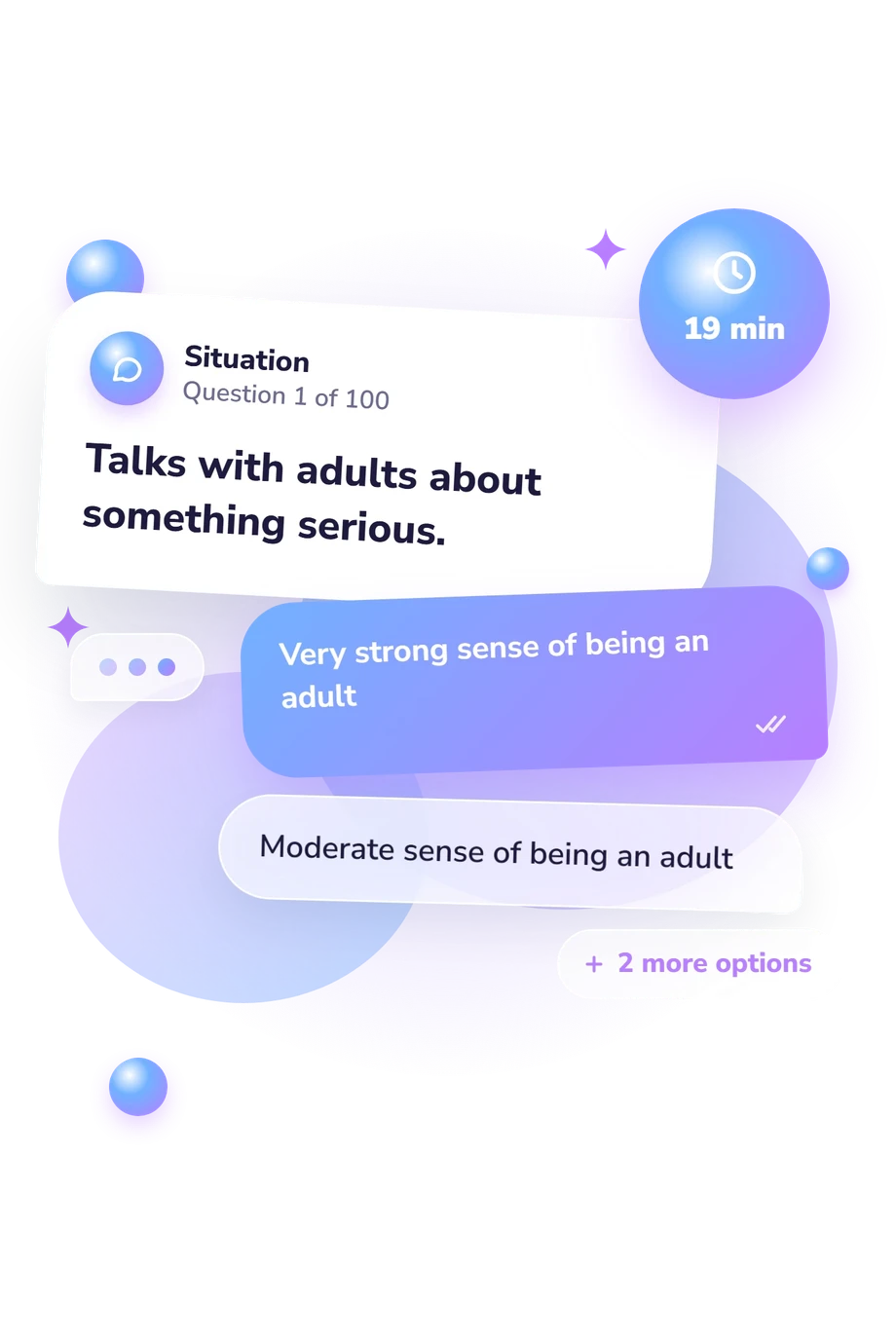
- Very strong sense of being an adult
- Moderate sense of being an adult
- Weak sense of being an adult
- No sense of being an adult
- A very strong sense of being an adult
- A moderate sense of being an adult
- A weak sense of being an adult
- No sense of being an adult
My Child’s Adultness Image Test - Description and methodology of the test
For parents wanting a closer look at a child’s developing responsibility, communication, and self-direction, this My Child’s Adultness Image Test offers a structured profile of adult-like behavior in everyday contexts. Used as a child adultness assessment, it can organize observations about school, family, peers, and adults, showing where the child’s sense of growing up appears more or less established.
What This Assessment Explores
Adultness is treated as a context-sensitive profile, so this child’s sense of adulthood questionnaire avoids a single verdict. It covers school, family, peers, adults, responsibility, initiative, and social conduct. The bands show where adult-like behavior is strongest or needs support. The scales are:
- Imitation (0-30) measures copying: Low imitation 0-10; Moderate imitation 11-20; High imitation 21-30. Interaction With Younger Children (0-30) measures care/leadership: Limited engagement 0-10; Developing skills 11-20; Strong leadership/care 21-30.
- Adultness Evaluation (0-30) measures self-recognition: Low awareness 0-10; Developing awareness 11-20; Well-formed awareness 21-30. School Life (0-30) measures school maturity: Low maturity 0-10; Moderate maturity 11-20; High maturity 21-30.
- Independent Action (0-30) measures initiative and self-regulation: Needs support 0-14; Developing independence 15-22; Strong independence 23-30. Other Situations (0-30) measures flexibility: Limited adult-like behavior 0-10; Developing flexibility 11-20; Consistent maturity 21-30.
- Home Situations (0-30) measures family autonomy: Limited autonomy 0-10; Developing autonomy 11-20; Strong autonomy 21-30. Peer Communication (0-30) measures peer adjustment: Limited peer interaction 0-10; Typical peer interaction 11-20; Strong peer interaction 21-30.
- Communication With Adults (0-30) measures confidence and dialogue: Limited engagement 0-10; Developing dialogue 11-20; Confident communication 21-30. Adherence to Social Norms (0-30) measures responsibility: Low adherence 0-10; Moderate adherence 11-20; High adherence 21-30.
Methodology and Scientific Basis
Each item presents a situation with four ordered responses, from a very strong sense of being an adult to no sense of being an adult. Parents rate how strongly it reflects the child. Scoring groups answers into displayed dimensions and uses the catalogue’s bands; no extra point-conversion rule is inferred.
Conceptually, the adult-like behavior assessment is consistent with My Image of Adulthood (Kurysheva, 2000), but is neither a direct adaptation nor a standardized reproduction. Polivanova and Kurysheva (2004) connect adulthood image with home behavior; Khudaeva et al. (2020) and Miklyaeva et al. (2023) discuss links with self-awareness and personal maturity.
No normative sample or standardization is stated. Compare patterns across contexts; observation, recall, and self-understanding can shape answers. A high profile does not establish uniform maturity or a developmental diagnosis; use the result as a structured conversation starter.
- Kurysheva, O. V. (2000). Development of the Image of Adulthood and Its Influence on the Behavior of Younger Adolescents in Real Situations: Dissertation for the Candidate Degree in Psychological Sciences, specialty 19.00.13. Moscow, 139 pp.
- Polivanova, K. N., and Kurysheva, O. V. (2004). The Adulthood Image in Relation to the Home Behavior Types of the Children of Fore-Adolescent Age. Psychological Science and Education, 9(2), 36-46.
- Khudaeva, M. Y., Godovnikova, L. V., Ovsyanikova, E. A., Tkachenko, N. S., and Velikanova, A. S. (2020). Influence of the Adulthood Image of Adolescent on the Characteristics of Structural Links of Self-Awareness. Revista ESPACIOS, 41(23), Article 19, 224-231.
- Miklyaeva, A. V., Rudykhina, O. V., and Tolkacheva, A. S. (2023). The Content of the Attitudes “I Am Now” and “I Am an Adult” in Adolescents with Different Characteristics of Personal Maturity. Integration of Education, 27(1), 100-118. 10.15507/1991-9468.110.027.202301.100-118
Updated: