
Freudly+971 508685814hello@freudly.ai
Freudly
arrange

My Attitude Toward Work Questionnaire Test
Take the online My Attitude Toward Work Questionnaire Test - AI psychologist FreudlyYou can take My Attitude Toward Work Questionnaire Testhere. Online version of a simple and accurate psychological test with interpretation.en
Understand what at work lifts or drains your mood and energy in 11 minutes. Pinpoint burnout risks and practical levers to boost fit, support, workload balance, and growth.
Start Online Test
Questions: 6011 minutes
08:30
October 2, 2025
October 2, 2025
Material has been updated
October 2, 2025
Material has been published
32,779 views
2,933 completions
2,430 likes
Verified by Daniel Hall
Psychologist with 25 years of experience
Share
Scale Explorer

How the Scales are Structured

example score
10/20
Values (V)
Measures how well your personal values align with the values and expectations emphasized in your workplace.
Low alignment
Moderate alignment
High alignment
07: Low alignment | 813: Moderate alignment | 1420: High alignment
A score of 10 suggests a moderate fit between your values and your workplace’s priorities, with some areas of alignment and some potential mismatches.
example score
7/20
Fairness (F)
Measures how fair a person perceives workplace distribution of responsibilities, rewards, and decision-making to be.
Low fairness
Moderate fairness
High fairness
08: Low fairness | 914: Moderate fairness | 1520: High fairness
A score of 7 suggests a low perception of fairness, indicating concerns about how responsibilities, rewards, or decisions are handled at work.
example score
14/20
Work Team (WT)
Measures the perceived support, cohesion, and overall atmosphere in your work team.
Strained/isolated
Mixed/variable
Supportive/cohesive
07: Strained/isolated | 814: Mixed/variable | 1520: Supportive/cohesive
A score of 14 suggests a generally workable team climate with some inconsistencies in support or connection that may affect day-to-day mood and energy.
example score
14/20
Rewards (R)
Measures satisfaction with how work is rewarded and recognized, including both material and non-material compensation.
Low reward
Moderate reward
High reward
06: Low reward | 713: Moderate reward | 1420: High reward
A score of 14 indicates a high level of perceived reward and recognition for your work, suggesting you generally feel adequately compensated and appreciated.
example score
8/20
Control (C)
Measures how much autonomy and influence a person feels they have over tasks, decisions, and work conditions.
Low control
Moderate control
High control
09: Low control | 1014: Moderate control | 1520: High control
A score of 8 suggests low perceived control, indicating limited autonomy and fewer opportunities to influence how work is organized.
example score
16/20
Workload (W)
This scale measures how heavy and demanding the workload feels in day-to-day work.
Low workload
Moderate workload
High workload
06: Low workload | 713: Moderate workload | 1420: High workload
A score of 16 falls in the high workload range, suggesting your current demands may be stretching your resources and reducing energy over time.
example score
4/10
Overall Attitude Toward Work (OATW)
This scale measures your overall attitude toward work by integrating perceptions of workload, control, support, team dynamics, fairness, rewards, and alignment with values.
Strained fit
Mixed fit
Healthy fit
14: Strained fit | 57: Mixed fit | 810: Healthy fit
A score of 4 suggests a strained overall fit with current work conditions, indicating several areas may be undermining energy and satisfaction.
Start Online Test
just completed the test
DATA-BASED USER COHORTS

Who Usually Takes This Test?

Tired and overworked staff
41%OF USERS
People feeling drained, irritable, or close to burnout take it to pinpoint what in their workload, control, or support is undermining energy.
Team leads and HR
34%OF USERS
Managers and HR specialists use it to spot team-wide friction in values, fairness, feedback, and resources and plan targeted improvements.
Career changers and newcomers
25%OF USERS
Employees starting a new role or considering a change take it to check whether the job fits their values, growth needs, and sense of belonging.
BASED ON AGGREGATED, ANONYMIZED DATA FROM TENS OF THOUSANDS OF FREUDLY USERS.
Benchmarking

See How You Compare

Once you complete the test, your results are compared with real-world data from people in your country.
Below is a preview of how scores are typically distributed across each scale.
Values (V)
Values (V)
Average
12.6
Normal range
9.715.4
min.
0
max.
20
This curve shows how scores are typically distributed.
Once you complete the test, your result will appear on the scale so you can see how you compare.
Justice (J)
Justice (J)
Average
11.6
Normal range
9.114.1
min.
0
max.
20
This curve shows how scores are typically distributed.
Once you complete the test, your result will appear on the scale so you can see how you compare.
Work Team (WT)
Work Team (WT)
Average
7
Normal range
4.59.4
min.
0
max.
20
This curve shows how scores are typically distributed.
Once you complete the test, your result will appear on the scale so you can see how you compare.
Reward (R)
Reward (R)
Average
8.1
Normal range
5.310.8
min.
0
max.
20
This curve shows how scores are typically distributed.
Once you complete the test, your result will appear on the scale so you can see how you compare.
Control (C)
Control (C)
Average
9.1
Normal range
5.412.8
min.
0
max.
20
This curve shows how scores are typically distributed.
Once you complete the test, your result will appear on the scale so you can see how you compare.
Workload (W)
Workload (W)
Average
11
Normal range
7.414.7
min.
0
max.
20
This curve shows how scores are typically distributed.
Once you complete the test, your result will appear on the scale so you can see how you compare.
My attitude toward work (Matw)
Average
4.6
Normal range
3.45.9
min.
1
max.
10
This curve shows how scores are typically distributed.
Once you complete the test, your result will appear on the scale so you can see how you compare.
Featured On
SAMPLE QUESTIONS

Example Questions From the Test

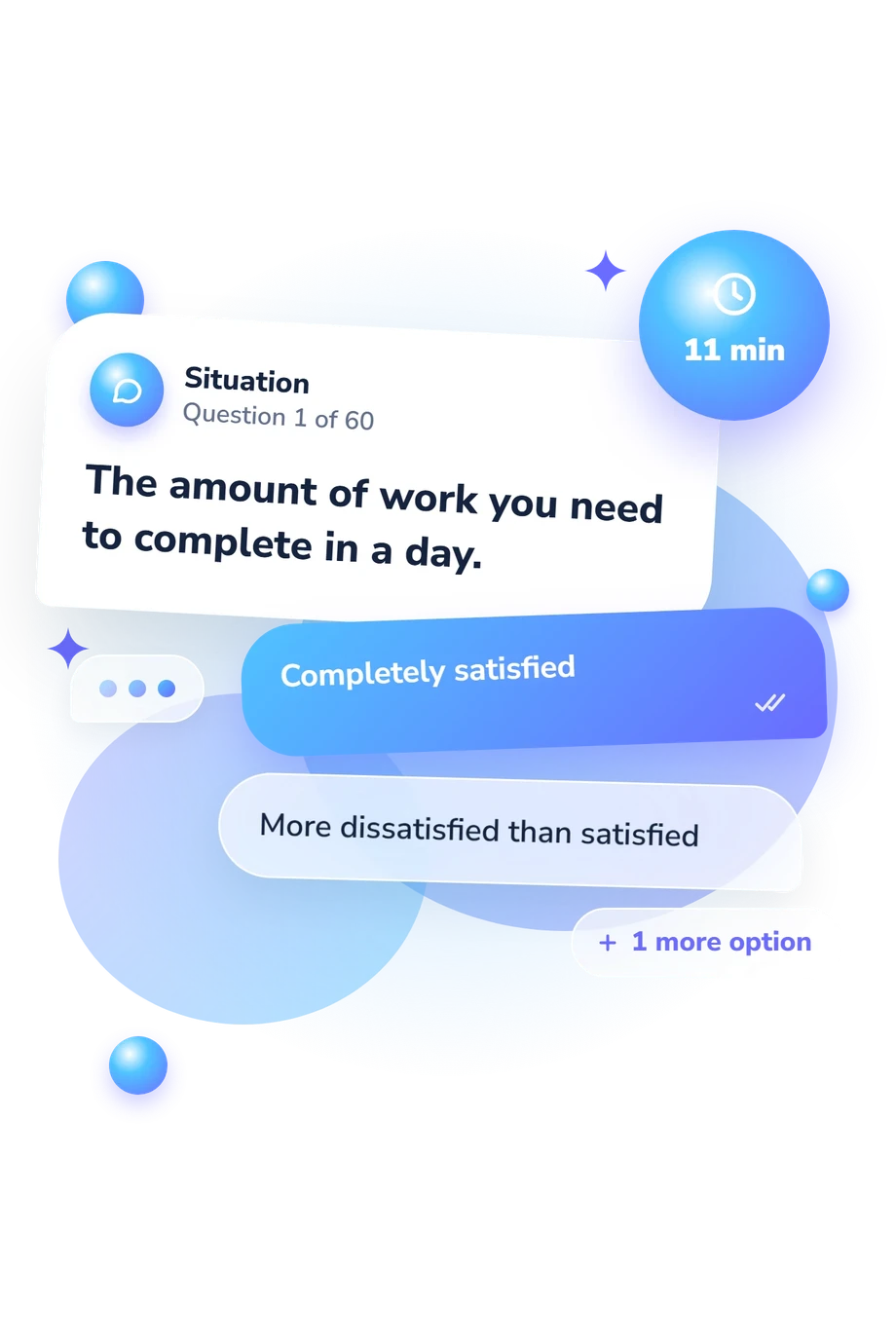
Below are six areas of work. For each area, rate the extent to which your current job matches your preferences, typical work behavior patterns, and goals. How satisfied are you with it?
    • Completely satisfied
    • More dissatisfied than satisfied
    • Completely dissatisfied
    • Completely satisfied
    • More dissatisfied than satisfied
    • Completely dissatisfied
    • Completely satisfied
    • More dissatisfied than satisfied
    • Completely dissatisfied
WHAT THE TEST MEASURES
About This Assessment
My attitude toward work Test

My Attitude Toward Work Questionnaire Test - Symptoms and Signs

arrange
job satisfaction
burnout

This questionnaire is a self-report measure designed to assess an individual’s perceptions and attitudes related to their work environment and work experience. The My Attitude Toward Work Questionnaire is typically used to identify work-related factors that may be associated with motivation, engagement, stress, or strain, based on the respondent’s appraisal of key aspects of the job.

It consists of 60 items and takes about 11 minutes to complete. Item content commonly addresses perceived fit between personal values and work demands, degree of control and autonomy, availability of support and feedback, sense of belonging, workload relative to resources, and opportunities for development. The My Attitude Toward Work Questionnaire may be administered in organizational or clinical settings to inform discussion, guide workplace-focused intervention planning, and monitor change over time; it should be interpreted in conjunction with other clinical or occupational data. Authorship is attributed to G. R. Oldham and J. R. Hackman.

Author: G. R. Oldham, J. R. Hackman
Literature: Schaufeli, W. B., & Bakker, A. B. Job demands, job resources, and their relationship with burnout and engagement: A multi-sample study. Journal of Organizational Behavior. 2004.; Leiter, M. P., & Maslach, C. Banishing burnout: Six strategies for improving your relationship with work. Jossey-Bass. 2005.
Popular tests
Comments
Leave a Comment