
War Attitudes Questionnaire Test
How the Scales are Structured
Who Usually Takes This Test?
See How You Compare
Below is a preview of how scores are typically distributed across each scale.
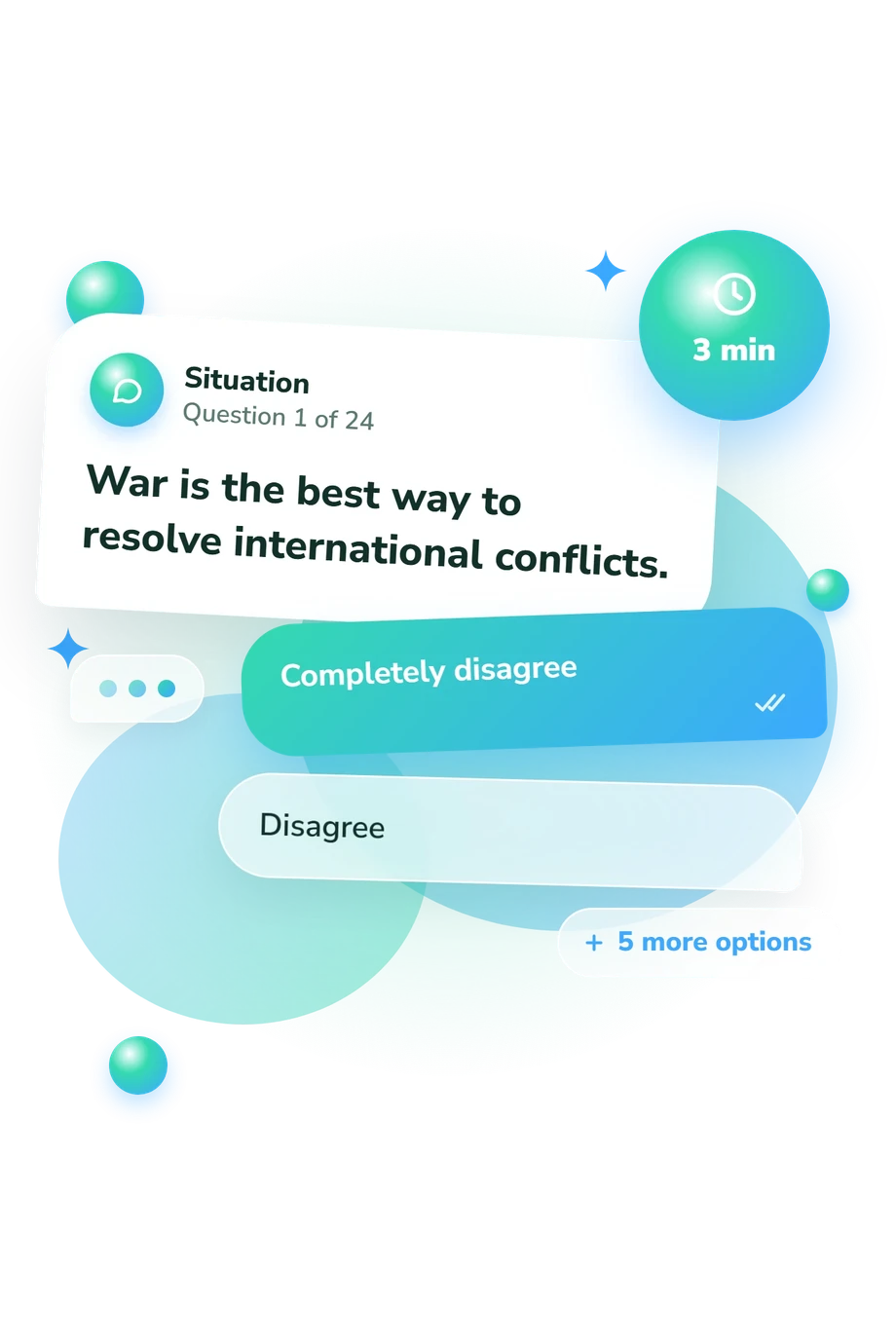
Example Questions From the Test
- Strongly disagree
- Disagree
- Somewhat disagree
- Unsure
- Somewhat agree
- Agree
- Strongly agree
- Completely disagree
- Disagree
- Rather disagree
- Unsure
- Rather agree
- Agree
- Completely agree
- Strongly disagree
- Disagree
- Somewhat disagree
- Not sure
- Somewhat agree
- Agree
- Strongly agree
War Attitudes Questionnaire Test - Description and methodology of the test
People who want to examine their views of armed conflict can use the War Attitudes Questionnaire Test to organise judgments that may otherwise remain mixed. This war attitude test is intended for readers reflecting on whether force is harmful, useful, socially consequential, or morally defensible. Its profile separates several perspectives, helping respondents recognise an overall position and the beliefs shaping it.
What This Assessment Explores
The profile gives people taking an attitudes toward war questionnaire a concise view of these result dimensions:
- Negative Humanitarian Consequences (2-14) measures recognition of harm: Low recognition 2-5; Moderate recognition 6-10; High recognition 11-14.
- Positive Humanitarian Consequences (2-14) measures endorsement of beneficial change: Low endorsement 2-6; Moderate endorsement 7-10; High endorsement 11-14.
- Social Consequences (2-14) measures recognition of social effects: Low awareness 2-6; Moderate awareness 7-10; High awareness 11-14.
- Economic Consequences (2-14) measures recognition of economic effects: Low awareness 2-6; Moderate awareness 7-10; High awareness 11-14.
- Moral Justification (2-14) measures ethical acceptance: Low justification 2-5; Moderate justification 6-10; High justification 11-14.
- Perceived Effectiveness of War (2-14) measures belief war achieves goals: Skeptical of effectiveness 2-6; Mixed view 7-10; Sees war as effective 11-14.
- General Attitudes Toward War (12-84) measures overall stance: Negative toward war 12-36; Mixed or ambivalent 37-60; More justifying of war 61-84.
Methodology and Evidence Base
Each statement uses a seven-point agreement scale, from strong disagreement through an unsure midpoint to strong agreement. Items address negotiation, protection, progress, personal experience, social effects, economic change, and whether war is justified or effective. This captures degree of endorsement rather than a simple yes-or-no position.
The scoring combines responses into six thematic results and one broader total. The displayed bands show how the catalogue groups scores; they are not universal norms or clinical cutoffs. Conceptually, the structure is closest to the Russian Attitudes Toward War Scale (Nevryuev, 2018), while this online questionnaire is not a direct reproduction or validated adaptation.
Research by Bizumic et al. (2013) and Van der Linden et al. (2017) is relevant because it treats peace and war attitudes as related but distinguishable. That evidence supports reading the profile as a pattern, not assuming that approval of force means rejection of peace. As a war beliefs assessment, it remains sensitive to current events, personal experience, wording, and self-report bias; the result is a structured reflection aid rather than a standardized diagnostic measure.
- Nevryuev, A. N. (2018). Development of a Questionnaire to Measure Attitude to War as a Means of Solving International Conflicts. Psychology: Journal of the Higher School of Economics, 15(3), 464-476. 10.17323/1813-8918-2018-3-464-476
- Bizumic, B., Stubager, R., Mellon, S., Van der Linden, N., Iyer, R., & Jones, B. M. (2013). On the (In)Compatibility of Attitudes Toward Peace and War. Political Psychology, 34(5), 673-693. 10.1111/pops.12032
- Van der Linden, N., Leys, C., Klein, O., & Bouchat, P. (2017). Are Attitudes Toward Peace and War the Two Sides of the Same Coin? Evidence to the Contrary from a French Validation of the Attitudes Toward Peace and War Scale. PLOS ONE, 12(9), e0184001. 10.1371/journal.pone.0184001
Updated: