
Portrait Values Questionnaire (PVQ) Test
How the Scales are Structured
Who Usually Takes This Test?
See How You Compare
Below is a preview of how scores are typically distributed across each scale.
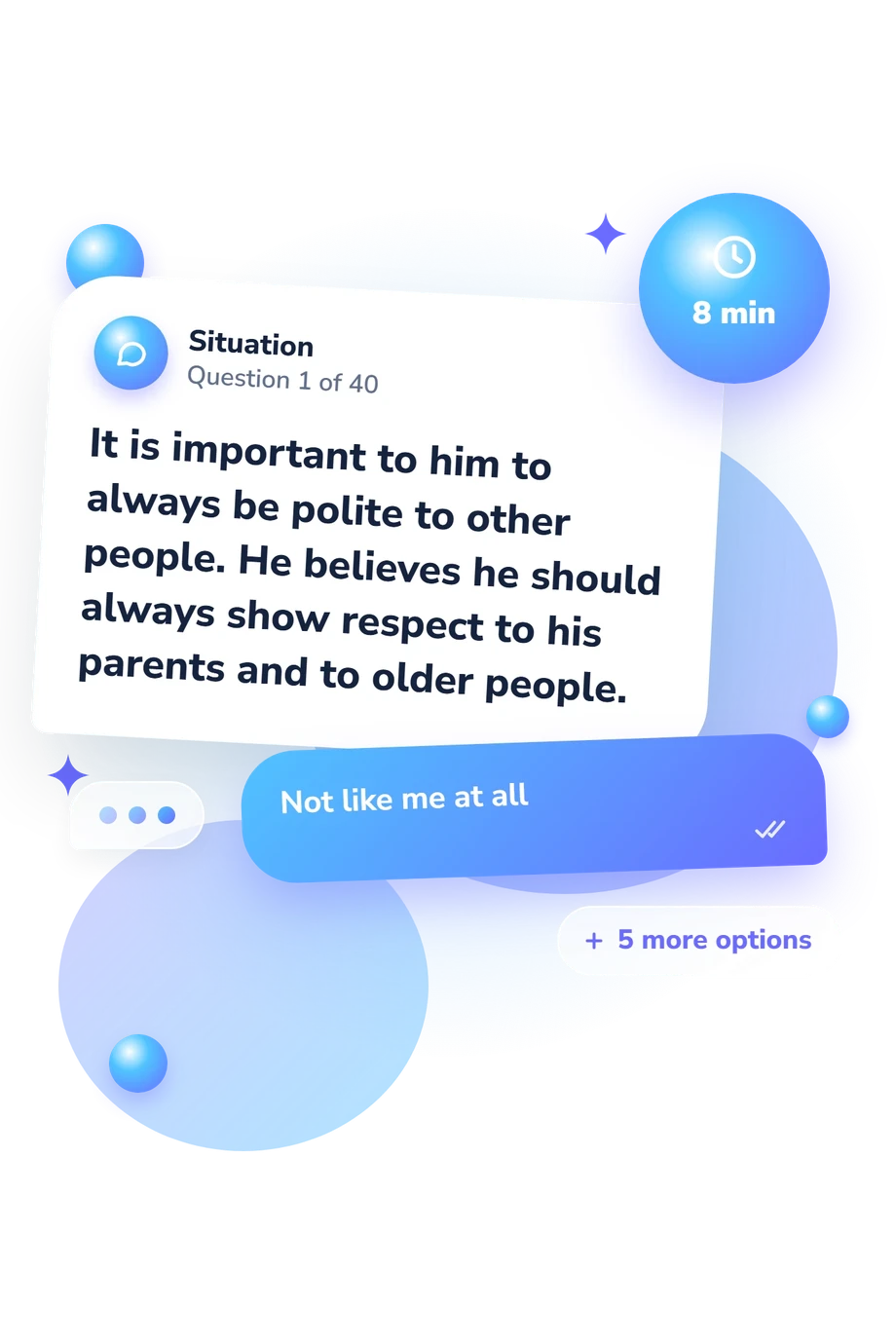
Example Questions From the Test
- Not at all like me
- Not like me
- A little like me
- Somewhat like me
- Like me
- Very much like me
- Not like me at all
- Not like me
- A little like me
- Somewhat like me
- Like me
- Very much like me
- Not at all like me
- Not like me
- Not much like me
- A little like me
- Like me
- Very much like me
Portrait Values Questionnaire (PVQ) Test - Description and methodology of the test
People seeking clarity about the principles behind everyday choices, relationships, or long-term goals can use the Portrait Values Questionnaire (PVQ) Test to examine priorities. It is not a moral ranking of values. This personal values questionnaire shows which motivations feel more central, helping you reflect on tensions among independence, security, enjoyment, achievement, and care.
What This Assessment Measures
This values assessment covers:
- Security, Stimulation, and Power (1-6 each) cover safety, harmony, novelty, challenge, status, and influence: Low 1-2.9, Moderate 3-4.4, High 4.5-6; Low 1-2.9, Moderate 3-4, High 4.1-6; and Low 1-2.6, Moderate 2.7-4.3, High 4.4-6, respectively.
- Achievement, Conformity, and Tradition (1-6 each) cover success, recognition, restraint, order, customs, and beliefs: Lower priority 1-2.9, Moderate priority 3-4.4, Higher priority 4.5-6; Low 1-2, Moderate 3-4, High 5-6; and Low 1-2, Moderate 3-4, High 5-6, respectively.
- Universalism and Benevolence (1-6 each) cover tolerance, justice, people, nature, and care: Lower emphasis 1-2, Moderate 3-4, Higher emphasis 5-6; and Lower benevolence 1-2.9, Moderate benevolence 3-4.4, Higher benevolence 4.5-6, respectively.
- Self-Direction and Hedonism (1-6 each) cover autonomy, creativity, learning, pleasure, and enjoyment: Lower independence 1-2.9, Moderate independence 3-4, Higher independence 4.1-6; and Low 1-2.6, Moderate 2.7-4.3, High 4.4-6, respectively.
Methodology and Scientific Basis
Responses use six ordered choices, from “Not at all like me” to “Very much like me,” with intermediate options showing degrees of resemblance. The portrait format asks respondents to compare themselves with a described person, making abstract values easier to connect with daily decisions.
Each answer contributes to the profile reported on 1-6 scales. Higher placement indicates stronger endorsement of that motivation within this profile; the bands are descriptive labels, not clinical thresholds. One result cannot establish population norms or a diagnosis.
The published reference point is Portrait Values Questionnaire (PVQ-40; Schwartz et al., 2001), which measures Schwartz’s basic human values through a different method. Cieciuch and Schwartz (2012) examined PVQ-40 structure, while Beramendi and Zubieta (2017) studied 40- and 21-item versions in Argentina. Those studies support construct interpretation, but do not establish identical norms, translation properties, reliability, or validity for this online form. As a Schwartz values test, it is a structured snapshot that can be influenced by current context, self-presentation, and self-awareness.
- Schwartz, S. H., Melech, G., Lehmann, A., Burgess, S., Harris, M., & Owens, V. (2001). Extending the Cross-Cultural Validity of the Theory of Basic Human Values with a Different Method of Measurement. Journal of Cross-Cultural Psychology, 32(5), 519-542. 10.1177/0022022101032005001
- Cieciuch, J., & Schwartz, S. H. (2012). The Number of Distinct Basic Values and Their Structure Assessed by PVQ-40. Journal of Personality Assessment, 94(3), 321-328. 10.1080/00223891.2012.655817
- Beramendi, M., & Zubieta, E. (2017). Validation of the 40 and 21 Items Versions of the Portrait Values Questionnaire in Argentina. Psychologia, 60(2), 68-84. 10.2117/psysoc.2017.68
Updated: