
Unconditional Self-Acceptance Questionnaire (USAQ) Test
How the Scales are Structured
Who Usually Takes This Test?
See How You Compare
Below is a preview of how scores are typically distributed across each scale.
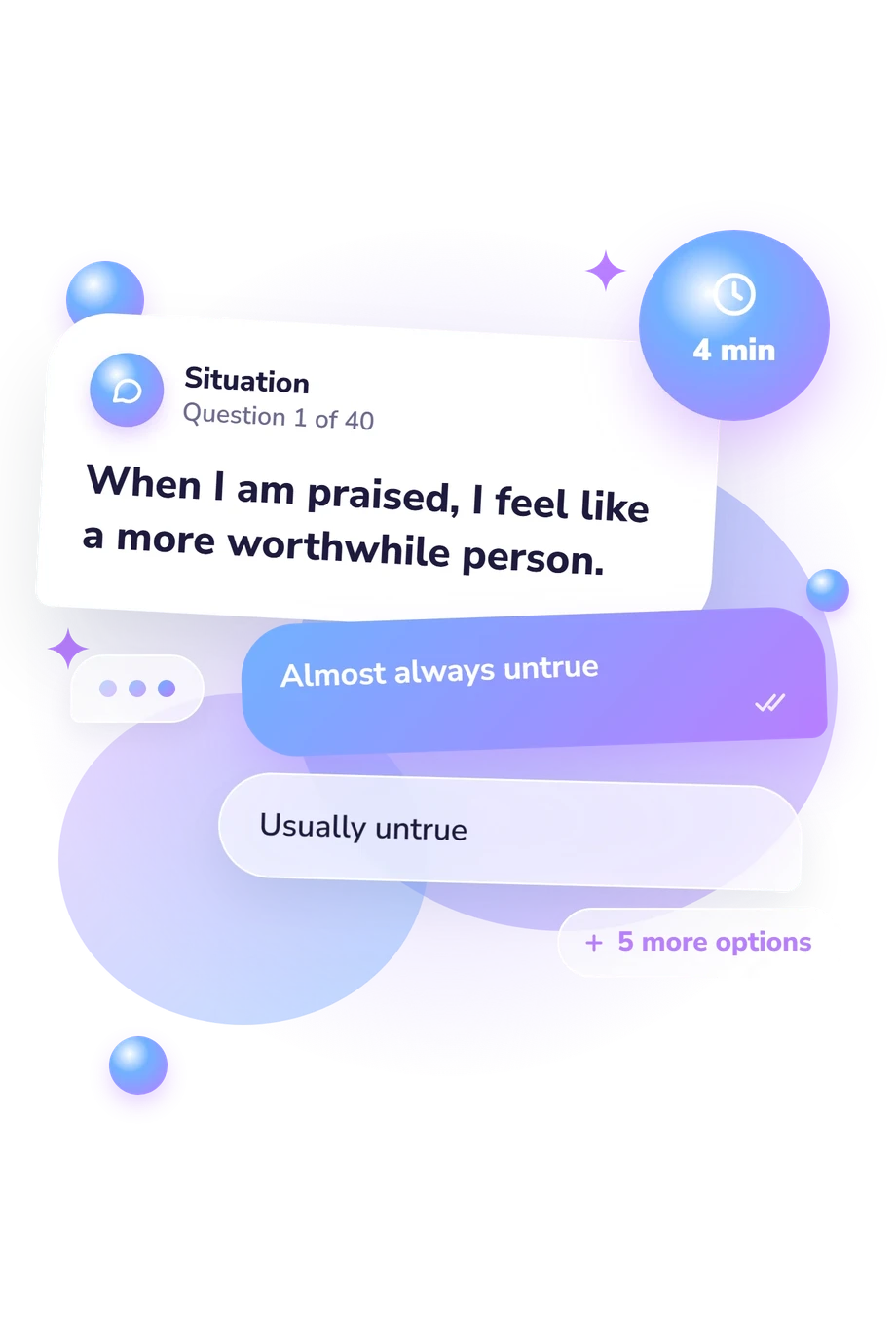
Example Questions From the Test
- Almost always untrue
- Usually untrue
- More often untrue than true
- About equally true and untrue
- More often true than untrue
- Usually true
- Almost always true
- Almost always untrue
- Usually untrue
- More untrue than true
- Equally true and untrue
- More true than untrue
- Usually true
- Almost always true
- Almost always untrue
- Usually untrue
- More often untrue than true
- Equally often true and untrue
- More often true than untrue
- Usually true
- Almost always true
Unconditional Self-Acceptance Questionnaire (USAQ) Test - Description and methodology of the test
People who want to understand whether their sense of worth depends on success, approval, or performance may find the Unconditional Self-Acceptance Questionnaire (USAQ) Test useful. It treats self-evaluation as a recurring psychological pattern rather than a verdict on character. As an unconditional self-acceptance assessment, it can help readers reflect on whether mistakes, criticism, and other people’s reactions change their basic regard for themselves.
What This Assessment Explores
At its core, the questionnaire examines whether a person can value themselves without making worth conditional on outcomes. Items address praise, failure, goals, comparison, approval, criticism, competence, and beliefs about human value. A self-worth questionnaire of this kind helps identify the personal rules that make self-regard rise or fall.
The displayed scale is Unconditional Self-Acceptance (20-140). Higher scores indicate greater ability to accept yourself despite behavior, achievements, or other people’s attitudes. Results appear as Low 20-68, Moderate 69-102, or High 103-140.
The main themes are:
- Praise and achievement show whether success becomes proof of personal value.
- Failure and criticism show how setbacks affect overall self-regard.
- Approval and relationships show whether acceptance feels necessary for worth.
- Comparison and global judgments show whether performance defines the whole person.
Methodology and Scientific Basis
Each statement uses seven ordered truth-frequency responses, from almost always untrue to almost always true. Some items use false or not true wording; the options indicate how often or to what degree the statement is true. The questionnaire produces the displayed result from these responses, with higher results indicating greater unconditional self-acceptance.
The questionnaire is conceptually consistent with Chamberlain and Haaga’s published Unconditional Self-Acceptance Questionnaire (2001), which links unconditional self-acceptance with psychological functioning and reactions to negative feedback. Albert Ellis’s rational-emotive view likewise treats human value as irreducible to achievement, conduct, or approval. As an online self-acceptance test, it should not be described as an adaptation, validated online reproduction, or restandardized version of that instrument.
Interpretation is descriptive: higher results suggest less conditional self-regard; lower results suggest greater dependence on success or approval. The catalogue treats the displayed levels as descriptive result bands; the questionnaire does not establish clinical cutoffs or population norms.
Self-report can reflect mood, criticism, relationships, or the wish to appear favorable, so the result is one perspective on a broader pattern.
- Chamberlain, John M., & Haaga, David A. F. (2001). Unconditional self-acceptance and psychological health. Journal of Rational-Emotive & Cognitive-Behavior Therapy, 19(3), 163-176. 10.1023/A:1011189416600
- Chamberlain, John M., & Haaga, David A. F. (2001). Unconditional self-acceptance and responses to negative feedback. Journal of Rational-Emotive & Cognitive-Behavior Therapy, 19(3), 177-189. 10.1023/A:1011141500670
- Ellis, Albert (1977). Psychotherapy and the value of a human being. In Albert Ellis & Russell Grieger (Eds.), Handbook of Rational-Emotive Therapy (pp. 99-112). New York: Springer Publishing Company.
Updated: