
Cognitive Avoidance Questionnaire (CAQ) Test
How the Scales are Structured
Who Usually Takes This Test?
See How You Compare
Below is a preview of how scores are typically distributed across each scale.
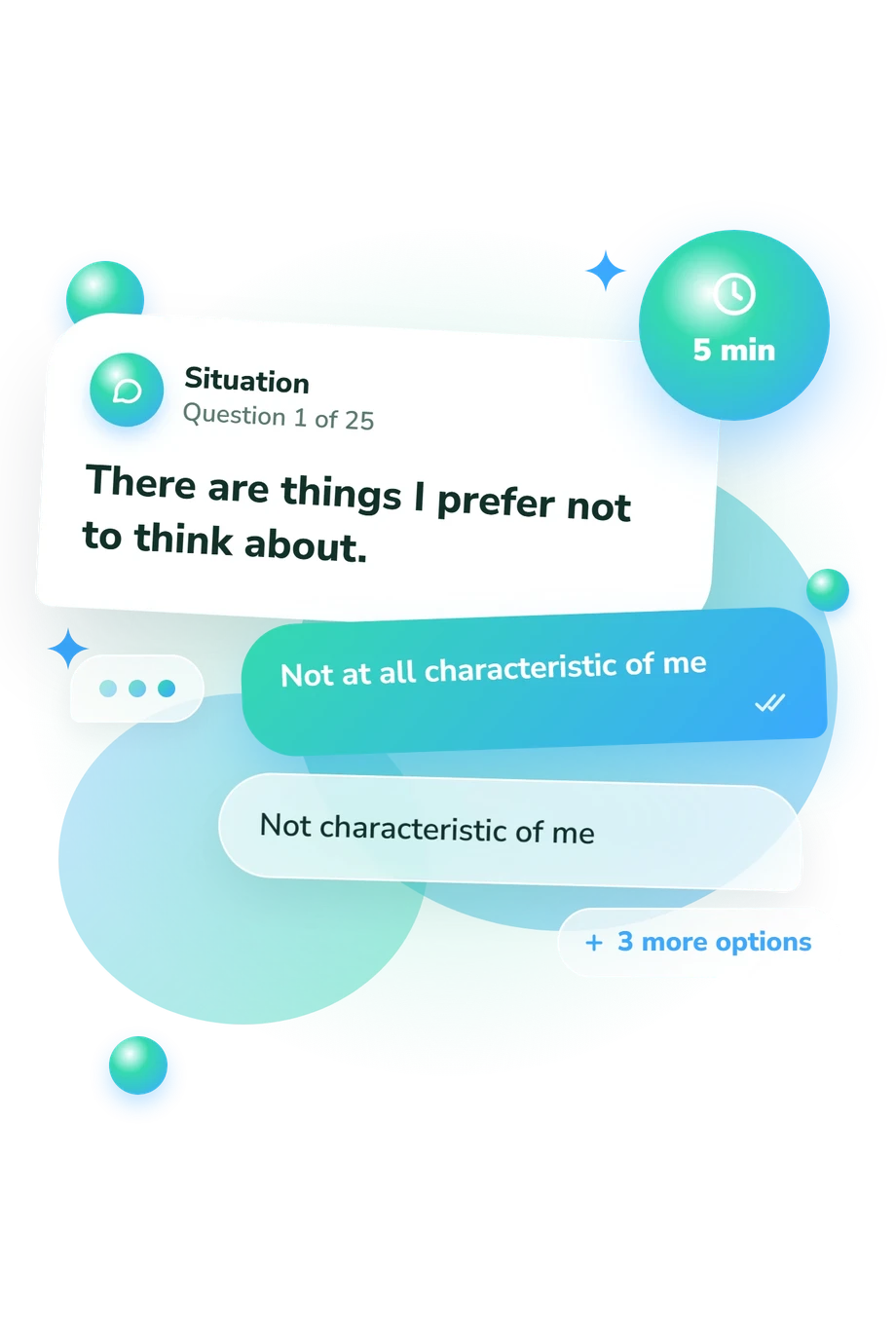
Example Questions From the Test
- Not at all characteristic of me
- Not characteristic of me
- Neither characteristic nor uncharacteristic of me
- Characteristic of me
- Completely characteristic of me
- Not at all characteristic of me
- Not characteristic of me
- Neither characteristic nor uncharacteristic
- Characteristic of me
- Completely characteristic of me
- Not at all characteristic of me
- Not characteristic of me
- Somewhat
- Characteristic of me
- Completely characteristic of me
Cognitive Avoidance Questionnaire (CAQ) Test - Description and methodology of the test
People who notice recurring efforts to push away upsetting thoughts, images, or situations can use this questionnaire to examine those patterns more closely. The Cognitive Avoidance Questionnaire (CAQ) Test offers a focused profile for self-reflection about anxiety-provoking inner experiences. This cognitive avoidance assessment highlights which coping responses appear most prominent, helping readers consider how they manage distress in daily life.
What This Assessment Explores
Rather than judging thoughts, it examines responses to distressing images, worries, reminders, and situations. It suits people reflecting on cognitive avoidance strategies under stress, while results describe tendencies rather than identity. These are the measured dimensions:
- Transformation of Images Into Thoughts (5-25) measures turning frightening images into abstract inner speech; Low use 5-16, High use 17-25.
- Avoidance of Threatening Stimuli (5-25) measures avoiding anxiety-provoking situations, objects, or thoughts; Low avoidance 5-16, High avoidance 17-25.
- Distraction (5-25) measures shifting attention to other activities or thoughts; Low 5-16, Moderate 17-18, High 19-25.
- Thought Substitution (5-25) measures replacing unpleasant thoughts with neutral or positive content; Low use 5-14, High use 15-25.
- Thought Suppression (5-25) measures trying to push unwanted thoughts from awareness; Low 5-18, High 19-25.
- Cognitive Avoidance Scale (25-125) measures overall use of these strategies during stress; Low 25-78, High 79-125.
Methodology and Scientific Basis
The self-report cognitive-avoidance approach uses a five-point response format, with choices from 1 to 5 describing how characteristic or typical a reaction is. Items address trigger avoidance, image transformation, distraction, thought substitution, and suppression. Responses are combined into the displayed subscales and total score, and each resulting value is interpreted through the bands shown for its scale, giving the reader a profile of reported strategy use across separate dimensions and the overall pattern.
This cognitive avoidance questionnaire is conceptually consistent with the published Cognitive Avoidance Questionnaire (CAQ). Sexton and Dugas (2008) validated its English version; Gosselin and colleagues developed the instrument, and Latorre Postigo and colleagues examined its factor structure. The cited studies’ samples, norms, and psychometric estimates cannot automatically be generalized to this online version.
Results are interpretive rather than diagnostic: the displayed bands are labels for this questionnaire, not independently established clinical cutoffs. Self-report can shift with current stress, memory, self-awareness, and willingness to acknowledge private habits. The profile is most useful when read alongside the situations in which these strategies occur and their broader impact.
- Sexton, K. A., & Dugas, M. J. (2008). The Cognitive Avoidance Questionnaire: Validation of the English translation. Journal of Anxiety Disorders, 22(3), 355-370. 10.1016/j.janxdis.2007.04.005
- Gosselin, P., Langlois, F., Freeston, M. H., Ladouceur, R., Dugas, M. J., & Pelletier, O. (2002). The Cognitive Avoidance Questionnaire (CAQ): Development and validation among adults and adolescents. Journal de Thérapie Comportementale et Cognitive, 12(1), 24-37
- Latorre Postigo, J. M., Nieto López, M., Font Payeras, M. A., Ros Segura, L., Heras, J., & Ricarte Trives, J. J. (2020). Cognitive Avoidance Questionnaire: Factor structure and psychometric properties. Anales de Psicología, 36(3), 457-467. 10.6018/analesps.397711
Updated: