
INL-2 Questionnaire Test
How the Scales are Structured
Who Usually Takes This Test?
See How You Compare
Below is a preview of how scores are typically distributed across each scale.
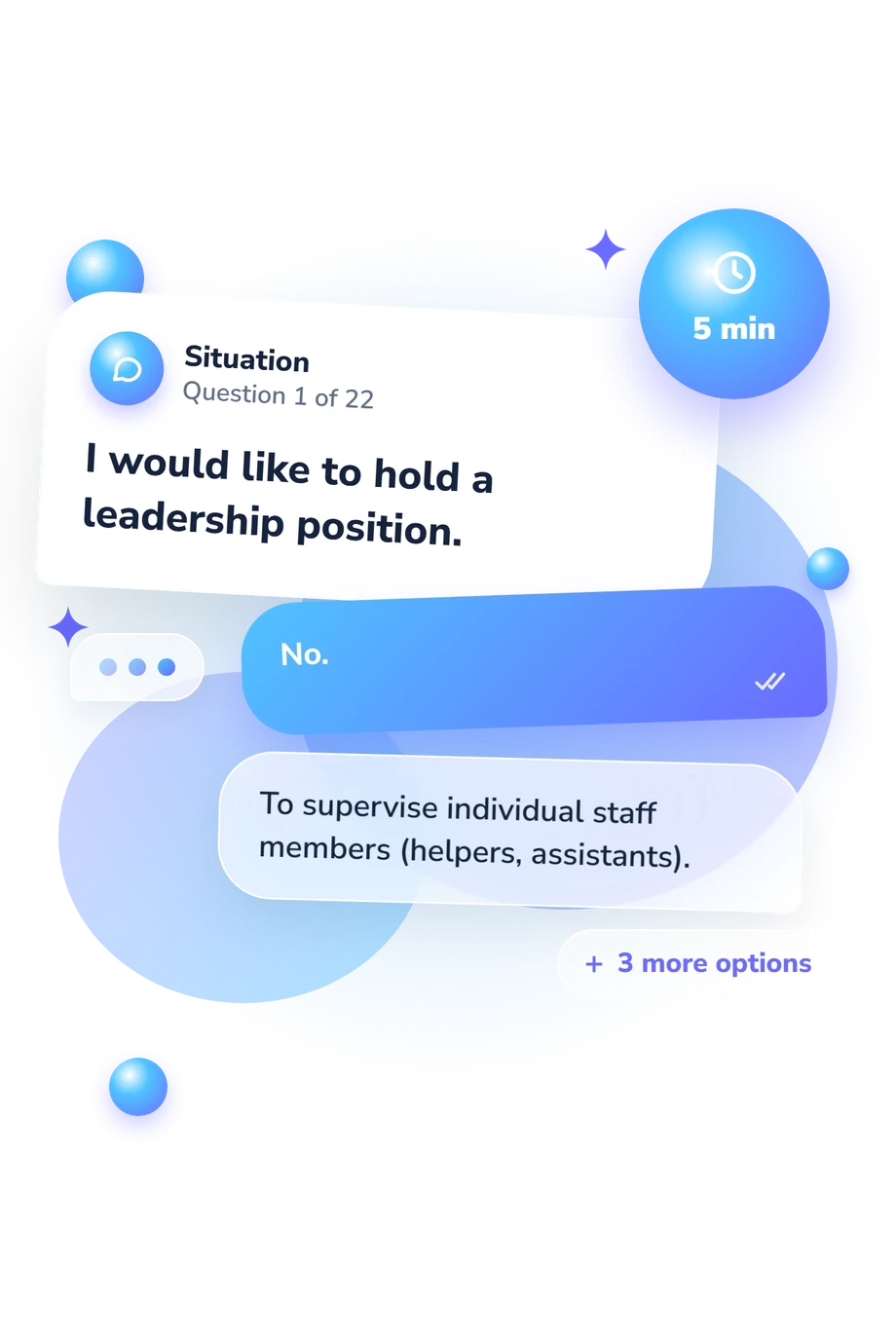
Example Questions From the Test
- No
- Rather no
- Somewhere in between
- Rather yes
- Definitely yes
- 1) No
- 2) Probably no
- 3) Neither yes nor no
- 4) Probably yes
- 5) Definitely yes
- No
- Mostly no
- Somewhere in between
- Mostly yes
- Definitely yes
INL-2 Questionnaire Test - Description and methodology of the test
For people weighing work settings, responsibilities, or career directions, this assessment maps the activities that feel more natural and the demands that may require more effort. The INL-2 Questionnaire Test offers a structured profile of professional preferences rather than a single occupational label. The resulting work preference profile organizes self-reflection around roles and workplace environments.
What This Assessment Explores
Across seven dimensions, professional work preferences vary.
The result groups these preferences into:
- Information (0-9) shows preference for information work: Low 0-3, Moderate 4-6, High 7-9.
- People (0-9) shows interpersonal preference: Low people-focus 0-3, Moderate 4-6, High people-focus 7-9.
- Objects (0-9) shows object preference: Low object focus 0-3, Balanced / versatile 4-6, High object focus 7-9.
- Operational Efficiency (0-9) shows operational regulation: Low responsiveness 0-3, Balanced responsiveness 4-6, High responsiveness 7-9.
- Strategies (0-9) shows long-term regulation: Tactical focus 0-3, Balanced planning 4-6, Strategic focus 7-9.
- Execution (0-9) shows execution preference: Low execution preference 0-3, Typical execution preference 4-6, High execution preference 7-9.
- Management (0-9) shows managerial preference: Low 0-3, Moderate 4-6, High 7-9.
Methodology and Scientific Basis
Each statement rates interest, agreement, comfort, or experience on ordered responses. Most offer five positions from no/probably no to definite interest; others describe frequency or responsibility. This captures desired activities and ease with work demands.
The questionnaire reports seven named scales with scale-specific result bands; no weighting or item allocation should be assumed.
Interpretation is scale-specific, not a shared low-middle-high rule. Middle results may indicate versatility in object-oriented work or execution qualities common across professions, while low-to-moderate interpersonal results indicate less orientation toward working with people. Other bands concern responsiveness, information processing, long-term planning, or managerial inclination, so meaning follows each definition.
This online version is separate from, but conceptually consistent with, the published INL-2 Questionnaire (Rubtsova & Lenkov, 2023), not that instrument itself. Rubtsova's 2012 integrative-typological model and a 2024 application study support the dimensions, not validation of this version.
The online career preference assessment has descriptive bands, not population norms or clinical cutoffs. Self-report can reflect current circumstances, self-awareness, and response style, so consider the profile alongside skills, experience, values, and job demands.
- Rubtsova, N. E., & Lenkov, S. L. (2023). The Questionnaire "Integrative-Typological Professional Direction of a Personality": Development of the Second Version. Yaroslavl Pedagogical Bulletin, 1(130), 158-170. 10.20323/1813_145X_2023_1_130_158_170
- Rubtsova, N. E., & Lenkov, S. L. (2024). Practice of Applying the Questionnaire "Integrative Professional Orientation of Personality". Vestnik of Tver State Technical University. Series: Sciences of Society and Humanities, 4(39), 44-56. 10.46573/2409-1391-2024-4-44-56
- Rubtsova, N. E. (2012). Psychological Classification of Contemporary Professional Activity: An Integrative-Typological Approach. Monograph in Two Books. Tver: Publishing House of the Tver Branch of the Moscow Humanitarian-Economic Institute, Book 2, 458 pages.
Updated: