
Acute Mental Fatigue Assessment Questionnaire Test
How the Scales are Structured
Who Usually Takes This Test?
See How You Compare
Below is a preview of how scores are typically distributed across each scale.
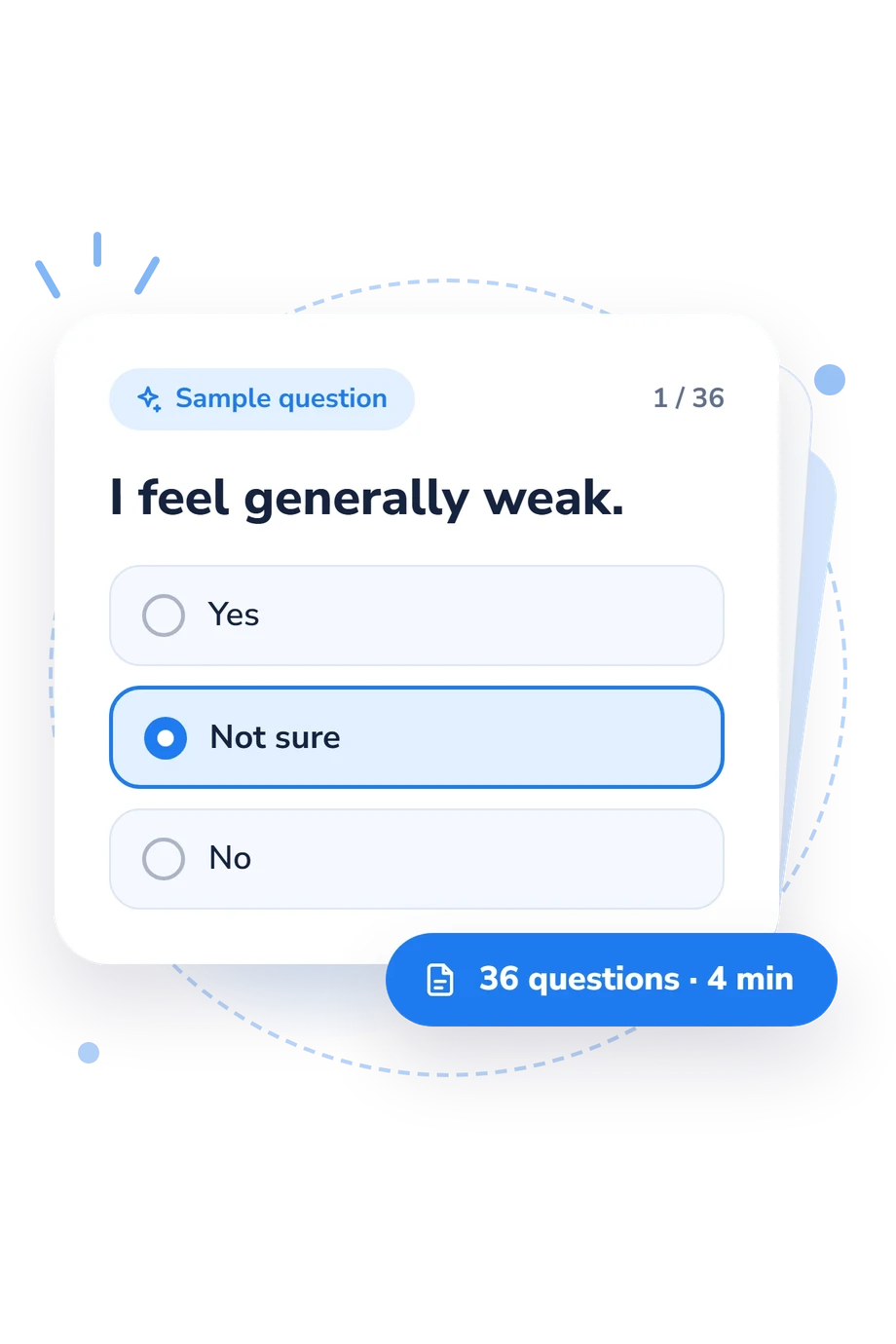
Example Questions From the Test
- Yes
- Not sure
- No
- Yes
- Not sure
- No
- Yes
- Not sure
- No
Acute Mental Fatigue Assessment Questionnaire Test - Description and methodology of the test
People who notice slowing thoughts, effortful responding, irritability, or reduced interest in work may use this questionnaire to organize a snapshot of their current functional state. The Acute Mental Fatigue Assessment Questionnaire Test focuses on how mental strain is experienced during demanding activity, helping a reader compare reported difficulties with the instrument’s severity bands. It is a self-report questionnaire for reflecting on mental fatigue symptoms and current functioning under mental demands.
What This Assessment Explores
Items cover weakness, tired eyes, slowed thinking, work pauses, accuracy doubts, irritability, and wanting a break. Other prompts address calmness, cheerfulness, attention, conversation, and willingness to work. This describes a current functional state, not a stable personality trait.
The result has three readouts:
- Scale 1 (0-20) assesses reduced work capacity and cognitive discomfort associated with mental fatigue; bands are Low 0-6, Moderate 7-13, and High 14-20.
- Scale 2 (0-16) assesses impairments in regulatory processes supporting task performance that may be associated with mental fatigue; bands are Low disruption 0-5, Moderate disruption 6-11, and High disruption 12-16.
- Mental Fatigue Index (0-36) assesses fatigue severity; bands are None-Mild 0-16, Moderate 17-28, and Severe 29-36.
Together, these readouts distinguish capacity, regulation, and overall fatigue. As a mental fatigue questionnaire, it suits people considering demanding work, study, or sustained information processing.
Methodology and Scientific Basis
Each statement offers affirmative, uncertain, and negative response options; the uncertainty label appears as either Not sure or Unsure, and several items number these choices from 1 to 3. The sample includes fatigue complaints and preserved-function statements. Responses feed three readouts, but the questionnaire does not state each answer’s point value or any reverse-scoring rule. Read the result through its displayed bands, not a formula inferred from score ranges.
Its conceptual reference is Leonova’s work on subjective functional-state assessment, while this acute mental fatigue assessment remains conceptually consistent with that tradition rather than an adaptation of it. Hockey’s cognitive-energetical model explains why task demands, effort, regulation, and perceived performance appear together. A study by Boksem, Meijman, and Lorist links sustained mental effort with attentional changes, but it does not validate this online questionnaire.
The result is best treated as a time-sensitive self-report of current mental fatigue symptoms. No norms or clinical cutoffs are stated for this form, and answers can shift with workload, sleep, mood, context, and self-awareness. It can help organize those reports for reflection without converting them into a clinical label.
- Leonova, A. B. (1984). Psychodiagnostics of Human Functional States. Moscow: Moscow State University Publishing House.
- Leonova, A. B., & Kapitsa, M. S. (2003). Methods of Subjective Assessment of Human Functional States. In Y. K. Strelkov (Ed.), Workshop on Engineering Psychology and Ergonomics (pp. 136-167). Moscow: Akademiya.
- Markin, A. A., Zhuravleva, O. A., Zhuravleva, T. V., Kuzichkin, D. S., Markina, E. A., Polyakov, A. V., Vostrikova, L. V., Zabolotskaya, I. V., & Loginov, V. I. (2023). Influence of the Hypomagnetic Environment on the Metabolism and Psychophysiological Reactions of a Healthy Human. Human Physiology, 49(6), 84-91. 10.31857/S013116462370042X
- Hockey, G. R. J. (1993). Cognitive-energetical Control Mechanisms in the Management of Work Demands and Psychological Health. In A. D. Baddeley & L. Weiskrantz (Eds.), Attention: Selection, Awareness, and Control (pp. 328-345). Oxford: Oxford University Press.
Updated: