
Self-Confidence Scale Test
How the Scales are Structured
Who Usually Takes This Test?
See How You Compare
Below is a preview of how scores are typically distributed across each scale.
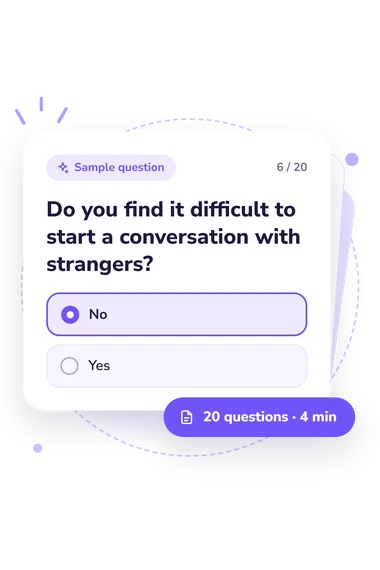
Example Questions From the Test
- Look for a good opportunity to confront them
- Stop communicating with them and avoid meeting them
- No
- Yes
- No
- Yes
Self-Confidence Scale Test - Description and methodology of the test
For readers who want to examine how they handle everyday social and practical demands, the Self-Confidence Scale Test provides a focused self-report profile. This self-confidence questionnaire asks you to examine how your inner conviction appears when you make decisions, enter conversations, set boundaries, and face interpersonal pressure. The result highlights where personal agency feels accessible and where hesitation, avoidance, or self-doubt may restrict action.
What This Assessment Explores
Internal conviction in your strengths, capabilities, and abilities is the construct; situational items provide behavioral contexts for reading it.
Items cover disagreement, refusal, boundaries, unfamiliar people, questions, unfair treatment, and embarrassment. This self-confidence assessment suits readers reflecting on personal resources, autonomy, persistence, and action.
The result brings these themes into one dimension:
- Self-Confidence is scored from 0-81; Low (0-32) may indicate self-doubt, insecurity, and self-limitation, Moderate (33-60) is the middle category, and High (61-81) indicates greater autonomy, persistence, and decision-making.
- Boundary-setting shows how readily you protest unfairness, refuse risky favors, or address disruptive behavior.
- Social initiative reflects willingness to start conversations, speak up, approach unfamiliar people, and ask questions.
A higher result reflects readiness for independent action, while a lower one may indicate insecurity or a tendency to hold yourself back.
Methodology and Evidence Base
Each item presents a short situation with two or three response options. The choices represent degrees of hesitation, directness, avoidance, or comfort, allowing the respondent to select the reaction closest to usual behavior. Responses are combined and presented as one total score; the answer-to-point conversion is not specified, so individual answers should not be treated as separate subscale results.
The scenario-based content is conceptually consistent with Ilyina's questionnaire, Rathus's assertiveness schedule, Bandura's self-efficacy model, and Rosenberg's self-image framework. These sources explain why confidence can involve inner belief and observable action; this online questionnaire is a separate self-report rather than a standardized administration of those instruments.
This self-confidence quiz organizes reflection around speaking up, initiative, defending personal interests, and tolerating social evaluation. The displayed bands are descriptive catalogue categories rather than established clinical thresholds. Scores may shift with mood, stress, relationship dynamics, current circumstances, or the wish to appear more capable. Read the result as a reflection prompt rather than a clinical conclusion.
- Ilyina, Tatyana Vladimirovna. (2012). Tests for Students in Grades 10-11: How Confident Are You in Yourself?.
- Rathus, Spencer A. (1973). A 30-item schedule for assessing assertive behavior. Behavior Therapy, 4(3), 398-406. 10.1016/S0005-7894(73)80120-0
- Bandura, Albert. (1997). Self-Efficacy: The Exercise of Control. New York: W. H. Freeman.
- Rosenberg, Morris. (1965). Society and the Adolescent Self-Image. Princeton, NJ: Princeton University Press.