
Asthenia Assessment Questionnaire Test
How the Scales are Structured
Who Usually Takes This Test?
See How You Compare
Below is a preview of how scores are typically distributed across each scale.
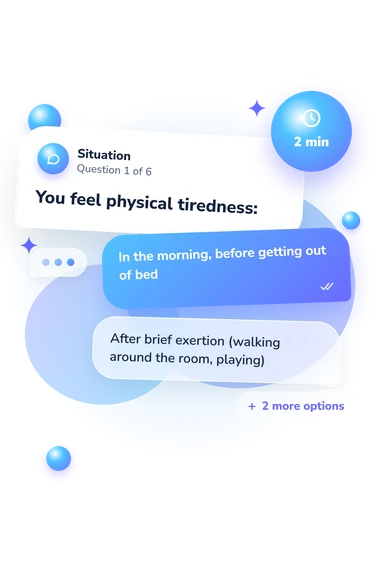
Example Questions From the Test
- you cannot memorize anything even after repeated repetition
- you need to read and repeat it many times
- you need to listen to or read it more than 2–3 times
- you memorize quickly
- often cry for no reason
- cry over any minor reason
- cry when you feel very hurt or when something does not work out
- never get irritated
- are irritable for no reason
- are irritable over minor things
- are irritable only when there are serious reasons
- are never irritable
Asthenia Assessment Questionnaire Test - Description and methodology of the test
For people trying to understand a cluster of fatigue-related difficulties, the Asthenia Assessment Questionnaire Test offers a focused self-report snapshot rather than a broad personality profile. It is suited to readers noticing reduced stamina, physical weakness, or changes in concentration and memory. Current asthenia symptoms can be organized into a result showing the apparent intensity of the current pattern.
What This Assessment Measures
The questionnaire examines how asthenic symptoms affect daily functioning through physical energy, weakness, attention, memory, crying, and irritability. The situations include activity-related tiredness, ordinary tasks, verbal recall, concentration, crying, and irritability. A fatigue assessment of this kind uses these connected indicators to describe one overall result rather than separate cognitive or emotional scores.
Its questions group the result around these observable areas:
- Physical endurance reflects when tiredness appears and whether ordinary activity can be sustained.
- Memory and concentration show how fatigue may affect learning, recall, and staying with a task.
- Crying and irritability mark emotional symptoms that contribute to the overall picture of asthenic difficulty.
The result summarizes apparent symptom burden rather than personality. More marked results reflect more pervasive difficulty across the situations represented, while less marked results are compatible with a fatigue response or relatively preserved functioning.
Methodology and Scientific Basis
Each item offers four ordered response choices. They move from marked difficulty or frequent emotional reaction toward little or no difficulty, so the respondent indicates degree rather than a yes-or-no status. The questionnaire combines responses into one index, but does not specify the points assigned to each option. Together, the options represent gradations in fatigue, weakness, reduced capacity, and related concentration or emotional symptoms.
Overall Asthenia Severity is reported on a 0-18 scale: Fatigue response 0-6, Moderate asthenia 7-12, and Pronounced asthenia 13-18. These bands describe the apparent intensity at completion and may help monitor change over time.
Conceptually, the content is consistent with the Asthenia Diagnostic Questionnaire by Shats (1991), but this online form is not presented as a validated adaptation. This relationship supports the focus on fatigue, weakness, and reduced capacity without establishing norms or validation for the digital form.
When interpreting fatigue severity, read the result alongside current sleep, health, stress, and functioning. No population norms, reliability estimates, or diagnostic thresholds are specified for this digital form, and the score indicates symptom intensity rather than its underlying cause.
- Shats, Igor K. (1991). Asthenia Diagnostic Questionnaire. In D. N. Isaev and V. E. Kagan (Eds.), Psychodiagnostic Methods in Pediatrics and Child Psychoneurology: Methodological Manual (pp. 11-14). Saint Petersburg: PMI.
- Shats, Igor K. (2002). Application of Clinical and Clinical-Psychological Scales in Child Psychiatry and Pediatrics: Methodological Recommendations. Child and Adolescent Mental Health Issues, 2(2), 99-105.
- Shabrov, Alexander V., Fominykh, Yulia A., Uspenskiy, Yury P., and Nadzhafova, Kyamalya N. (2022). Principles of Asthenia Diagnosis. University Therapeutic Journal, 4(3), 57-63. 10.56871/3052.2022.73.10.007