
Adult Attachment Questionnaire Test
How the Scales are Structured
Who Usually Takes This Test?
See How You Compare
Below is a preview of how scores are typically distributed across each scale.
Example Questions From the Test
- Strongly disagree
- Disagree
- Somewhat disagree
- Not sure
- Somewhat agree
- Agree
- Strongly agree
- Strongly disagree
- Disagree
- Somewhat disagree
- Not sure
- Somewhat agree
- Agree
- Strongly agree
- Strongly disagree
- Disagree
- Somewhat disagree
- Not sure
- Somewhat agree
- Agree
- Strongly agree
Adult Attachment Questionnaire Test - Description and methodology of the test
People who want to understand how they typically approach closeness can use this questionnaire to consider recurring relationship experiences. The Adult Attachment Questionnaire Test is designed for respondents who can answer from familiar patterns across relationships rather than from one isolated conflict. As an adult attachment assessment, it offers a structured starting point for noticing how responses may shift with context.
What This Assessment Explores
Attachment patterns are read as dimensions rather than fixed labels. The statements cover closeness, dependence, trust, reassurance, rejection, and reactions to distance.
The displayed result includes:
- Anxiety (9-63) assesses anxious attachment, sometimes termed anxious-ambivalent, and a tendency to experience anxiety in close relationships: Low anxiety (9-27) indicates little to no anxiety, Moderate anxiety (28-42) indicates moderate anxiety, and High anxiety (43-63) indicates a pronounced tendency toward anxiety in close relationships.
- Avoidance (8-56) assesses avoidant attachment: Low avoidance (8-25) indicates no tendency toward avoidance, Moderate avoidance (26-40) indicates a slight to moderate tendency, and High avoidance (41-56) indicates a pronounced tendency to avoid close relationships.
- Closeness and dependence show how trust, reliance, intimacy, and discomfort with excessive closeness shape the profile.
The anxiety score can show whether worries about love or abandonment stand out in the attachment questionnaire results.
Methodology and Evidence Base
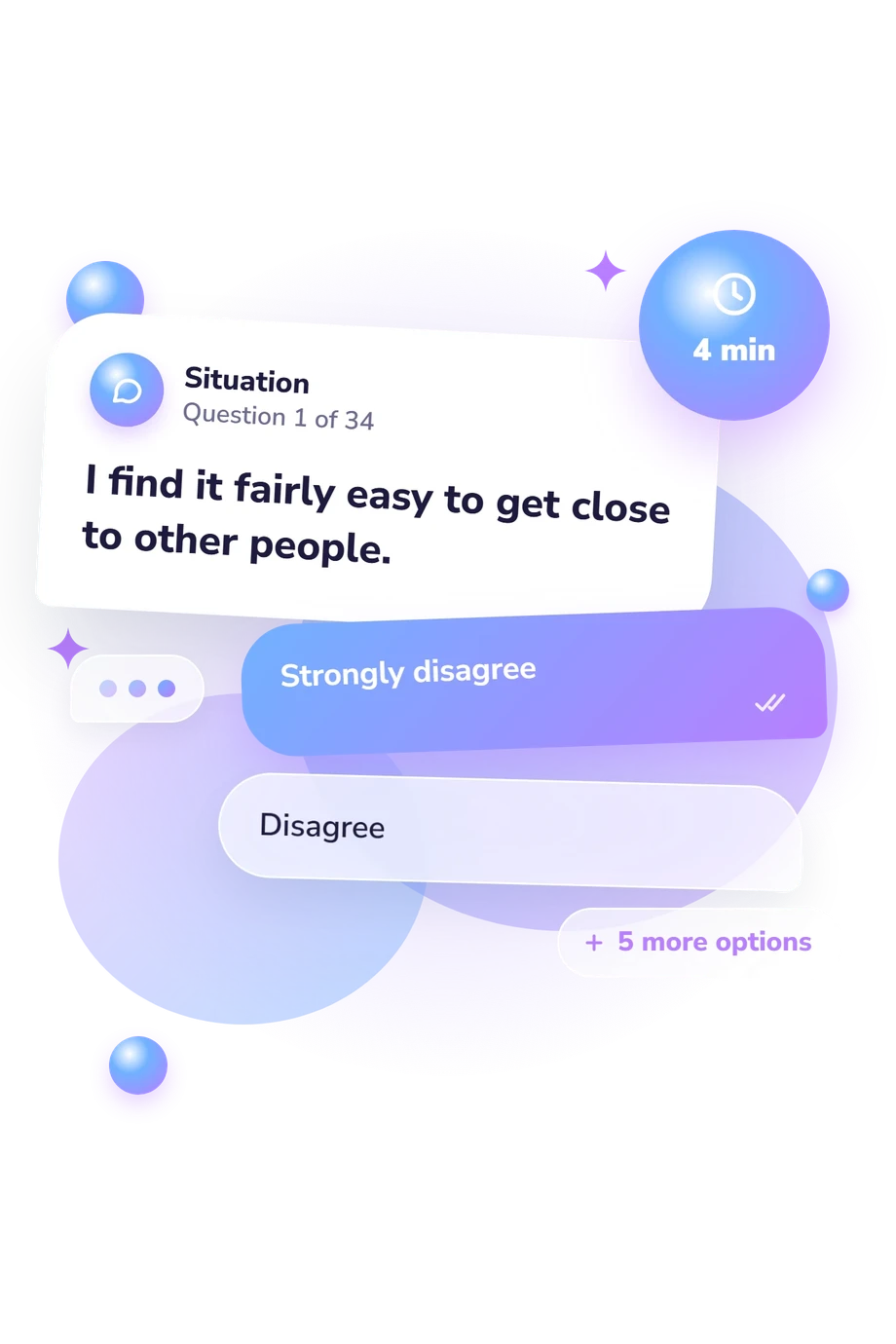
Each item uses a seven-point agreement scale; endpoint wording varies from Strongly disagree or Completely disagree to Strongly agree or Completely agree, with Not sure or Unsure near the midpoint. Statements ask how closely typical relationship thoughts, feelings, or behavior match the respondent, capturing degree rather than simple reactions.
The displayed result gives separate scores for the two dimensions within the supplied bands. An item-level scoring rule is not provided, so the ranges do not show how each response contributes. The avoidance score can indicate whether emotional distance or discomfort with dependence merits reflection in an attachment style assessment.
The 17-item form corresponds to the Adult Attachment Questionnaire reported by Simpson et al. (1996), making this online questionnaire a version of that instrument. Adult attachment theory, applied to romantic love by Hazan and Shaver (1987), supplies the framework. Fraley, Waller, and Brennan (2000) provide psychometric context but do not validate this online version.
Mood, context, memory, self-awareness, and impression management can affect self-report; read the profile as patterns to examine over time, not as a diagnosis.
- Simpson, J. A., Rholes, W. S., & Phillips, D. (1996). Conflict in close relationships: An attachment perspective. Journal of Personality and Social Psychology, 71(5), 899-914. 10.1037/0022-3514.71.5.899
- Hazan, C., & Shaver, P. R. (1987). Romantic love conceptualized as an attachment process. Journal of Personality and Social Psychology, 52(3), 511-524. 10.1037/0022-3514.52.3.511
- Fraley, R. C., Waller, N. G., & Brennan, K. A. (2000). An item response theory analysis of self-report measures of adult attachment. Journal of Personality and Social Psychology, 78(2), 350-365. 10.1037/0022-3514.78.2.350
Updated: