
Dysfunctional Beliefs Questionnaire for Borderline Personality Disorder Test
How the Scales are Structured
Who Usually Takes This Test?
See How You Compare
Below is a preview of how scores are typically distributed across each scale.
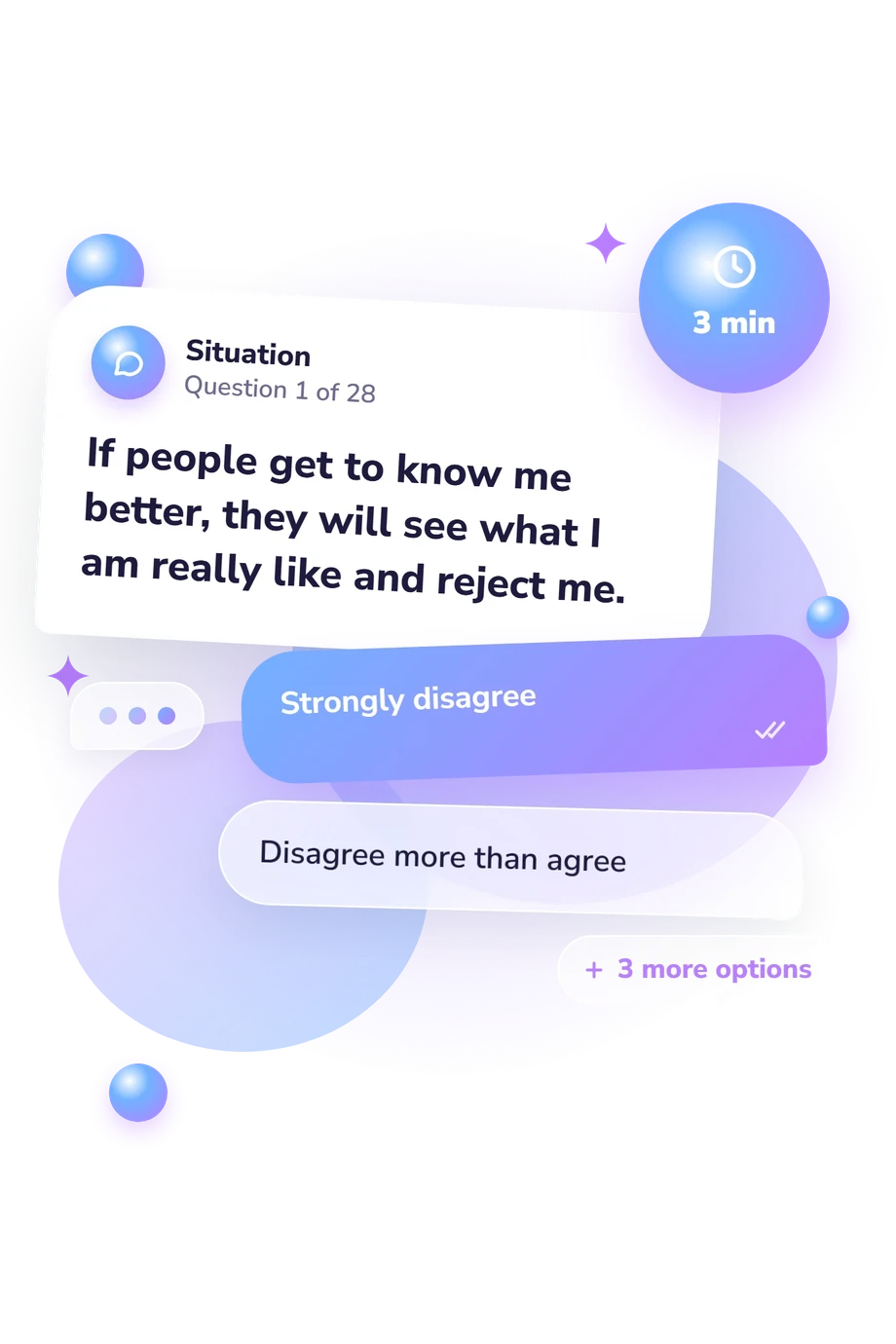
Example Questions From the Test
- Strongly disagree
- Disagree more than agree
- Neither agree nor disagree
- Agree more than disagree
- Strongly agree
- Strongly disagree
- Disagree
- Neither agree nor disagree
- Agree
- Strongly agree
- Strongly disagree
- Somewhat disagree
- Neither agree nor disagree
- Somewhat agree
- Strongly agree
Dysfunctional Beliefs Questionnaire for Borderline Personality Disorder Test - Description and methodology of the test
Readers seeking a structured way to reflect on recurring emotional reactions may use the Dysfunctional Beliefs Questionnaire for Borderline Personality Disorder Test to clarify what they notice in themselves. It supports self-reflection when someone wants to organize difficult experiences before deciding what to explore further. This assessment, a borderline personality disorder beliefs test, gives respondents a structured way to identify assumptions worth examining in their own relationships and emotional responses.
What This Assessment Explores
Statements explore rejection, betrayal, hidden intentions, emotional escalation, helplessness, self-doubt, reliance on others, and defensive reactions to harm. These themes link beliefs to closeness, vigilance, self-worth, and conflict. They are relevant to readers examining dysfunctional beliefs in borderline personality disorder, showing how threat may heighten vigilance, complicate closeness, or intensify conflict.
The four displayed dimensions are:
- Protection (0-20) measures beliefs that guarding is needed against rejection or emotional attack; Low 0-6, Moderate 7-13, High 14-20.
- Dependency (0-16) measures beliefs of being needy, helpless, and reliant on continuing support; Low 0-5, Moderate 6-10, High 11-16.
- Mistrust (0-20) measures expectations that others are untrustworthy or exploitative; Low distrust 0-6, Moderate distrust 7-13, High distrust 14-20.
- Borderline Personality Disorder (0-56) measures severity of dysfunctional beliefs characteristic of BPD; Low 0-18, Moderate 19-37, High 38-56; high scores may indicate BPD-like thinking, not diagnosis.
Methodology and Evidence Base
Each item is a first-person statement answered on a five-point agreement scale from strong disagreement to strong agreement. The result reflects endorsed beliefs at completion, and responses are combined into four displayed totals. The scoring display reports each total with its corresponding bands, so the reader can compare the pattern across the four measured areas.
The closest published reference is PBQ-BPD (Butler et al., 2002), which examines dysfunctional beliefs associated with borderline personality disorder. This online questionnaire is conceptually consistent with that work, not a direct adaptation of the published instrument. Bhar et al. (2008) reported an association between these beliefs and BPD psychopathology, while Beck et al. (2001) support their broader relevance across personality-disorder presentations.
For a reader considering a borderline personality disorder questionnaire, the bands organize the profile into descriptive levels. Scores can shift with current mood, relationship stress, self-awareness, and the wish to present oneself in a particular way, so the profile is best read as a snapshot of the respondent's current self-report.
- Butler, A. C., Brown, G. K., Beck, A. T., & Grisham, J. R. (2002). Assessment of dysfunctional beliefs in borderline personality disorder. Behaviour Research and Therapy, 40(10), 1231-1240. 10.1016/S0005-7967(02)00031-1
- Bhar, S. S., Brown, G. K., & Beck, A. T. (2008). Dysfunctional beliefs and psychopathology in borderline personality disorder. Journal of Personality Disorders, 22(2), 165-177. 10.1521/pedi.2008.22.2.165
- Beck, A. T., Butler, A. C., Brown, G. K., Dahlsgaard, K. K., Newman, C. F., & Beck, J. S. (2001). Dysfunctional beliefs discriminate personality disorders. Behaviour Research and Therapy, 39(10), 1213-1225. 10.1016/S0005-7967(00)00099-1
Updated: