
Freudly+971 508685814hello@freudly.ai
Freudly
viability

Adult Resilience Questionnaire (RRC-ARM) Test
Take the online Adult Resilience Questionnaire (RRC-ARM) Test - AI psychologist FreudlyYou can take Adult Resilience Questionnaire (RRC-ARM) Testhere. Online version of a simple and accurate psychological test with interpretation.en
Understand how well you handle stress using personal strengths, family, and community support in about 6 minutes. A quick 28-item snapshot that points to what to build on and where added support may help.
Start Online Test
Questions: 286 minutes
08:30
October 2, 2025
October 2, 2025
Material has been updated
October 2, 2025
Material has been published
17,945 views
1,522 completions
1,250 likes
Verified by Daniel Hall
Psychologist with 25 years of experience
Share
Scale Explorer

How the Scales are Structured

example score
4/5
Family Support (FS)
Assesses perceived physical and emotional support from family and the family-based resources that help a person stay resilient under stress.
Low
Moderate
High
12.9: Low | 33.9: Moderate | 45: High
A score of 4 indicates high perceived family support, suggesting family relationships are a strong resource for coping with difficulties.
example score
3/5
Culture (C)
Assesses how a person relates to other people and to cultural identity, including attitudes toward national origin, traditions, and the country.
Low
Moderate
High
12.9: Low | 33.9: Moderate | 45: High
A score of 3 indicates a moderate level of cultural connectedness, with generally balanced attitudes toward traditions and national identity that may vary by context.
example score
3/5
Education (E)
Assesses attitudes toward education and the degree of engagement in the professional community.
Low engagement
Moderate engagement
High engagement
12.9: Low engagement | 33.9: Moderate engagement | 45: High engagement
A score of 3 suggests a moderate level of interest in education and some involvement in the professional community, with room to increase active participation.
example score
3/5
Spirituality (S)
Measures how much religion and faith in higher powers serve as a personal source of resilience and support during difficulties.
Low reliance
Moderate reliance
High reliance
12.9: Low reliance | 33.9: Moderate reliance | 45: High reliance
A score of 3 indicates a moderate reliance on spirituality as a resource, suggesting it can be supportive at times but is not the primary source of vitality.
example score
3/5
Context (C)
Assesses social-contextual resources that support resilience, including spirituality, education, and cultural connectedness.
Limited context resources
Adequate context resources
Strong context resources
12.9: Limited context resources | 33.9: Adequate context resources | 45: Strong context resources
A score of 3 indicates adequate social-context resources, suggesting some supportive cultural, educational, or spiritual factors are present but may not be consistently accessible.
example score
3/5
Psychological Care (PC)
Measures how much psychological support and understanding the respondent perceives from their family.
Low support
Moderate support
High support
12.9: Low support | 33.9: Moderate support | 45: High support
A score of 3 suggests a moderate perceived level of psychological care from family, with support present but not consistently strong.
example score
3/5
Individual and Social Skills (IaSS)
Assesses practical social-behavioral skills such as taking responsibility, seeking help when needed, and using these skills effectively in everyday situations.
Needs development
Developing
Well developed
12.9: Needs development | 33.9: Developing | 45: Well developed
A score of 3 indicates a developing level of individual social skills, with basic coping behaviors present but room to strengthen consistency in taking responsibility and seeking support.
example score
3/5
Individual Support (IS)
Measures the person’s perceived availability and reliability of support from friends and other close people outside the family.
Low support
Moderate support
High support
12.9: Low support | 33.9: Moderate support | 45: High support
A score of 3 suggests a moderate level of perceived individual support, with some reliable help available but not consistently across situations.
example score
2/5
Individual Skills (IS)
Assesses how well a person uses problem-solving, collaboration, perseverance, self-attitude, and awareness of personal strengths as individual resilience skills.
Needs strengthening
Developing
Well-developed
12.9: Needs strengthening | 33.9: Developing | 45: Well-developed
A score of 2 falls in the “Needs strengthening” range, suggesting these individual resilience skills are currently less consistently used and may benefit from further development.
example score
2/5
Individual Characteristics (IC)
Assesses personal resilience resources such as problem-solving, persistence, self-attitude, and awareness of one’s strengths.
Low resources
Moderate resources
High resources
12.9: Low resources | 33.9: Moderate resources | 45: High resources
A score of 2 suggests comparatively limited reliance on personal coping skills and awareness of strengths in challenging situations.
example score
3/5
General Resilience (GR)
General Vitality reflects the overall strength of individual, family, and social resources that support coping and adaptation under stress.
Low resources
Moderate resources
High resources
12.9: Low resources | 33.9: Moderate resources | 45: High resources
A score of 3 indicates moderate overall vitality, suggesting coping resources are present but may vary across personal strengths, family support, and social support.
example score
3/5
Physical Care (PC)
Assesses how much physical care and hands-on support from family the respondent feels they can rely on.
Limited support
Moderate support
Strong support
12.9: Limited support | 33.9: Moderate support | 45: Strong support
A score of 3 indicates a moderate level of perceived physical care from family, suggesting some reliable support with room for strengthening.
Start Online Test
just completed the test
DATA-BASED USER COHORTS

Who Usually Takes This Test?

Adults under chronic stress
41%OF USERS
People juggling work, family, or health pressures who want to understand how well they cope and where they need more support.
Clients in counseling
34%OF USERS
Adults already working with a psychologist or coach who use the results to spot strengths and plan practical next steps.
Social support program participants
25%OF USERS
People involved in community or assistance services who want to see whether their main resources come from themselves, family, or their social network.
BASED ON AGGREGATED, ANONYMIZED DATA FROM TENS OF THOUSANDS OF FREUDLY USERS.
Benchmarking

See How You Compare

Once you complete the test, your results are compared with real-world data from people in your country.
Below is a preview of how scores are typically distributed across each scale.
Family Support (FS)
Family Support (FS)
Average
2.4
Normal range
1.93
min.
1
max.
5
This curve shows how scores are typically distributed.
Once you complete the test, your result will appear on the scale so you can see how you compare.
Culture (C)
Culture (C)
Average
2.3
Normal range
1.73
min.
1
max.
5
This curve shows how scores are typically distributed.
Once you complete the test, your result will appear on the scale so you can see how you compare.
Education (E)
Education (E)
Average
4
Normal range
3.24.7
min.
1
max.
5
This curve shows how scores are typically distributed.
Once you complete the test, your result will appear on the scale so you can see how you compare.
Spirituality (S)
Spirituality (S)
Average
2.4
Normal range
1.73
min.
1
max.
5
This curve shows how scores are typically distributed.
Once you complete the test, your result will appear on the scale so you can see how you compare.
Context (C)
Context (C)
Average
2.3
Normal range
1.62.9
min.
1
max.
5
This curve shows how scores are typically distributed.
Once you complete the test, your result will appear on the scale so you can see how you compare.
Psychological Care (PC)
Average
3.5
Normal range
2.94.1
min.
1
max.
5
This curve shows how scores are typically distributed.
Once you complete the test, your result will appear on the scale so you can see how you compare.
Ind.-social skills (Is)
Average
2.1
Normal range
1.62.6
min.
1
max.
5
This curve shows how scores are typically distributed.
Once you complete the test, your result will appear on the scale so you can see how you compare.
Individual Support (IS)
Average
3.6
Normal range
34.1
min.
1
max.
5
This curve shows how scores are typically distributed.
Once you complete the test, your result will appear on the scale so you can see how you compare.
Individual Skills (IS)
Average
2.1
Normal range
1.42.8
min.
1
max.
5
This curve shows how scores are typically distributed.
Once you complete the test, your result will appear on the scale so you can see how you compare.
Individual characteristics (Ic)
Average
2.9
Normal range
2.33.6
min.
1
max.
5
This curve shows how scores are typically distributed.
Once you complete the test, your result will appear on the scale so you can see how you compare.
General Vitality (GV)
Average
3.7
Normal range
3.24.2
min.
1
max.
5
This curve shows how scores are typically distributed.
Once you complete the test, your result will appear on the scale so you can see how you compare.
Physical Care (PC)
Physical Care (PC)
Average
3.4
Normal range
2.74.1
min.
1
max.
5
This curve shows how scores are typically distributed.
Once you complete the test, your result will appear on the scale so you can see how you compare.
Featured On
SAMPLE QUESTIONS

Example Questions From the Test

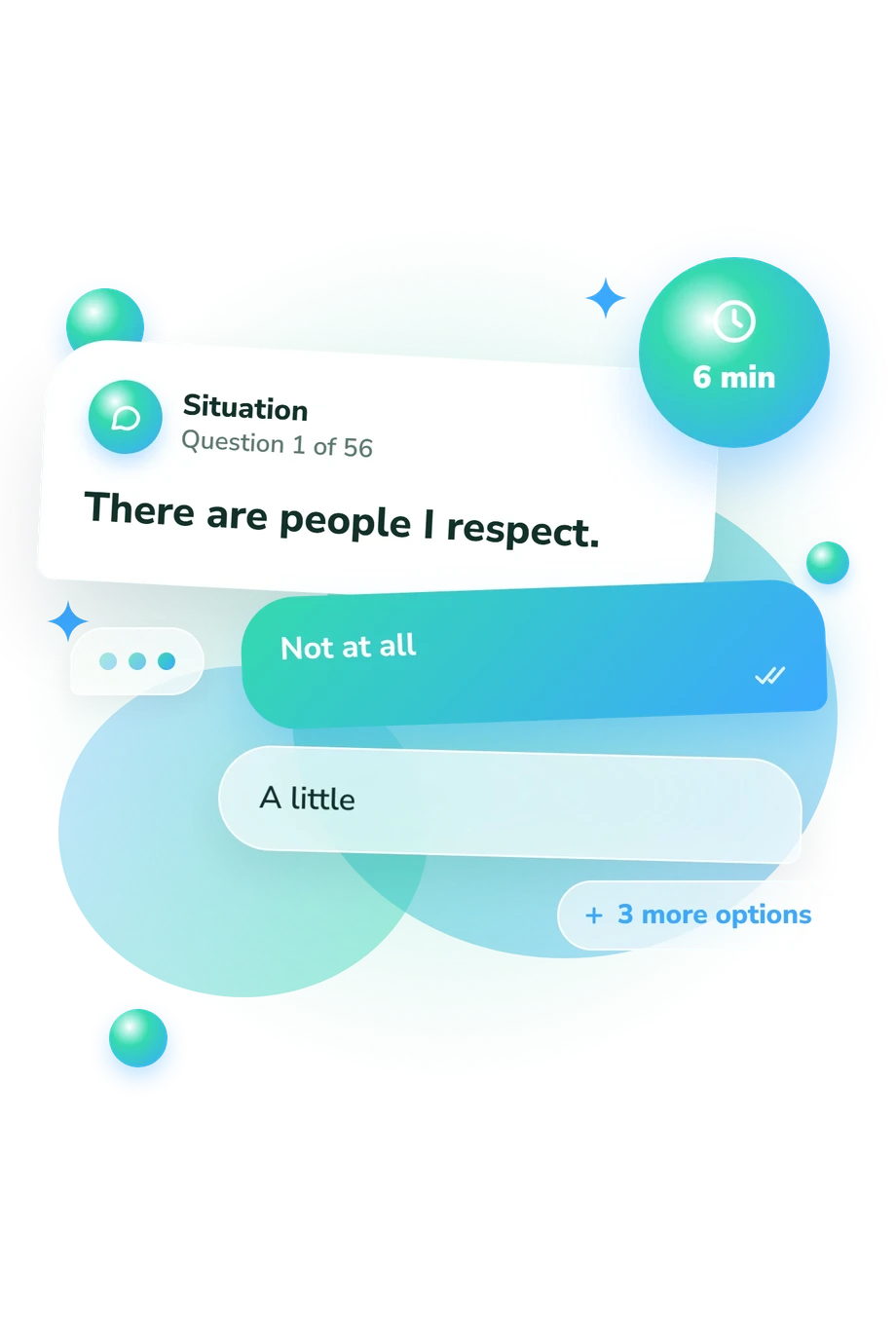
Below are questions about you, your family, and your relationships with other people. For each question, select the response option that most accurately reflects your opinion.
    • Not at all
    • A little
    • To some extent
    • To a large extent
    • To a very great extent
    • Not at all
    • A little
    • To some extent
    • To a great extent
    • To a very great extent
    • Not at all
    • A little
    • To some extent
    • To a considerable extent
    • To a very great extent
WHAT THE TEST MEASURES
About This Assessment
Adult Life Resilience Questionnaire, RRC-ARM Test

Adult Resilience Questionnaire (RRC-ARM) Test - Symptoms and Signs

viability

This self-report measure assesses protective factors that support resilience in adults. The Adult Resilience Questionnaire (RRC-ARM) is designed to characterize the extent to which an individual can draw on personal strengths and external supports when managing stressors.

The instrument includes 28 items and typically takes about 6 minutes to complete. Items generally reflect domains such as individual coping resources, family support, and broader social or community supports, and responses may be used to inform clinical formulation, case planning, or program evaluation.

Results from the Adult Resilience Questionnaire (RRC-ARM) are interpreted as indicators of relative strengths and potential areas for intervention, rather than as a standalone diagnostic finding. Interpretation should consider the respondent’s context and be integrated with other clinical information.

Author: Ann S. Masten, Michael Rutter
Literature: Masten, A. S. Ordinary magic: Resilience processes in development. American Psychologist. 2001.; Ungar, M., & Liebenberg, L. Assessing resilience across cultures using mixed methods: Construction of the child and youth resilience measure. Journal of Mixed Methods Research. 2011.; Resilience Research Centre. Adult Resilience Measure (RRC-ARM) user’s manual. Dalhousie University. 2013.
Popular tests
Comments
Leave a Comment