
Unconditional Self-Acceptance Questionnaire (USAQ) Test
How the Scales are Structured
Who Usually Takes This Test?
See How You Compare
Below is a preview of how scores are typically distributed across each scale.
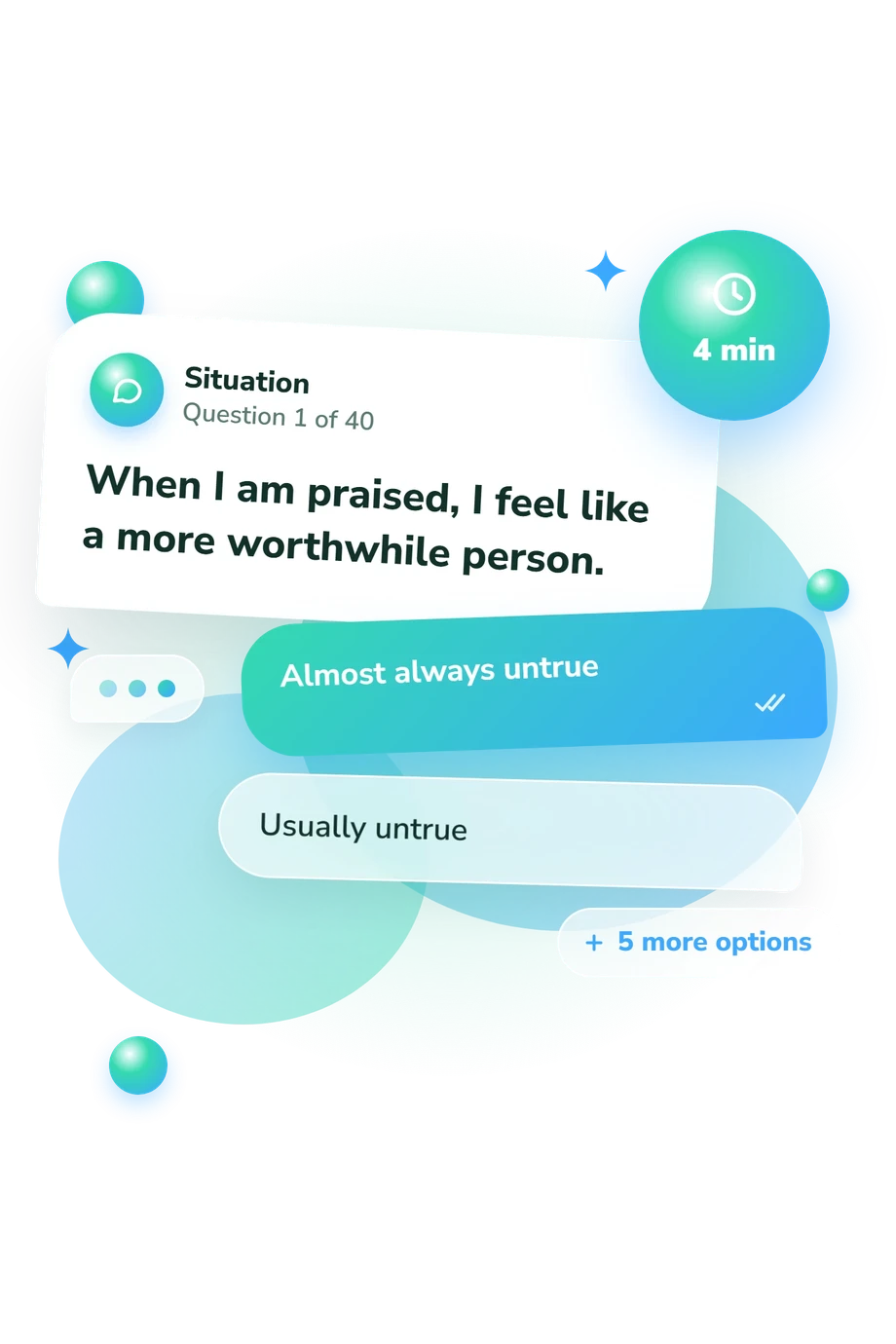
Example Questions From the Test
- Almost always untrue
- Usually untrue
- More often untrue than true
- True and untrue equally often
- More often true than untrue
- Usually true
- Almost always true
- Almost always untrue
- Usually untrue
- More often untrue than true
- True and untrue equally often
- More often true than untrue
- Usually true
- Almost always true
- Almost always untrue
- Usually untrue
- More often untrue than true
- Equally true and untrue
- More often true than untrue
- Usually true
- Almost always true
Unconditional Self-Acceptance Questionnaire (USAQ) Test - Description and methodology of the test
People who are unsure whether their sense of worth is an enduring personal stance or a response to changing circumstances may use the Unconditional Self-Acceptance Questionnaire (USAQ) Test to organize that pattern. As a self-acceptance questionnaire, it offers a structured way to examine the principles behind self-evaluation and identify areas for personal reflection. The result gives that pattern a clear starting point for closer self-understanding.
What This Assessment Explores
At its core, the questionnaire asks whether a person can regard themselves as worthwhile without making that judgment depend on performance, approval, or comparison. It also considers whether criticism is treated as information or as evidence of personal defect. The unconditional self-acceptance test therefore suits reflection on self-criticism, conditional confidence, and setbacks.
The questions group into four themes:
- Setbacks reveal whether failures or missed goals change self-worth.
- Approval and achievement show how praise, love, or success supports value.
- Comparison reveals whether other people’s performance ranks the respondent’s worth.
- Feedback shows whether criticism can be considered without triggering self-condemnation.
One scale is reported: Unconditional Self-Acceptance, 0-100, with Low 0-39, Moderate 40-69, and High 70-100. Higher scores indicate steadier self-acceptance; lower scores suggest stronger dependence on external conditions.
Methodology and Evidence Base
Each item uses a seven-point response scale, from “Almost always untrue” to “Almost always true,” with a midpoint for mixed experience. The statements focus on praise, failure, goals, comparison, approval, and criticism, so respondents rate patterns in their reactions rather than one isolated event.
The construct fits rational-emotive and cognitive-behavioral thinking, which separates a person’s inherent worth from performance and other evaluations. The online questionnaire produces one displayed scale, but its exact item weighting and any reverse-scoring rule are not stated.
Conceptually, the USAQ questionnaire is consistent with USAQ (Chamberlain & Haaga, 2001), including their work on psychological health and responses to negative feedback. Popov and Sokić’s (2022) Serbian translation and short-form study provides related psychometric evidence, but does not prove that this online version shares its wording, norms, or validation. It should therefore be treated as a digital self-reflection version, not assumed to be a direct reproduction or validated adaptation of the published instrument.
Because the online score has no stated population norms, interpretation should account for current mood, self-awareness, and socially desirable responding; it cannot establish a diagnosis or explain the whole person.
- Chamberlain, John M., & Haaga, David A. F. (2001). Unconditional Self-Acceptance and Psychological Health. Journal of Rational-Emotive & Cognitive-Behavior Therapy, 19(3), 163-176. 10.1023/A:1011189416600
- Chamberlain, John M., & Haaga, David A. F. (2001). Unconditional Self-Acceptance and Responses to Negative Feedback. Journal of Rational-Emotive & Cognitive-Behavior Therapy, 19(3), 177-189. 10.1023/A:1011141500670
- Popov, Stanislava, & Sokić, Jelena. (2022). Psychometric Characteristics of a Serbian Translation of the Unconditional Self-Acceptance Questionnaire and the Development of a Short Form. Psihologija, 55(1), 107-122. 10.2298/PSI200820005P
Updated: