
First-Grade School Adaptation Assessment Test
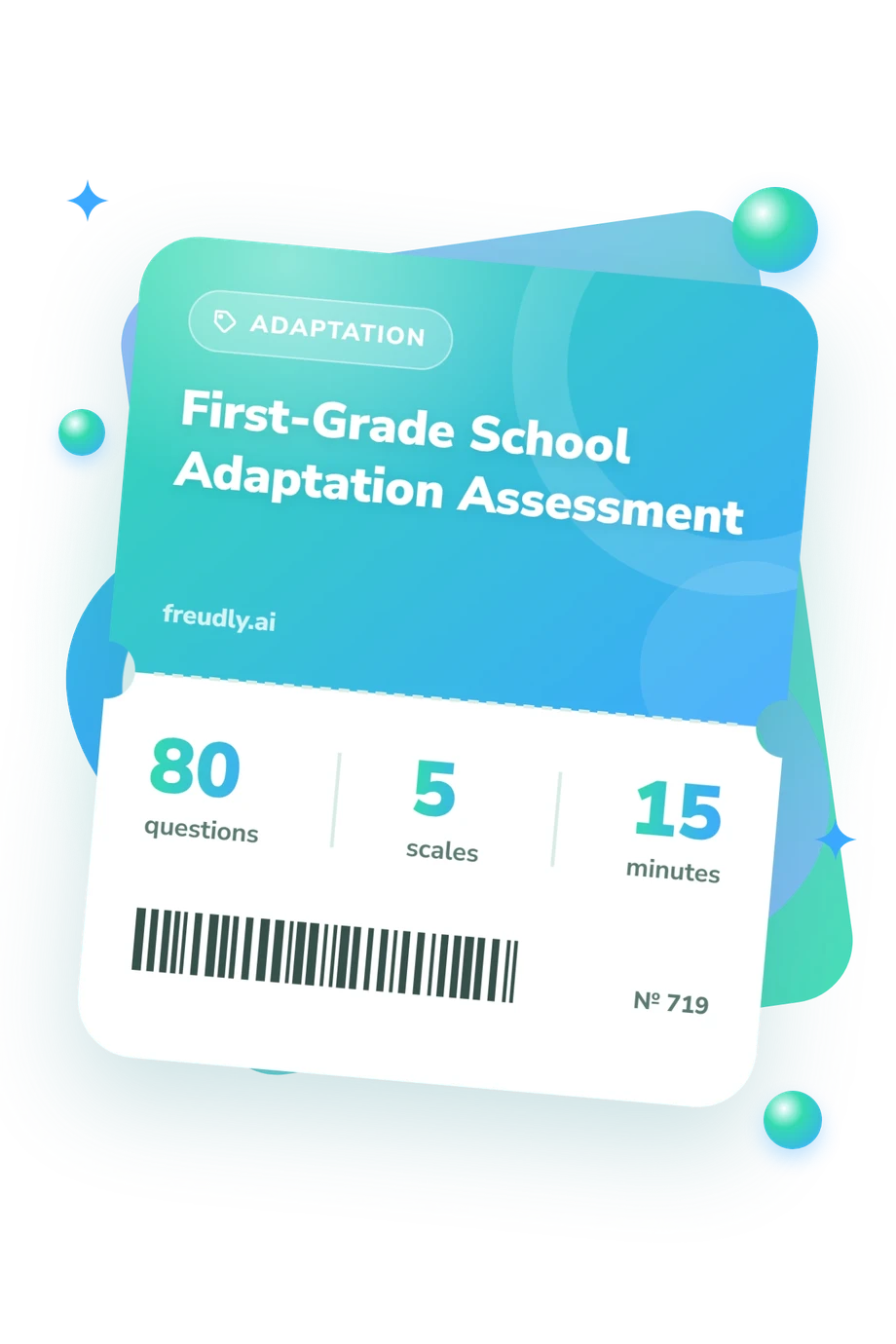
How the Scales are Structured
Who Usually Takes This Test?
See How You Compare
Below is a preview of how scores are typically distributed across each scale.
Example Questions From the Test
- Yes
- No
- Yes
- No
- Yes
- No
First-Grade School Adaptation Assessment Test - Description and methodology of the test
Parents, teachers, and school psychologists can use this assessment to examine how a child is responding to the demands of first grade, especially when classroom behavior, learning, or wellbeing has changed. The First-Grade School Adaptation Assessment Test produces four domain results plus an overall Maladaptation Index; higher index scores represent more pronounced adaptation difficulties. The questionnaire's first-grade adaptation assessment can guide closer conversations and practical support.
What This Assessment Measures
It covers emotional, physical, social, and classroom signs of strain. Higher domain scores generally indicate more difficulty within that area. It is useful when considering first-grade school adjustment across settings. The displayed scales are:
- Psychological Domain (0-100) reflects emotional state, self-esteem, and anxiety: Low strain 0-33; Moderate strain 34-66; High strain 67-100.
- Psychophysiological Domain (0-100) reflects physical wellbeing and fatigue: Low strain 0-15; Moderate strain 16-45; High strain 46-100.
- Social Domain (0-100) reflects peer interaction and group integration: Good integration 0-33; Some difficulties 34-66; Marked difficulties 67-100.
- Academic Domain (0-100) reflects learning activity and teacher relationships: Good adaptation 0-33; Moderate difficulties 34-66; Marked difficulties 67-100.
- Maladaptation Index (0-100) reflects overall adaptation difficulty: Low difficulties 0-15; Moderate difficulties 16-45; High difficulties 46-100.
Methodology and Evidence Base
The representative items use brief statements answered Yes or No. In that sample, the themes include emotional reactions, physical complaints, fatigue, attention, learning, teacher contact, and peer behavior. As a school adjustment test, it is useful for reviewing recurring patterns rather than isolated moments.
Responses are combined into the displayed scales. Because the ranges do not specify how each answer is weighted, no extra point-by-point scoring rule should be inferred.
The themes are conceptually consistent with MOSHAP as described in Badyina’s published work on school adaptation, but this online questionnaire is not presented as a direct adaptation of that instrument. Its displayed ranges provide result bands, while no standardized norms are stated for this version.
Reliability estimates and diagnostic cutoffs are not stated for this version. Read the profile with teacher observations, health information, family context, and the child’s experience. Current stress, adult expectations, and limited self-awareness can shape Yes/No responses, so a high score marks an area for attention rather than a diagnosis.
- Kovaleva, L. M., and Tarasenko, N. N. (1996). Psychological Analysis of the Characteristics of First-Graders’ Adaptation to School. Primary School, no. 7, pp. 17-22.
- Badyina, N. P. (2007). Frequently Ill Children: Psychological Support in Primary School. Moscow: Genesis.
- Kazakova, E. V., and Sokolova, L. V. (2019). Influence of Adverse Socioeconomic Factors on the School Adaptation of First-Graders. Psychological Science and Education, 24(2), 59-71. 10.17759/pse.2019240206
Updated: