
General Decision-Making Style Inventory (GDMS) Test
How the Scales are Structured
Who Usually Takes This Test?
See How You Compare
Below is a preview of how scores are typically distributed across each scale.
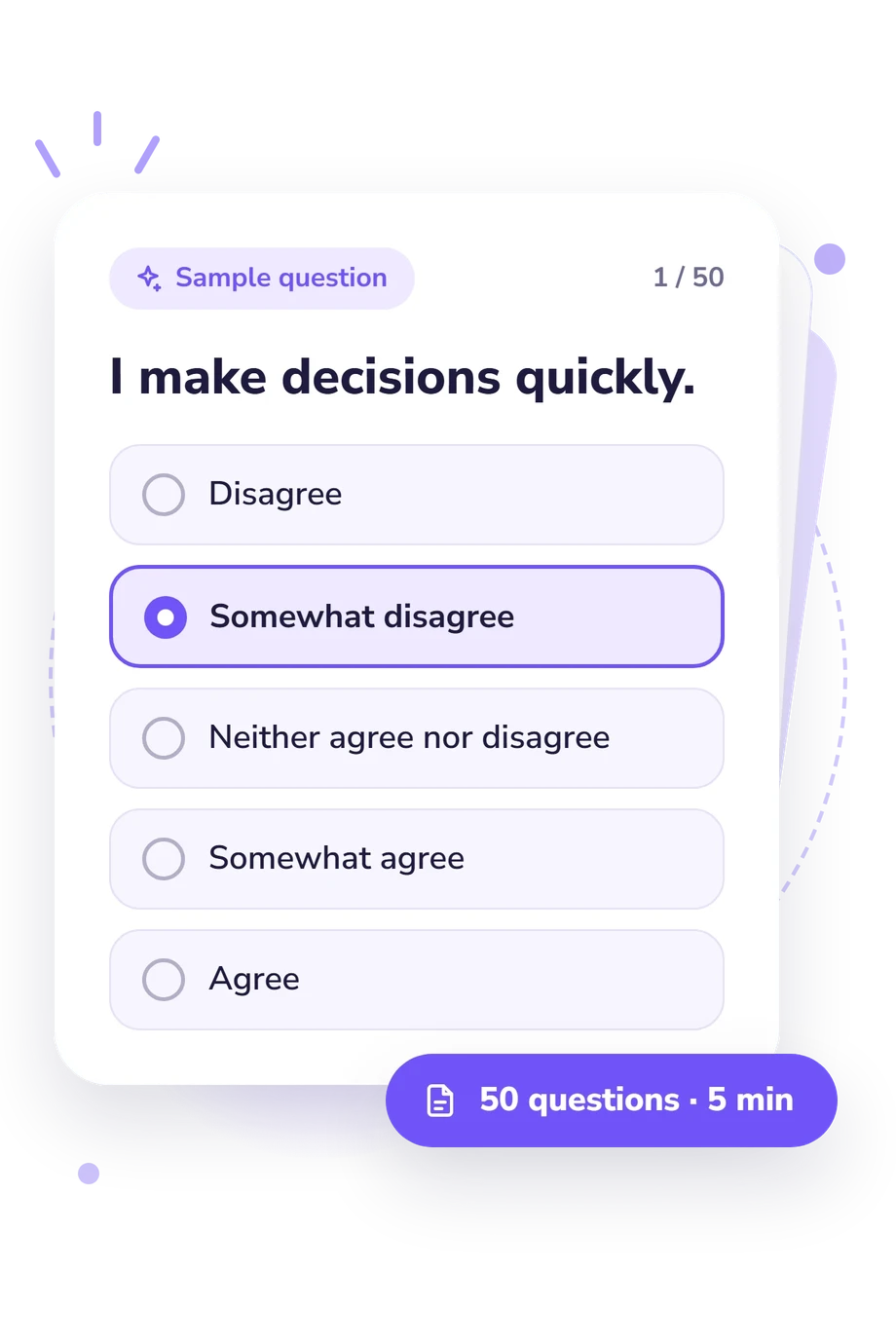
Example Questions From the Test
- Disagree
- Somewhat disagree
- Neither agree nor disagree
- Somewhat agree
- Agree
- Disagree
- Somewhat disagree
- Neither agree nor disagree
- Somewhat agree
- Agree
- Disagree
- Somewhat disagree
- Neither agree nor disagree
- Somewhat agree
- Agree
General Decision-Making Style Inventory (GDMS) Test - Description and methodology of the test
People who want to understand how they approach everyday choices can use the General Decision-Making Style Inventory (GDMS) Test as a structured self-reflection tool. This decision-making style assessment focuses on the habits that appear when choices require speed, information, confidence, or outside input. Results help you notice a preferred pattern without reducing every decision to a single fixed personality label.
What This Assessment Explores
Across this GDMS questionnaire, the profile describes tendencies, not fixed abilities. It suits readers reflecting on planning, speed, uncertainty, inner feelings, and advice from others. A higher result indicates a stronger expression of a style in this questionnaire, not that the style is preferable in every situation.
The five displayed dimensions are:
- Spontaneous (4-20) measures quick, in-the-moment choices; bands are Deliberate (4-9), Balanced pace (10-14), and Impulsive (15-20).
- Avoidant (5-25) measures postponing or avoiding choices; bands are Low (5-11), Moderate (12-18), and High (19-25).
- Dependent (5-25) measures reliance on advice; bands are Independent (5-11), Balanced (12-18), and Highly Dependent (19-25).
- Intuitive (6-30) measures trust in feelings; bands are Low intuitive (6-13), Moderate intuitive (14-22), and High intuitive (23-30).
- Rational (5-25) measures careful information use; bands are Less rational (5-12), Moderately rational (13-19), and Highly rational (20-25).
Methodology and Scientific Basis
Each statement uses a five-point agreement scale from Disagree to Agree. The items cover information checking, timing, worry, intuition, logic, and consultation. The questionnaire reports separate scores for the five styles, and the displayed bands provide a descriptive reading of each result; each band locates the tendency within its dimension.
Methodologically, this decision-making styles test uses the five-style framework associated with General Decision-Making Style (Scott & Bruce, 1995). Loo (2000) evaluated the inventory’s psychometric properties, while Spicer and Sadler-Smith (2005) examined its use in two UK samples. Neither study establishes norms for this online version.
Interpretation is strongest when the profile is read as a combination of tendencies: a person may check facts carefully yet trust a feeling, or seek advice while retaining responsibility for the final choice. The online questionnaire adapts the 25-item General Decision-Making Style Inventory of Scott and Bruce (1995), rather than reproducing its original research administration. Self-report can be shaped by current stress, memory, self-awareness, and impression management. Use the result to guide reflection, not as a clinical assessment or a forecast of one correct decision.
- Scott, S. G., & Bruce, R. A. (1995). Decision-Making Style: The Development and Assessment of a New Measure. Educational and Psychological Measurement, 55(5), 818–831. 10.1177/0013164495055005017
- Loo, R. (2000). A Psychometric Evaluation of the General Decision-Making Style Inventory. Personality and Individual Differences, 29(5), 895–905. 10.1016/S0191-8869(99)00241-X
- Spicer, D. P., & Sadler-Smith, E. (2005). An Examination of the General Decision Making Style Questionnaire in Two UK Samples. Journal of Managerial Psychology, 20(2), 137–149. 10.1108/02683940510579777
Updated: