
Motives for Sports Activity Test
How the Scales are Structured
Who Usually Takes This Test?
See How You Compare
Below is a preview of how scores are typically distributed across each scale.
Example Questions From the Test
- Very often
- Often
- Sometimes
- Very rarely
- Very often
- Often
- Sometimes
- Very rarely
- Very often
- Often
- Sometimes
- Very rarely
Motives for Sports Activity Test - Description and methodology of the test
People who want to understand why they train, compete, improve, or remain involved in physical activity can use this assessment as a structured self-reflection tool. The Motives for Sports Activity Test focuses on the personal forces behind participation rather than performance alone. As a sports motivation assessment, it can help athletes, coaches, and recreational participants notice patterns that shape commitment and training choices.
What This Assessment Explores
Sport can offer challenge, pleasure, learning, recognition, or connection. The items address goal pursuit, persistence, movement mastery, training curiosity, competition, anger, pride, rewards, and team relationships. Together, they indicate which reasons most strongly accompany the respondent’s involvement.
This athletic motivation questionnaire suits athletes and recreational participants seeking a clearer view of what sustains effort. Enjoyment, ambition, belonging, and recognition can operate together.
These are illustrative themes, not separate scored dimensions; other motivational factors may also shape the broad result:
- Achievement and mastery show the pull of progress, goals, and skill improvement.
- Enjoyment and engagement show whether pleasure sustains participation.
- Competition and excitement show the appeal of challenge and victory.
- Team connection, recognition, and rewards show how belonging, praise, and accomplishment matter.
The Motives for Sports Activity scale runs 0-100: Low motivation (0-39), Moderate motivation (40-69), High motivation (70-100).
Methodology and Scientific Basis
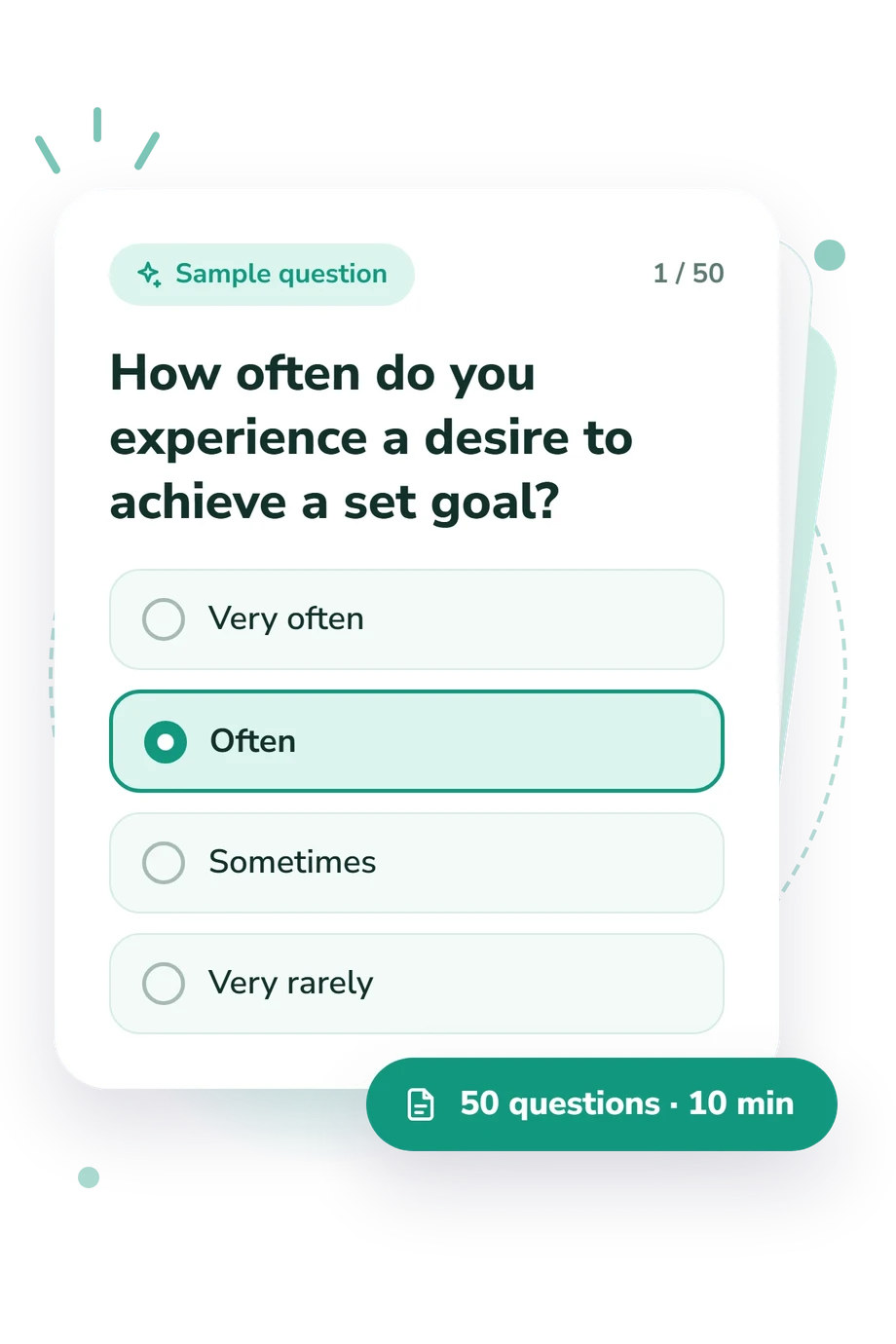
Items ask how often a motive or experience occurs, with four options: Very often, Often, Sometimes, and Very rarely. They cover achievement, improvement, pride, anger, enjoyment, competition, and team relationships, capturing frequency rather than a reason for participation.
Scoring presents one overall result rather than separate theme scores, and the questionnaire's scoring is not documented as a standardized method. Interpret the displayed result as a broad summary, without inferring an unstated point-allocation rule.
The Sports Activity Motivation Questionnaire (Kalinin, 1962) offers a conceptual comparison for themes in this online questionnaire, while remaining a distinct published instrument. Deci and Ryan’s self-determination framework offers another useful lens: enjoyment, mastery, connection, and external rewards can coexist, without turning this single result into formal theory-based scales.
For training conversations, the overall result can connect stated motives with goals, routines, support needs, and practical ways to organize future practice and review progress. As a measure of motivation for sports, it suits reflection and training conversations. Self-report can be affected by mood, recent performance, social desirability, and self-awareness, so interpret results alongside behavior and changing goals.
- Kalinin, E. A. (1962). Sports Activity Motivation Questionnaire. Moscow: All-Union Scientific Research Institute of Physical Culture, 15 pp.
- Krasmik, Y., Aimaganbetova, O., Iancheva, T., Zhantikeyev, S., Lashkova, E., Makhmutov, A., and Rakhmalin, B. (2024). Motivational determinants of athletes’ self-realisation depending on their professional qualification. BMC Psychology, 12, 416. 10.1186/s40359-024-01895-3
- Deci, E. L., and Ryan, R. M. (1985). Intrinsic Motivation and Self-Determination in Human Behavior. New York: Plenum Press.
Updated: