
Synesthesia Assessment Test
How the Scales are Structured
Who Usually Takes This Test?
See How You Compare
Below is a preview of how scores are typically distributed across each scale.
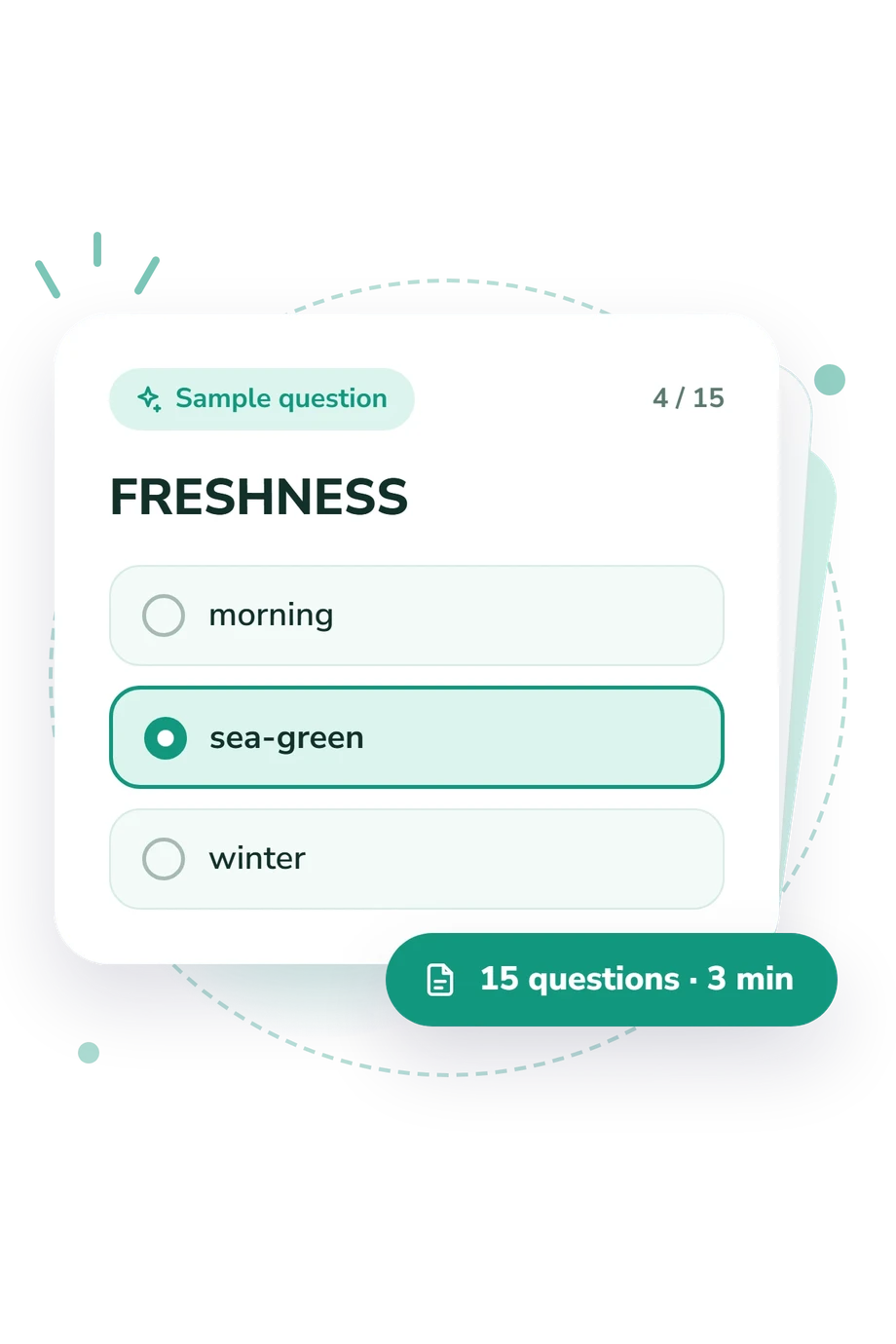
Example Questions From the Test
- evening
- distant
- cold
- bitter
- thick
- gray
- unharvested
- silent
- yellow
Synesthesia Assessment Test - Description and methodology of the test
People curious about unusual links between the senses can use the Synesthesia Assessment Test to consider whether sounds, words, smells, colors, tastes, or movements evoke one another. This synesthesia test suits readers seeking a structured snapshot of associative perception, not factual knowledge. The result highlights the sensory channels most prominent in the responses, giving language to personal experience.
What This Assessment Explores
These prompts test whether one kind of input evokes another modality, rather than factual knowledge. The profile shows where associations cluster. As a sensory association test, this questionnaire describes the recurring cross-modal patterns reflected in the answers. It covers:
- Gustatory (0-3) reflects taste triggered by other stimuli; Low 0-1, High 2-3.
- Olfactory (0-3) reflects odors triggered by other stimuli; Low 0-1, Moderate 2-2, High 3-3.
- Kinesthetic (0-3) reflects bodily or movement sensations linked to stimuli; Low 0-1, High 2-3.
- Auditory (0-3) reflects auditory imagery linked to other senses; Low 0-1, Moderate 2-2, High 3-3.
- Visual (0-3) reflects visual imagery elicited by stimuli; Low 0-1, High 2-3.
- Synesthesia Sensitivity (0-15) reflects overall synesthetic tendency; Low 0-5, Moderate 6-10, High 11-15.
Together, the profile distinguishes particular channels from broader cross-modal sensitivity.
Methodology and Scientific Basis
Methodologically, the items use compact forced choices. A cue may be a word, scene, color, smell, or sensory image, followed by descriptors; the respondent selects the option that best matches the experience. This format records associations through recognition rather than a written explanation.
The questionnaire reports component results alongside an overall Synesthesia Sensitivity result. The conversion of answer choices into points and the derivation of the overall result are not specified; displayed ranges do not establish a scoring rule. The displayed bands describe this synesthesia assessment’s profile and should not be treated as population norms or clinical thresholds.
The framework is traceable first to Lobanov's Synesthesia Method (1999), a methodological reference for cross-modal associations. The questionnaire is conceptually consistent with Cytowic's account and with Eagleman and colleagues' standardized battery from 2007, but it is not presented as an adaptation of either instrument. Carmichael and colleagues' 2015 study supports that battery's reliability, not this online questionnaire.
Interpret results as a self-report snapshot. Attention, memory, language, context, and willingness to notice associations can shape responses, so the profile is best treated as reflection rather than a conclusion.
- Lobanov, A. P. (1999). Synesthesia methodology. In S. I. Kopteva and A. P. Lobanov, Know Yourself: Current Problems of Psychology of Self-Consciousness. Minsk: Belarusian State Pedagogical University.
- Cytowic, R. E. (2002). Synesthesia: A Union of the Senses (2nd ed.). Cambridge, MA: The MIT Press.
- Eagleman, D. M., Kagan, A. D., Nelson, S. S., Sagaram, D., and Sarma, A. K. (2007). A standardized test battery for the study of synesthesia. Journal of Neuroscience Methods, 159(1), 139-145. 10.1016/j.jneumeth.2006.07.012
- Carmichael, D. A., Down, M. P., Shillcock, R. C., Eagleman, D. M., and Simner, J. (2015). Validating a standardised test battery for synesthesia: Does the Synesthesia Battery reliably detect synesthesia? Consciousness and Cognition, 33, 375-385. 10.1016/j.concog.2015.02.001
Updated: