
Preferred Work Goal Questionnaire Test
How the Scales are Structured
Who Usually Takes This Test?
See How You Compare
Below is a preview of how scores are typically distributed across each scale.
Example Questions From the Test
- To identify faults or malfunctions in technical systems.
- To work with materials (metal, wood, plastic, etc.).
- Set up and calibrate electronic equipment.
- Design new types of machines and mechanisms.
- Enter numeric and text information on a computer.
- Develop new mathematical constructs or mathematical theories.
Preferred Work Goal Questionnaire Test - Description and methodology of the test
People deciding which kinds of work feel engaging may use the Preferred Work Goal Questionnaire Test to examine the motives behind their choices. The questions help compare preferred work activities across science, technology, arts, mathematics, and human behavior, rather than assigning a personality label. Its result organizes these preferences into three complementary directions for practical decision-making.
What This Assessment Explores
The questionnaire examines whether work choices lean toward creating, changing, or understanding. Its paired activities span science, technology, arts, mathematics, and human behavior, so the profile describes task orientations rather than a job title.
These dimensions organize the profile:
- Exploratory (0-10) measures attraction to invention and original solutions; Low exploratory drive (0-3), Moderate exploratory drive (4-7), and High exploratory drive (8-10) mark the displayed levels.
- Transformative (0-10) measures a wish to improve or reshape objects, processes, relationships, or living systems; Low (0-3), Moderate (4-7), and High (8-10) mark the displayed levels.
- Gnostic (0-10) measures interest in analyzing and evaluating phenomena, products, or behavior; Low (0-3), Moderate (4-7), and High (8-10) mark the displayed levels.
For someone comparing occupations, the profile functions as a work preference assessment rather than a measure of ability.
Categories describe catalogue-defined work-goal orientations, while the pattern can support career self-reflection.
Methodology and Evidence Base
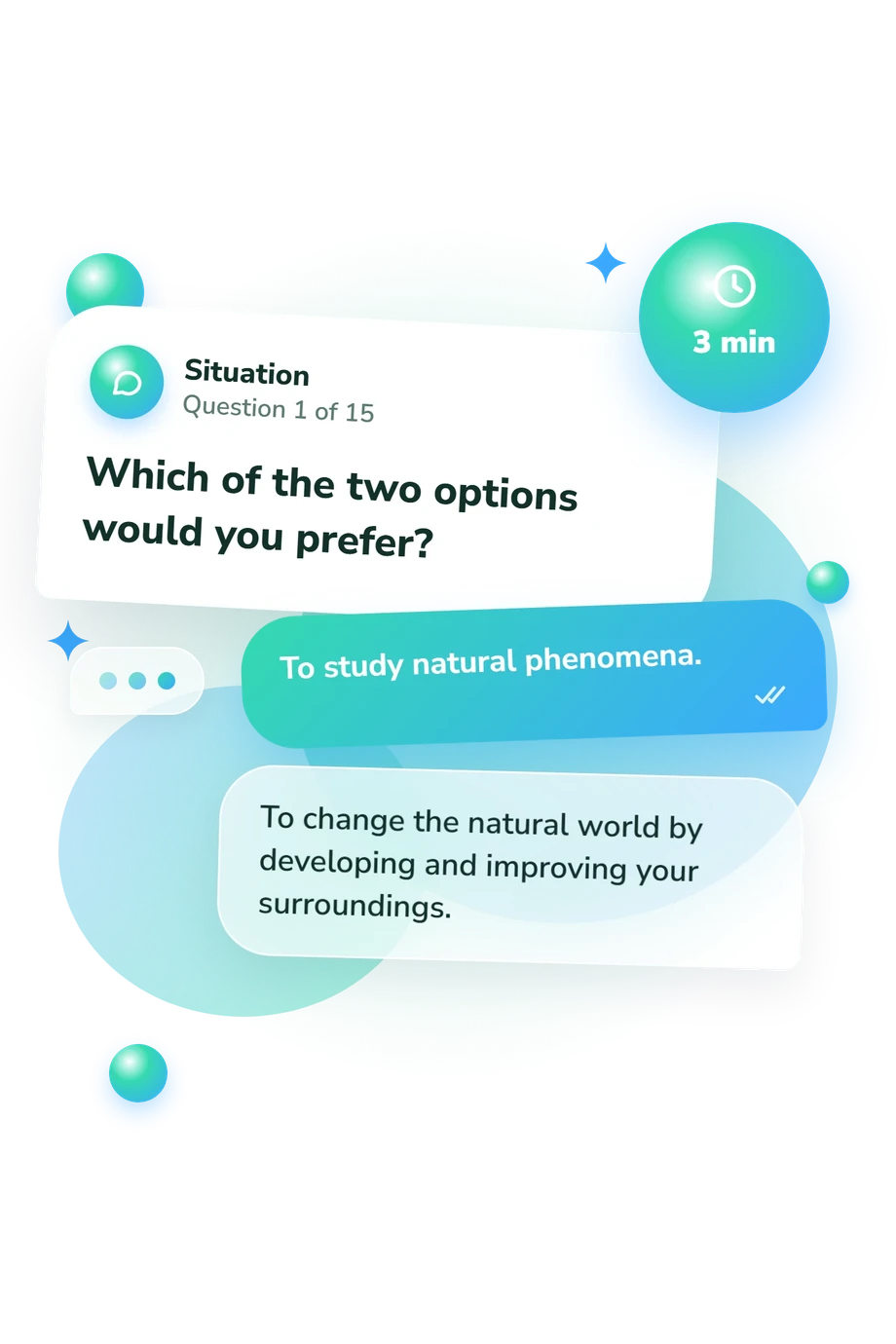
Each item uses a forced-choice format: two activities appear together, and the respondent selects the more appealing option. Contrasts include creating versus analyzing, improving versus assembling, and interpreting people or culture versus influencing or designing them. The format captures preference direction, not skill or performance.
The result of this work goal questionnaire is displayed across the three listed scales as a profile of work-goal orientations; the displayed ranges describe result categories rather than occupational qualification.
The questionnaire is conceptually consistent with Klimov's classification of the three main goals of labor, and is not presented as an adaptation or validation of that framework. Polyakova discusses related labor motives, and Ratanova, Zolotareva, and Shlyakhta place forced-choice methods within practical psychodiagnostics. Locke and Latham add context about how desired outcomes can shape effort, but their work does not validate this online questionnaire.
This online questionnaire is a structured self-report profile of stated work preferences. Answers may shift with current circumstances, familiarity, social desirability, and self-knowledge. Interpretation is strongest alongside abilities, experience, and concrete occupational information.
- Polyakova, O.B. (2004). Psychology of Labor: Teaching and Methodological Manual. Part I: Fundamentals of Labor Psychology. Moscow: Moscow State University of Technology and Management, pp. 48-50.
- Ratanova, T.A., Zolotareva, L.I., and Shlyakhta, N.F. (1997). Methods of Personality Study and Psychodiagnostics. Moscow: Moscow State Open Pedagogical University, pp. 190-192.
- Klimov, E.A. (1990). How to Choose a Profession: A Book for Senior Secondary-School Students. 2nd ed., revised and expanded. Moscow: Prosveshchenie.
- Locke, E.A., and Latham, G.P. (2004). What Should We Do About Motivation Theory? Six Recommendations for the Twenty-First Century. Academy of Management Review, 29(3), 388-403. 10.5465/amr.2004.13670974
Updated: