
Gray-Wilson Personality Questionnaire (GWPQ) Test
How the Scales are Structured
Who Usually Takes This Test?
See How You Compare
Below is a preview of how scores are typically distributed across each scale.
Example Questions From the Test
- Yes
- I don't know
- No
- Yes
- I don't know
- No
- Yes
- I don't know
- No
Gray-Wilson Personality Questionnaire (GWPQ) Test - Description and methodology of the test
People who want to understand their motivational reactions can use the Gray-Wilson personality test to reflect on how they pursue rewards, respond to provocation, and react to possible punishment or non-reward. The Gray-Wilson Personality Questionnaire (GWPQ) Test offers a focused profile of approach, fight-related reactivity, and inhibition, allowing the three dimensions to be read together as a motivational profile linked to everyday choices.
What This Assessment Explores
Items address pleasure, habits, risk, anger, criticism, social pressure, pain, and threat. The GWPQ questionnaire groups these situations into approach toward rewards, forceful or disinhibited reactions, and sensitivity to punishment or non-reward. Results describe tendencies that may shape everyday choices and emotionally charged situations, rather than every aspect of personality.
The three displayed dimensions are:
- BAS Approach (0-24) measures impulsivity, reward seeking, and pleasure pursuit; higher scores may relate to poorer regulation, neuroticism, and trait anxiety. Low 0-8; Moderate 9-16; High 17-24.
- SAPS Fight (0-24) measures hostility, disinhibition, and disregard for social norms; higher scores may relate to psychoticism features and problematic behavior. Low 0-8; Moderate 9-16; High 17-24.
- Behavioral Inhibition System (BIS) (0-24) measures sensitivity to punishment and non-reward, associated with avoidance and anxiety. Low inhibition 0-8; Moderate inhibition 9-16; High inhibition 17-24.
Methodology and Evidence Base
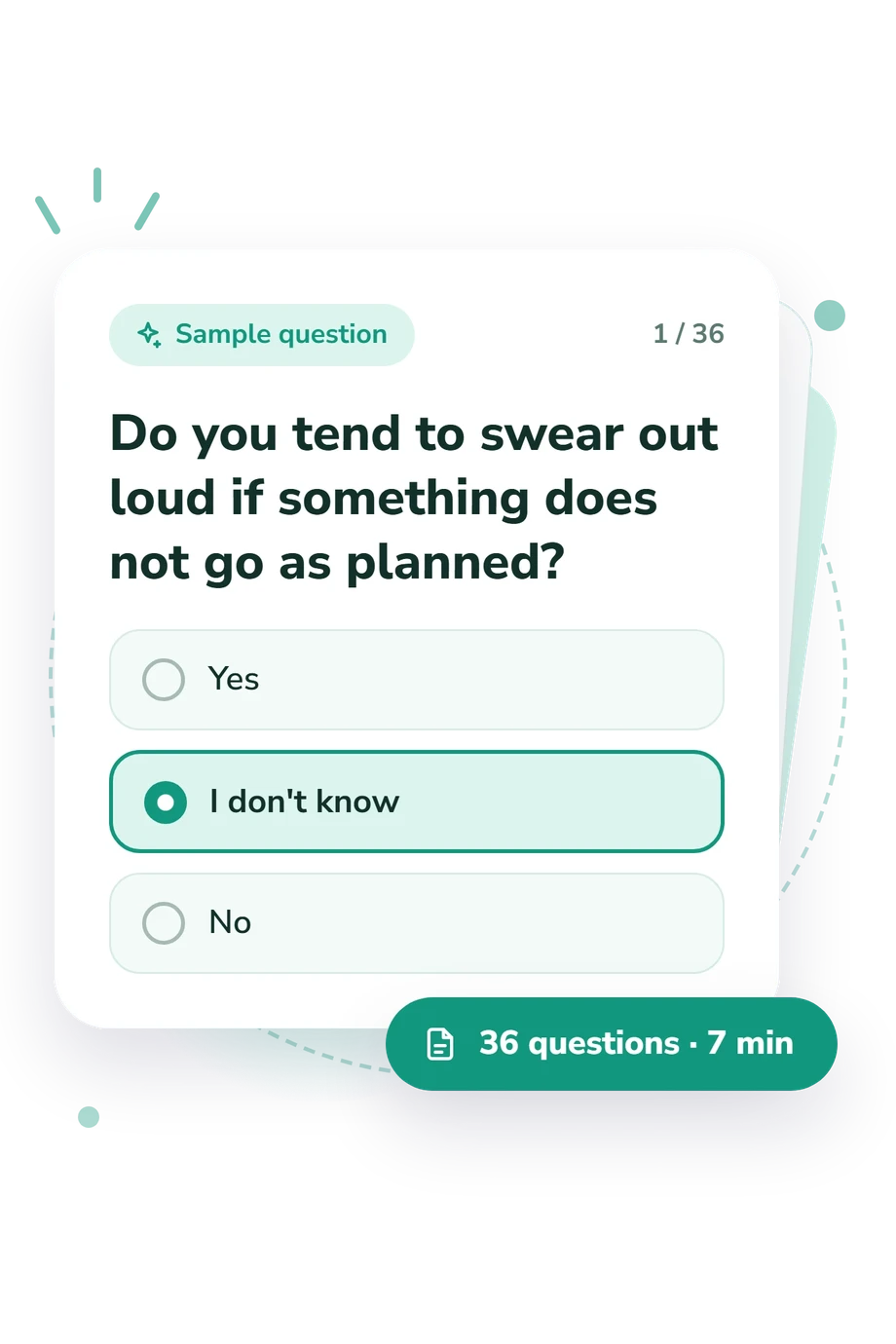
Responses are self-report judgments about concrete or imagined situations. Each item uses Yes, I don't know, or No; some screens show these as 1, 2, and 3. The middle option allows uncertainty instead of forcing a binary answer.
Results are reported separately for the displayed dimensions and interpreted through the shown bands. The score ranges alone do not reveal how individual responses are weighted, so an item-by-item scoring formula cannot be inferred.
The Gray-Wilson questionnaire is conceptually consistent with the published GWPQ (Wilson et al., 1989), a measure associated with Gray's reinforcement-sensitivity theory; the cited studies do not establish norms or standardization for this online form. Wilson, Gray, and Barrett (1990) examined its factor structure; Knyazev, Slobodskaya, and Wilson (2004) compared its construct validity with BIS/BAS scales. Smillie, Pickering, and Jackson (2006) discuss implications of newer reinforcement-sensitivity theory for measurement.
Mood, recent events, self-awareness, and socially desirable responding can affect answers, so treat the profile as context-sensitive self-reflection about motivational tendencies, not a diagnosis or complete account of behavior.
- Wilson, G. D., Barrett, P. T., & Gray, J. A. (1989). Human reactions to reward and punishment: A questionnaire examination of Gray's personality theory. British Journal of Psychology, 80(4), 509-515. 10.1111/j.2044-8295.1989.tb02339.x
- Knyazev, G. G., Slobodskaya, H. R., & Wilson, G. D. (2004). Comparison of the construct validity of the Gray-Wilson Personality Questionnaire and the BIS/BAS scales. Personality and Individual Differences, 37(8), 1565-1582. 10.1016/j.paid.2004.02.013
- Wilson, G. D., Gray, J. A., & Barrett, P. T. (1990). A factor analysis of the Gray-Wilson personality questionnaire. Personality and Individual Differences, 11(10), 1037-1044. 10.1016/0191-8869(90)90131-A
- Smillie, L. D., Pickering, A. D., & Jackson, C. J. (2006). The new reinforcement sensitivity theory: Implications for personality measurement. Personality and Social Psychology Review, 10(4), 320-335. 10.1207/s15327957pspr1004_3
Updated: