
Moral Readiness for Marriage Scale Test
How the Scales are Structured
Who Usually Takes This Test?
See How You Compare
Below is a preview of how scores are typically distributed across each scale.
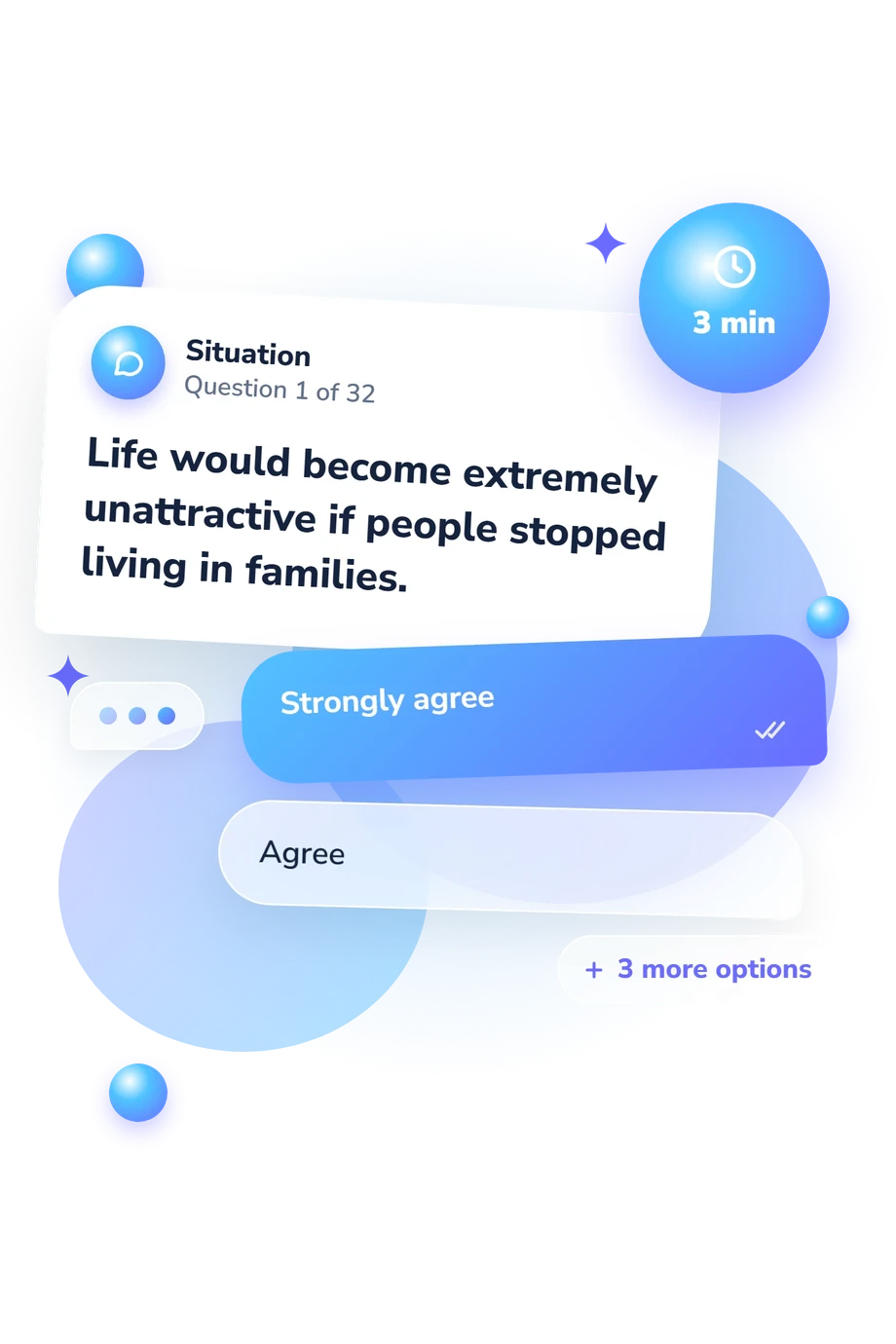
Example Questions From the Test
- Completely agree
- Agree
- Hard to say whether I agree or not
- Disagree
- Strongly disagree
- Fully agree
- Agree
- Hard to say whether I agree or not
- Disagree
- Completely disagree
- Completely agree
- Agree
- Not sure whether I agree or disagree
- Disagree
- Completely disagree
Moral Readiness for Marriage Scale Test - Description and methodology of the test
For people examining their attitudes toward commitment and family responsibility, the Moral Readiness for Marriage Scale Test offers a structured way to consider how they approach the expectations of married life. It may help prospective partners and other adults reflecting on relationships identify strengths, uncertainties, and topics worth discussing. Used as a marriage readiness test, it offers a starting point for self-reflection rather than a prediction of relationship success.
What This Assessment Explores
This assessment suits readers examining whether their attitudes and interpersonal habits fit family-life responsibilities. It focuses on moral readiness: awareness, responsibility, understanding of family values, and attitudes toward mutual adjustment and disagreement.
People using a readiness for marriage questionnaire can read the items through four themes, not as separate displayed scales:
- Family values: this theme shows whether family life is viewed as meaningful and worth sustaining.
- Responsibility: it reflects the importance given to commitments and accountability.
- Relational conduct: it captures tact, empathy, and attention to a partner’s feelings.
- Flexibility and conflict: it reflects expectations about resolving disagreements and changing habits.
The overall result places Moral Readiness for Marriage on a 0-100 scale: Low readiness (0-50), Moderate readiness (51-80), and High readiness (81-100). Average results suggest basic concepts and attitudes for harmonious family relationships; high results indicate a well-formed moral stance, while low results indicate insufficient readiness for family life.
Methodology and Evidence Base
Each statement uses a five-point agreement format, from strong agreement to strong disagreement, with a middle option for uncertainty. Items address partners, parents, commitments, conflict, tact, sexual conduct, and personal change, creating a self-report profile rather than an interview or observation.
Responses are combined into the displayed overall result. Because no item-by-item weighting rule is stated, points should not be inferred from the scale range alone; interpretation should use the stated readiness bands, not a self-created formula.
Family-life themes in Pogodina’s textbook are conceptually consistent with the questionnaire’s attention to values, responsibility, interpersonal conduct, and self-development; the online test is not presented as an adaptation of that book. A later study by Mannanova and Nikitina on psychological readiness for marriage describes a related multidimensional construct, but this questionnaire is not their validated instrument or direct adaptation.
This online self-reflection tool presents a displayed score, but its standardization procedure is not stated. Circumstances, social desirability, and self-awareness can shape answers, so the result helps organize reflection and topics for discussion.
- Pogodina, E. K. (2003). Fundamentals of Family Life: A Textbook. Vitebsk: Vitebsk State University named after P. M. Masherov, 94 pp. ISBN 985-425-212-4.
- Mannanova, E. A., & Nikitina, A. A. (2025). Psychological readiness for marriage of boys and girls during their student years. Russian Journal of Education and Psychology, 16(2), 434-451. 10.12731/2658-4034-2025-16-2-744
Updated: