
Autonomy-Dependence Questionnaire Test
How the Scales are Structured
Who Usually Takes This Test?
See How You Compare
Below is a preview of how scores are typically distributed across each scale.
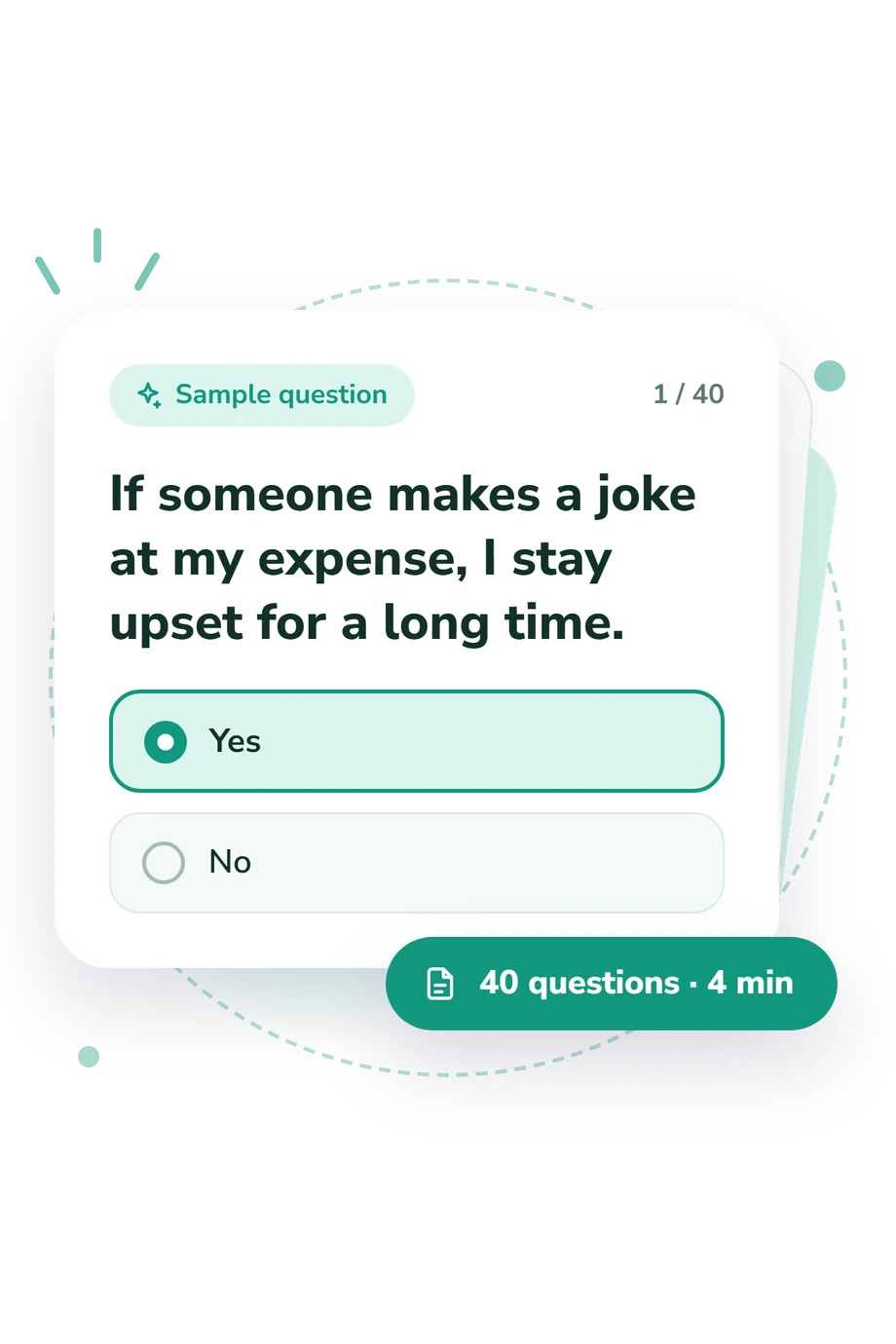
Example Questions From the Test
- Yes
- No
- Yes
- No
- Yes
- No
Autonomy-Dependence Questionnaire Test - Description and methodology of the test
When hesitation, asking for help, or uncertainty about personal judgment gets in the way, this Autonomy-Dependence Questionnaire Test can help you interpret the pattern behind those moments. Used as an autonomy assessment, it indicates whether the result leans toward dependence, a mixed pattern, or autonomy. The profile gives language for reflecting on how you respond to guidance and responsibility.
What This Assessment Explores
The questionnaire examines task initiation, reactions to mistakes and evaluation, and choices between personal judgment and outside direction. Its focus is practical autonomy: confidence in independent action, steadiness when plans change, and willingness to seek help.
For readers treating it as an independence questionnaire, the result uses one Autonomy-Dependence Scale (0-20) to describe reliance on personal decisions versus external guidance. Lower scores indicate dependence, middle scores a mixed type, and higher scores pronounced autonomy, self-control, and self-confidence. The displayed bands are Dependent (0-7), Mixed (8-10), and Autonomous (11-20).
The questions approach this single tendency through three situations:
- Task-starting situations show how readily the respondent begins work without immediate direction.
- Judgment situations indicate how the respondent evaluates ability, mistakes, disagreement, and being wrong.
- Guidance situations capture the tendency to wait, ask for help, or defer.
Methodology and Scientific Basis
Each item uses a direct yes-or-no response and describes a familiar situation involving work, authority, peers, confidence, or persistence. The format is clear, but it compresses nuanced experiences into two choices. Answers are most informative when they reflect the respondent's usual pattern rather than one unusual day.
Item weighting and reversal are not documented, so no more detailed scoring rule can be inferred from the yes-or-no answers. Interpretation should therefore stay at the level of the displayed tendency rather than assume a contribution for each response.
The questionnaire is conceptually consistent with Prygin's work on autonomy and dependence, but it is not presented as a direct reproduction or validation of related publications by Konopkin and Prygin or Burykina and Dorontsova. Deci and Ryan's self-determination framework supplies a broader lens for self-direction and external regulation.
In practical use, this autonomy questionnaire has no stated population norms, reliability coefficients, or diagnostic validation for this online format. Current context, self-awareness, and candor can influence self-report, so the result is best used as structured reflection on tendencies.
- Konopkin, O. A., & Prygin, G. S. (1984). Relationship between students' academic performance and individual-typological characteristics of their self-regulation. Questions of Psychology, no. 3, pp. 42-52.
- Prygin, G. S. (2009). Psychology of Independence: A Monograph. Izhevsk and Naberezhnye Chelny: Institute of Management Press, 408 pp.
- Burykina, M. Y., & Dorontsova, O. A. (2017). Comparative Analysis of Behavior Self-Management and Self-Regulation in Adolescents with Different Levels of Autonomy. Izvestiya of Saratov University. Educational Acmeology. Developmental Psychology, 6(3), 239-243. 10.18500/2304-9790-2017-6-3-239-243
- Deci, E. L., & Ryan, R. M. (2000). The 'What' and 'Why' of Goal Pursuits: Human Needs and the Self-Determination of Behavior. Psychological Inquiry, 11(4), 227-268. 10.1207/S15327965PLI1104_01
Updated: