
Cyberbullying Vulnerability Scale (NCS-13) Test
How the Scales are Structured
Who Usually Takes This Test?
See How You Compare
Below is a preview of how scores are typically distributed across each scale.
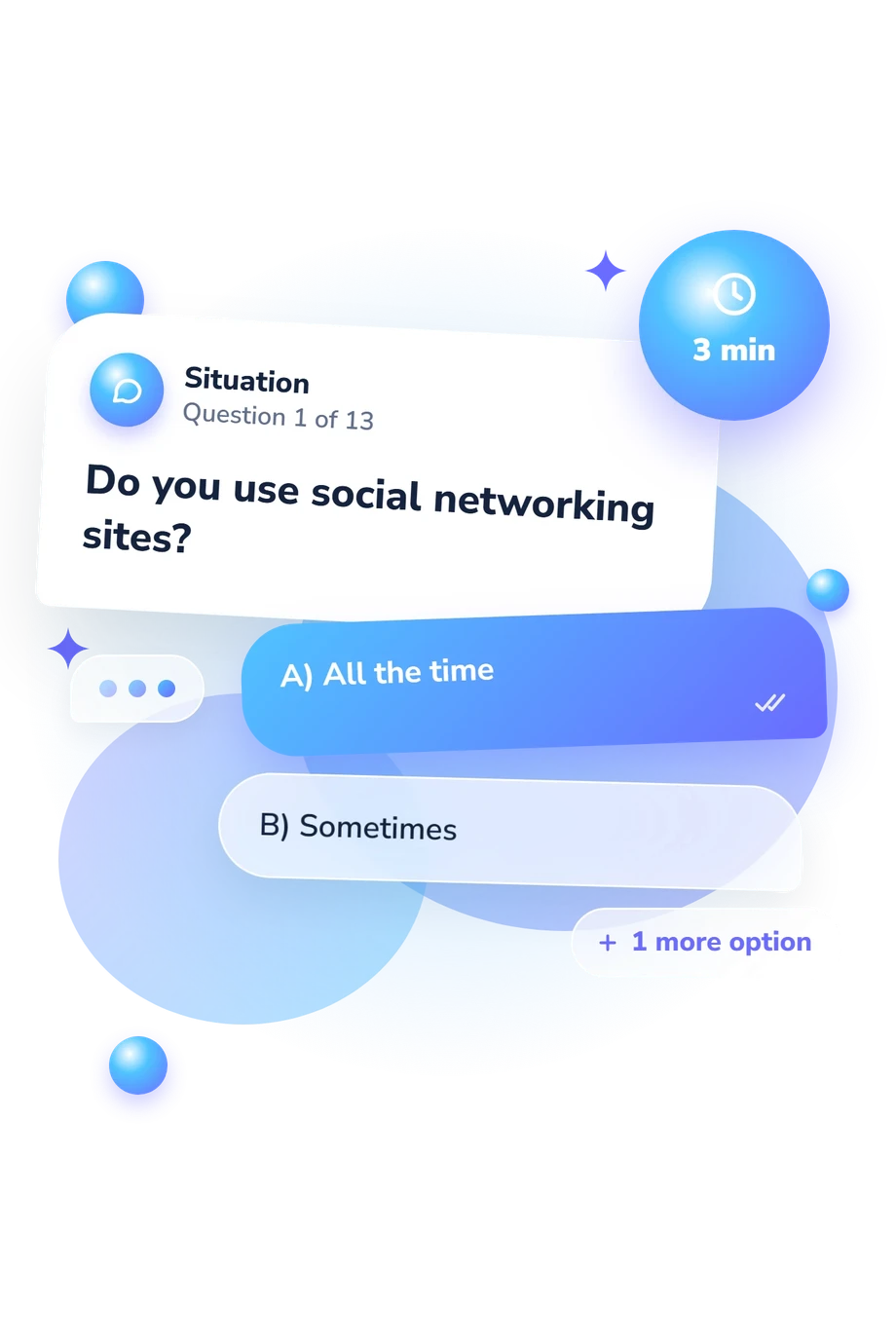
Example Questions From the Test
- A) All the time
- B) Sometimes
- C) No
- A) More than 100
- B) Between 10 and 100
- C) Fewer than 10
- Often
- Sometimes
- Never
Cyberbullying Vulnerability Scale (NCS-13) Test - Description and methodology of the test
For readers concerned about their susceptibility to online aggression or victimization, this Cyberbullying Vulnerability Scale (NCS-13) Test offers one focused self-report result. It functions as an online bullying vulnerability assessment, placing responses about digital experiences and conduct on a single vulnerability scale. The result indicates whether the displayed level is low, moderate, or high.
What This Assessment Explores
This assessment examines vulnerability to aggressive or humiliating behavior across social networks, forums, messaging, and other online settings. It also considers internet involvement, online contacts, reactions to disconnection, negative content, and past bullying experiences.
The result is a single vulnerability level, not a character judgment. The cyberbullying vulnerability test helps readers understand how participation, conduct, and past encounters may relate to exposure to online aggression.
The questions cover four themes, followed by the displayed scale:
- Online involvement describes how frequently a person enters digital social spaces.
- Social exposure covers contact with bullying, harassment, humiliation, or hostile content.
- Digital conduct concerns behavior that may upset or target another person online.
- Emotional and ethical responses address reactions to disconnection and responsibility in digital interactions.
- Cyberbullying Vulnerability (0-26) gives the overall level: Low vulnerability 0-8, Moderate vulnerability 9-17, and High vulnerability 18-26.
Methodology and Evidence Base
Each item offers three response options: some ask about frequency, others about intensity, agreement, or whether an event occurred. Together, the questions cover online habits, social norms, bullying experiences, and the respondent’s digital actions.
The questionnaire produces one combined score, interpreted through the displayed bands; the numerical range alone does not reveal how individual responses contribute. It is a self-reflection measure.
Its closest published reference is the NCS-13 short-version study by Sheinov and Devitsyn in 2023. This questionnaire is conceptually consistent with that study, but is not presented as a direct adaptation. Sheinov’s 2020 source questionnaire study supplies development and preliminary validation context for the underlying questionnaire, not evidence for this online version.
Chen, Ho, and Lwin’s 2017 meta-analysis provides broader context on cyberbullying correlates through a social cognitive and media-effects approach; it does not validate this test. Published questionnaire research therefore contextualizes the construct, while evidence for this online version remains separate.
Responses may shift with memory, current circumstances, willingness to disclose, and self-awareness, so this cyberbullying risk questionnaire offers one focused perspective on digital vulnerability.
- Sheinov, V. P., & Devitsyn, A. S. (2023). Factor Structure of the Short Version of Cyberbullying Vulnerability Assessment Questionnaire. Systems Psychology and Sociology, 1(45), 18-30. 10.25688/2223-6872.2023.45.1.02
- Sheinov, V. P. (2020). Questionnaire on Assessing Individual Vulnerability to Cyberbullying: Development and Preliminary Validation. RUDN Journal of Psychology and Pedagogics, 17(3), 521-541. 10.22363/2313-1683-2020-17-3-521-541
- Chen, L., Ho, S. S., & Lwin, M. O. (2017). A Meta-Analysis of Factors Predicting Cyberbullying Perpetration and Victimization: From the Social Cognitive and Media Effects Approach. New Media & Society, 19(8), 1194-1213. 10.1177/1461444816634037
Updated: