
Jenkins Activity Survey (JAS) Test
How the Scales are Structured
Who Usually Takes This Test?
See How You Compare
Below is a preview of how scores are typically distributed across each scale.
Example Questions From the Test
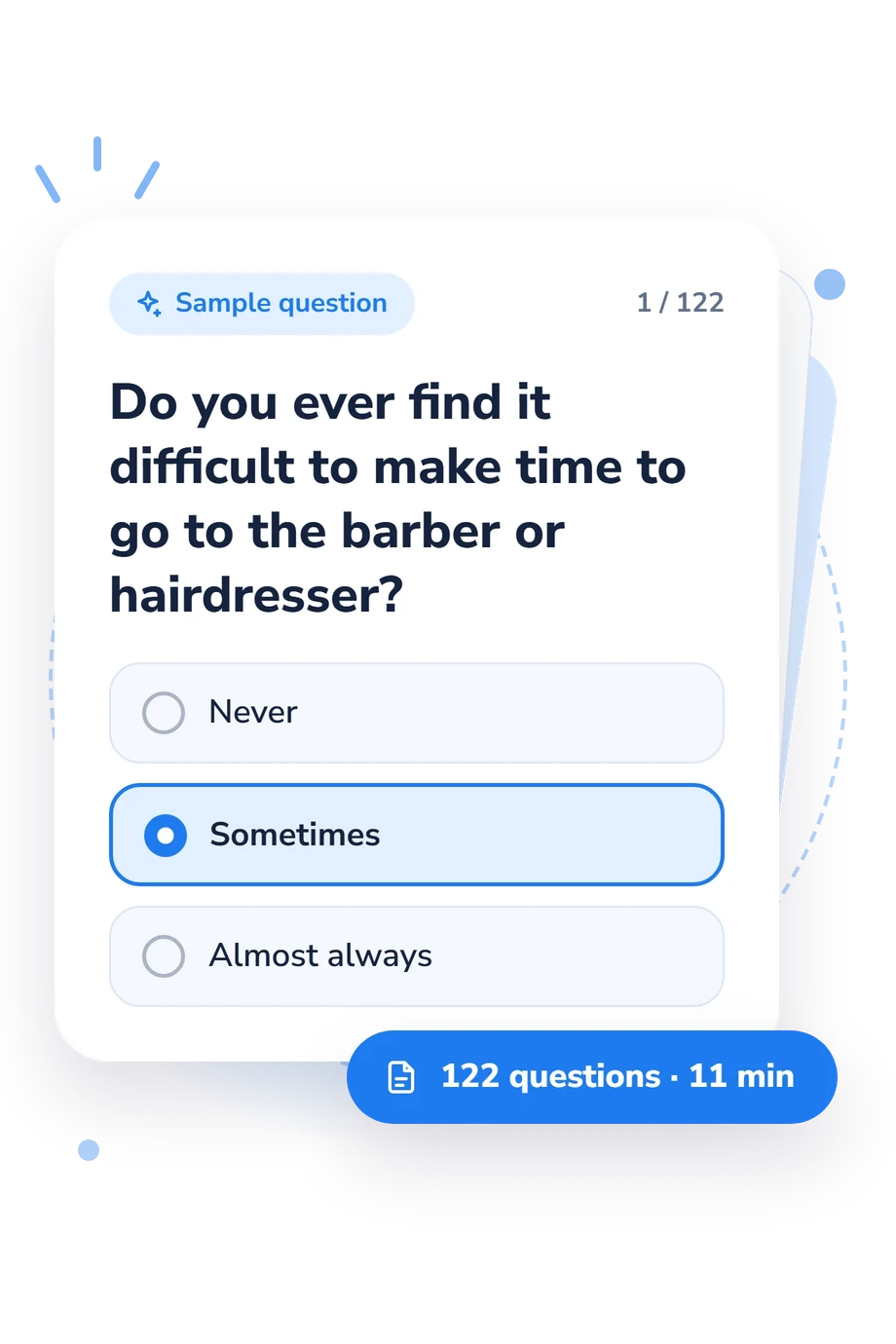
- Never
- Sometimes
- Almost always
- Less than most people's jobs
- About the same as most people's jobs
- More than most people's jobs
- Activities that require problem-solving
- Everyday routine activities
- Activities you find boring
Jenkins Activity Survey (JAS) Test - Description and methodology of the test
People considering a behavioral activity pattern test may find this questionnaire useful when they want to reflect on how they organize effort, handle demands, and approach work. The Jenkins Activity Survey (JAS) Test offers a structured starting point for considering personal habits without reducing personality to one label.
What This Assessment Explores
Questions cover pace, competition, irritation, leadership, work, and leisure in meals, deadlines, delays, multitasking, illness, and taking charge. The JAS questionnaire supports reflection on work habits and pressure responses.
Themes form three clusters rather than separate scales:
- Pace and time urgency show how readily someone hurries, multitasks, sets deadlines, or resists delays.
- Achievement and competition indicate the importance of being first, recognition, responsibility, or taking charge.
- Energy and emotional responses describe activity, irritability, anger control, appetite, and work-rest balance.
The Behavioral Activity Type scale runs from 61-789, summarizing these clusters as one behavioral-activity tendency. It measures the severity of the Jenkins behavioral activity pattern. Bands are Type B (low Type A traits), 61-167; Intermediate (balanced), 168-459; and Type A (high Type A traits), 460-789. The intermediate pattern involves active industriousness, balanced work and rest, moderate expressiveness, adaptability, emotional stability, and stress resistance.
Methodology and Scientific Basis
Each item uses multiple-choice alternatives describing frequency, speed, preference, activity, or reactions in ordinary situations. Topics include eating, waiting, deadlines, promotions, responsibility, illness, and leisure, so the questionnaire samples reported behavior rather than asking for one abstract label.
Individual option weights are not specified, so the total should not be reverse-engineered into an item-by-item rule. Interpret the total using the stated result bands and the pattern across answers.
The relevant source instrument is the Jenkins Activity Survey (JAS), developed by C. D. Jenkins, R. H. Rosenman, and M. Friedman in 1967. Jenkins, Zyzanski, and Rosenman reported later validation work in 1971, and Boyd and Begley examined the JAS as a Type A behavior assessment in 1987. This online questionnaire is conceptually consistent with that work, but it is not the standardized published instrument and does not automatically inherit its samples, norms, or administration.
Self-report results can shift with current workload, stress, health, self-awareness, and social context. The profile describes tendencies in the covered situations; it does not establish why they occur or guarantee the same pattern in every setting.
- Jenkins, C. D., Rosenman, R. H., & Friedman, M. (1967). Development of an objective psychological test for the determination of the coronary-prone behavior pattern in employed men. Journal of Chronic Diseases, 20(6), 371-379. 10.1016/0021-9681(67)90010-0
- Jenkins, C. D., Zyzanski, S. J., & Rosenman, R. H. (1971). Progress toward validation of a computer-scored test for the Type A coronary-prone behavior pattern. Psychosomatic Medicine, 33(3), 193-202. 10.1097/00006842-197105000-00001
- Boyd, D. P., & Begley, T. M. (1987). Assessing the Type A behaviour pattern with the Jenkins Activity Survey. British Journal of Medical Psychology, 60(2), 155-161. 10.1111/j.2044-8341.1987.tb02726.x
Updated: