
Pediatric Quality of Life Inventory (PedsQL) Test
How the Scales are Structured
Who Usually Takes This Test?
See How You Compare
Below is a preview of how scores are typically distributed across each scale.
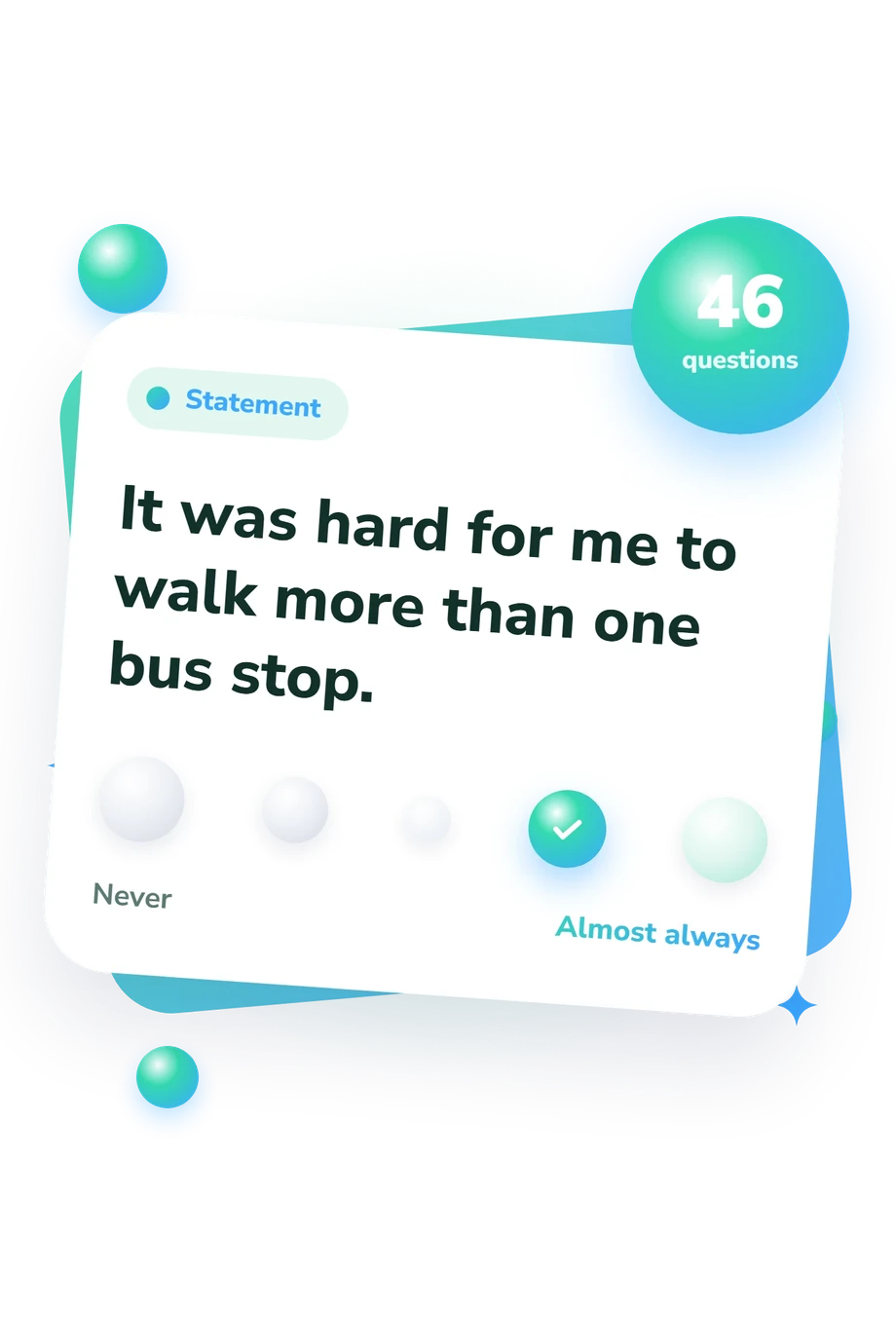
Example Questions From the Test
- Never
- Almost never
- Sometimes
- Often
- Almost always
- Never
- Almost never
- Sometimes
- Often
- Almost always
- Never
- Almost never
- Sometimes
- Often
- Almost always
Pediatric Quality of Life Inventory (PedsQL) Test - Description and methodology of the test
For parents, caregivers, and professionals seeking a structured view of a child’s well-being, this assessment brings physical abilities, emotions, relationships, and responsibilities into one profile. The child answers the first-person questions about their own functioning, while caregivers or professionals may help interpret the profile. The Pediatric Quality of Life Inventory (PedsQL) Test organizes experiences that may be difficult to compare. As a pediatric quality of life questionnaire, it highlights areas for support.
What This Assessment Explores
Questions cover functioning; this child quality of life test profiles physical, emotional, social, and school functioning:
- Role Functioning (0-100) reflects responsibilities and social roles; Low 0-50, High 51-100.
- Social Functioning (0-100) shows peer interaction and adjustment; Low 0-49, Moderate 50-79, High 80-100.
- Emotional Functioning (0-100) reflects emotional well-being and coping with stress; Low 0-49, Moderate 50-74, High 75-100.
- Psychosocial Quality of Life (0-100) combines emotional, social, and role functioning; Low 0-51, Moderate 52-76, High 77-100.
- Physical Quality of Life Scale (0-100) shows physical well-being and daily activity; Low 0-51, Moderate 52-76, High 77-100.
- Overall Quality of Life (0-100) summarizes physical and psychosocial functioning; higher scores indicate better well-being and life satisfaction; Low 0-25, Moderate 26-75, High 76-100.
Methodology and Scientific Basis
Each statement uses five options: Never, Almost never, Sometimes, Often, and Almost always. The items ask about difficulty or distress in physical activity, self-care, emotions, relationships, attention, and school participation. Results are reported on the displayed 0-100 scales; higher values indicate more favorable functioning.
Its evidence base is the PedsQL 4.0 Generic Core Scales, a pediatric health-related quality-of-life instrument described by James W. Varni and colleagues in 2001. The 1999 measurement model describes physical, emotional, social, and school functioning, while a 2003 study examined feasibility, reliability, and validity in pediatric populations. This PedsQL assessment is conceptually consistent with that work, not a direct adaptation of those studies.
This online presentation has no separate validation or norms. Its displayed catalogue bands belong to this presentation and are not norms from the published instrument.
The bands organize scores descriptively. Interpretation is strongest when the pattern is considered alongside the child’s current health and circumstances. Self-report can be affected by mood, recall, context, and openness, so decisions about health or school support require broader assessment and professional judgment.
- James W. Varni, Michael Seid, and Paul S. Kurtin. "PedsQL 4.0: Reliability and Validity of the Pediatric Quality of Life Inventory Version 4.0 Generic Core Scales in Healthy and Patient Populations." Medical Care 39(8) (2001): 800-812. 10.1097/00005650-200108000-00006
- James W. Varni, Tasha M. Burwinkle, Michael Seid, and Douglas Skarr. "The PedsQL 4.0 as a Pediatric Population Health Measure: Feasibility, Reliability, and Validity." Ambulatory Pediatrics 3(6) (2003): 329-341. 10.1367/1539-4409%282003%29003%3C0329%3ATPAAPP%3E2.0.CO%3B2
- James W. Varni, Michael Seid, and Christopher A. Rode. "The PedsQL: Measurement Model for the Pediatric Quality of Life Inventory." Medical Care 37(2) (1999): 126-139. 10.1097/00005650-199902000-00003
Updated: