
Freudly+971 508685814hello@freudly.ai
Freudly
pregnancy

Motives for Child Conception Questionnaire Test
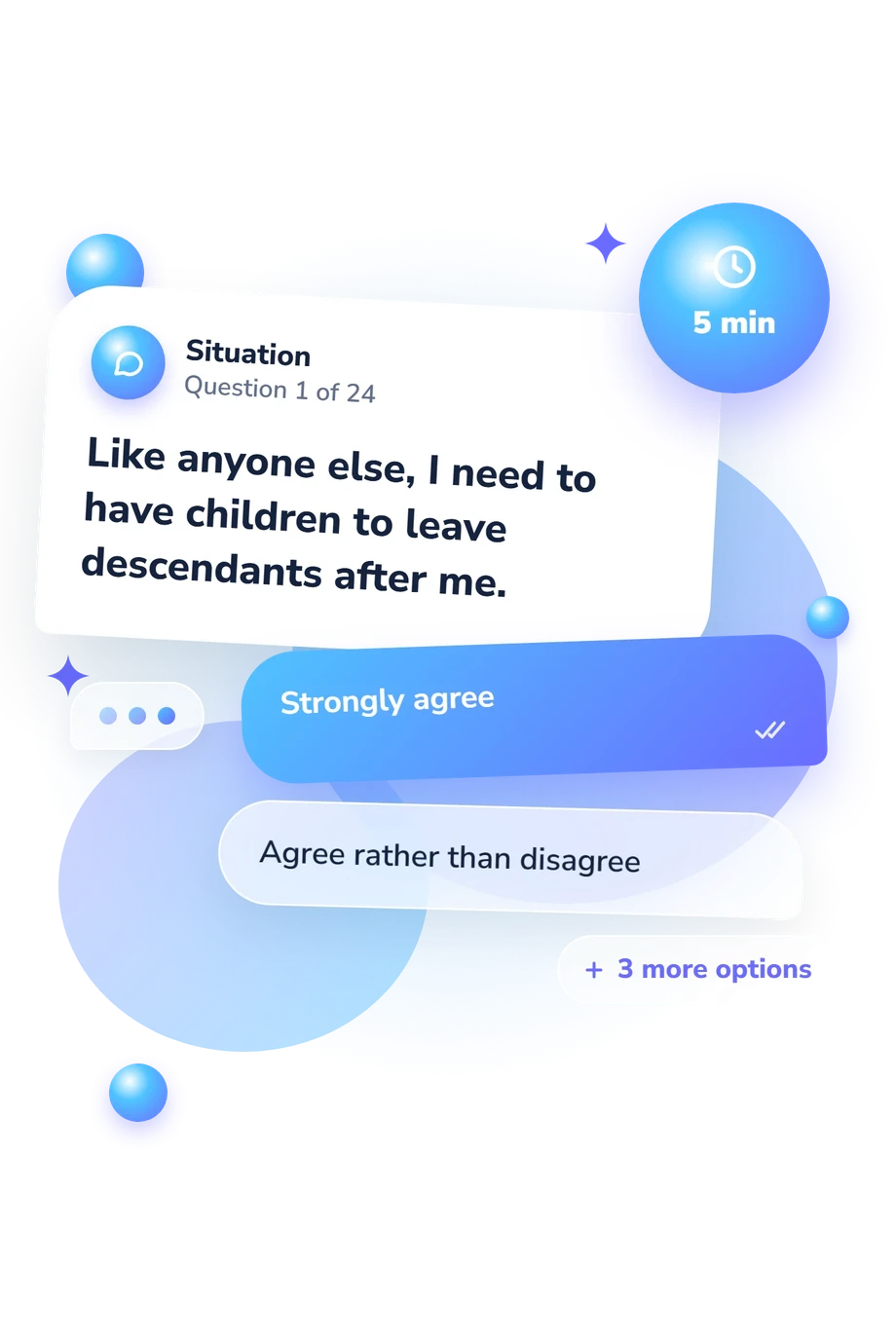
Take the online Motives for Child Conception Questionnaire Test - AI psychologist FreudlyYou can take Motives for Child Conception Questionnaire Testhere. Online version of a simple and accurate psychological test with interpretation.en
In about 5 minutes, it clarifies what motivates a woman to have a child. With 24 items, it offers fast insights to tailor perinatal counseling, align expectations, and reduce conflict.
Start Online Test
Questions: 245 minutes
08:30
October 2, 2025
October 2, 2025
Material has been updated
October 2, 2025
Material has been published
33,295 views
3,343 completions
2,921 likes
Verified by Daniel Hall
Psychologist with 25 years of experience
Share
Scale Explorer

How the Scales are Structured

example score
7/12
Responsibility Motive (RM)
Measures the degree to which a person emphasizes duty and accountability in deciding to conceive and raise a child.
Lower responsibility focus
Moderate responsibility focus
High responsibility focus
04: Lower responsibility focus | 58: Moderate responsibility focus | 912: High responsibility focus
A score of 7 indicates a moderate emphasis on parental duty and obligations as a motivation for having a child.
example score
6/12
Happiness Motive (HM)
Measures how strongly the respondent expects having a child to bring joy and positive emotions.
Low
Moderate
High
04: Low | 58: Moderate | 912: High
A score of 6 falls in the Moderate range, suggesting a balanced expectation that parenthood will contribute to happiness without being the dominant motive.
example score
9/12
Care and Love Motive (CaLM)
Measures the importance of wanting to provide care, tenderness, and emotional support to the child as a key motivation for conceiving.
Low
Moderate
High
04: Low | 58: Moderate | 912: High
A score of 9 indicates a high care-and-love motive, suggesting a strong emphasis on emotional connection and nurturing in the decision to have a child.
example score
6/12
Family Cohesion Motive (FCM)
Measures how strongly having a child is motivated by a desire to strengthen family relationships and unity.
Low
Moderate
High
04: Low | 58: Moderate | 912: High
A score of 6 falls in the Moderate range, suggesting family unity is a meaningful but not dominant motive for conceiving a child.
example score
4/12
Meaning of Life Motive (MoLM)
Measures the extent to which having a child is seen as a way to find or strengthen life meaning and purpose.
Low
Moderate
High
04: Low | 58: Moderate | 912: High
A score of 4 falls in the Low range, suggesting that seeking life meaning through parenthood is not a primary motivation right now.
example score
7/12
Motherhood Motive (MM)
Measures how strongly a woman is motivated to conceive in order to fulfill herself in the maternal role and engage in caregiving functions.
Low
Moderate
High
04: Low | 58: Moderate | 912: High
A score of 7 falls in the Moderate range, suggesting motherhood is an important motive, though it likely shares influence with other reasons for conceiving.
example score
7/12
Family Completeness Motive (FCM)
Measures how strongly the person views having a child as necessary to feel the family is complete and whole.
Low
Moderate
High
04: Low | 58: Moderate | 912: High
A score of 7 falls in the Moderate range, suggesting family completeness is a meaningful motive but not the sole or dominant driver for conceiving a child.
example score
2/12
Lineage Continuation Motive (LCM)
Measures the extent to which having a child is motivated by continuing the family or ancestral line.
Low
Moderate
High
03: Low | 48: Moderate | 912: High
A score of 2 falls in the Low range, suggesting that continuing the family line is currently a relatively minor motive compared with other possible reasons for conceiving a child.
Start Online Test
just completed the test
DATA-BASED USER COHORTS

Who Usually Takes This Test?

Expectant mothers seeking clarity
41%OF USERS
Pregnant women who want to understand what personally motivates them to have a child and what they hope will change in their lives.
Women planning a pregnancy
34%OF USERS
Women considering motherhood who want to sort out their reasons and expectations before deciding to conceive.
Perinatal counselors and psychologists
25%OF USERS
Professionals who use a quick screening tool to identify a client’s core motivations and guide counseling and family support.
BASED ON AGGREGATED, ANONYMIZED DATA FROM TENS OF THOUSANDS OF FREUDLY USERS.
Benchmarking

See How You Compare

Once you complete the test, your results are compared with real-world data from people in your country.
Below is a preview of how scores are typically distributed across each scale.
Motive of responsibility (Mor)
Average
6.9
Normal range
4.79.1
min.
0
max.
12
This curve shows how scores are typically distributed.
Once you complete the test, your result will appear on the scale so you can see how you compare.
The Motive of Happiness (TMoH)
Average
5.4
Normal range
3.27.6
min.
0
max.
12
This curve shows how scores are typically distributed.
Once you complete the test, your result will appear on the scale so you can see how you compare.
The motive of care and love (Tmocal)
Average
3.8
Normal range
2.25.4
min.
0
max.
12
This curve shows how scores are typically distributed.
Once you complete the test, your result will appear on the scale so you can see how you compare.
The theme of family unity (Ttofu)
Average
3.6
Normal range
2.15.1
min.
0
max.
12
This curve shows how scores are typically distributed.
Once you complete the test, your result will appear on the scale so you can see how you compare.
The Motivation of Life's Meaning (TMoLM)
Average
7
Normal range
59
min.
0
max.
12
This curve shows how scores are typically distributed.
Once you complete the test, your result will appear on the scale so you can see how you compare.
The Theme of Motherhood (TToM)
Average
5.4
Normal range
3.87
min.
0
max.
12
This curve shows how scores are typically distributed.
Once you complete the test, your result will appear on the scale so you can see how you compare.
The theme of family completeness (Ttofc)
Average
5.4
Normal range
3.27.5
min.
0
max.
12
This curve shows how scores are typically distributed.
Once you complete the test, your result will appear on the scale so you can see how you compare.
Motive for reproduction (Mfr)
Average
8.4
Normal range
6.910
min.
0
max.
12
This curve shows how scores are typically distributed.
Once you complete the test, your result will appear on the scale so you can see how you compare.
Featured On
SAMPLE QUESTIONS

Example Questions From the Test

    • Strongly agree
    • Agree rather than disagree
    • Hard to say
    • Disagree rather than agree
    • Strongly disagree
    • Strongly agree
    • Somewhat agree
    • Not sure
    • Somewhat disagree
    • Strongly disagree
    • Strongly agree
    • Agree somewhat
    • Not sure
    • Disagree somewhat
    • Strongly disagree
WHAT THE TEST MEASURES
About This Assessment
Motivations for Conceiving a Child Test

Motives for Child Conception Questionnaire Test - Symptoms and Signs

pregnancy

In perinatal and family assessment, clarifying reasons for pursuing parenthood can inform case formulation and clinical planning. The Motives for Child Conception Questionnaire is a brief self-report measure designed to identify salient motivations related to conceiving a child (Belsky). It includes 24 items and typically takes about 5 minutes to complete.

Respondents rate the personal importance of various conception-related motives, yielding a profile that can support clinical discussion of expectations, values, and potential areas of tension or ambivalence. The Motives for Child Conception Questionnaire may be used to guide collaborative exploration in perinatal counseling, couples work, or psychosocial support by helping clinicians organize themes for follow-up interview and intervention planning.

Author: John L. Belsky
Literature: Miller, W. B. Childbearing motivations, desires, and intentions: A theoretical framework. Genetic, Social, and General Psychology Monographs. 1994.; Cowan, C. P., & Cowan, P. A. When partners become parents: The big life change for couples. Basic Books. 1992.
Popular tests
Comments
Leave a Comment