
Pediatric Quality of Life Inventory (PedsQL) Test
How the Scales are Structured
Who Usually Takes This Test?
See How You Compare
Below is a preview of how scores are typically distributed across each scale.
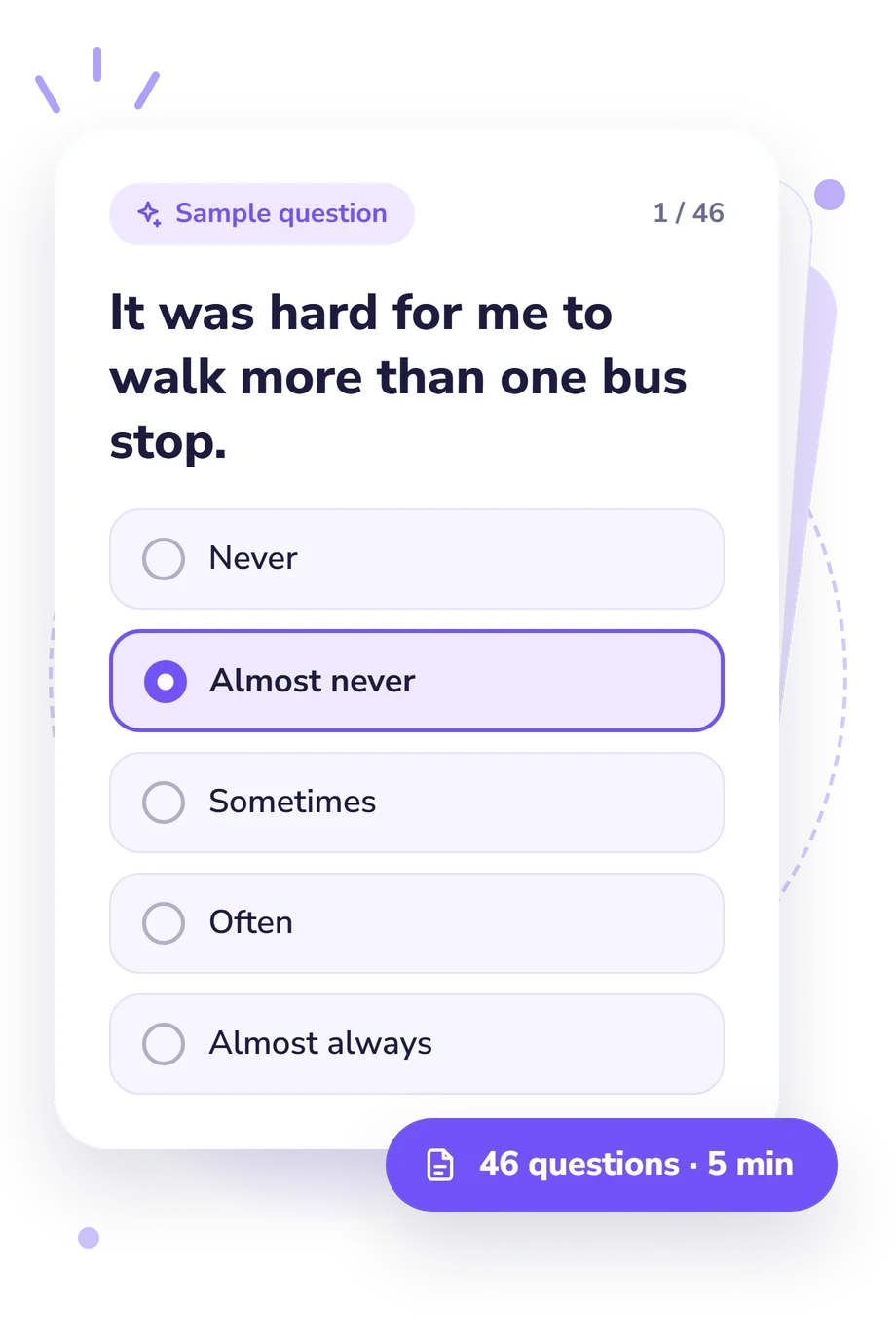
Example Questions From the Test
- Never
- Almost never
- Sometimes
- Often
- Almost always
- Never
- Almost never
- Sometimes
- Often
- Almost always
- Never
- Almost never
- Sometimes
- Often
- Almost always
Pediatric Quality of Life Inventory (PedsQL) Test - Description and methodology of the test
For a young respondent seeking a structured view of everyday wellbeing, the Pediatric Quality of Life Inventory (PedsQL) Test organizes experiences that may affect participation at home, with peers, and at school. It helps the child notice patterns in functioning and choose areas for further conversation. As a pediatric quality of life test, it gives one overall 0-100 result, reported as Low, Moderate, or High.
What This Assessment Explores
At its core, the questionnaire examines how health experiences affect ordinary activities and relationships. Items address movement, pain, energy, emotions, sleep, peer connection, attention, schoolwork, and attendance. It is written for a child or young respondent reflecting on daily quality of life.
A young respondent can use a PedsQL questionnaire to organize reflection, while a caregiver may help discuss the result.
The items cover four areas:
- Physical functioning reflects how movement, pain, energy, self-care, and exercise affect activity.
- Emotional functioning captures fear, sadness, anger, worry, and sleep difficulties.
- Social functioning describes communication, belonging, teasing, and peer relationships.
- School functioning covers attention, memory, schoolwork, and attendance.
Together, these item groups show which parts of daily functioning the questions cover. The single Pediatric Quality of Life Inventory scale is scored from 0-100: Low (0-33), Moderate (34-66), and High (67-100). Higher scores generally indicate better quality of life, while lower scores suggest greater difficulties.
Methodology and Scientific Basis
Five ordered choices-Never, Almost never, Sometimes, Often, and Almost always-ask how often each difficulty is experienced. The items use concrete situations involving mobility, self-care, peers, attention, and attendance, creating a consistent self-report format across domains.
The result is shown as one overall score with three result bands, but the questionnaire does not state how answers are weighted or transformed. Higher values generally indicate better quality of life; lower values indicate more difficulty.
The questionnaire is conceptually consistent with PedsQL 4.0 Generic Core Scales (Varni et al., 2001), a published instrument evaluated for reliability and validity in healthy and patient populations. The PedsQL measurement model described by Varni, Seid, and Rode (1999) treats quality of life as multidimensional, while Varni et al. (2003) examined feasibility, reliability, and validity for population health use. These studies support the source instrument but do not establish online-specific norms or independently validate this digital presentation or its displayed bands.
As a pediatric quality of life assessment, the score should be read with current context, self-awareness, recall, and response style in mind. It is a structured reflection of reported functioning, not a diagnosis.
- Varni, J. W., Seid, M., & Kurtin, P. S. (2001). PedsQL 4.0: Reliability and validity of the Pediatric Quality of Life Inventory version 4.0 generic core scales in healthy and patient populations. Medical Care, 39(8), 800-812. 10.1097/00005650-200108000-00006
- Varni, J. W., Burwinkle, T. M., Seid, M., & Skarr, D. (2003). The PedsQL 4.0 as a pediatric population health measure: Feasibility, reliability, and validity. Ambulatory Pediatrics, 3(6), 329-341. 10.1367/1539-4409(2003)003<0329:TPAAPP>2.0.CO;2
- Varni, J. W., Seid, M., & Rode, C. A. (1999). The PedsQL: Measurement model for the pediatric quality of life inventory. Medical Care, 37(2), 126-139. 10.1097/00005650-199902000-00003
Updated: