
Socio-Psychological Distance Scale Test
How the Scales are Structured
Who Usually Takes This Test?
See How You Compare
Below is a preview of how scores are typically distributed across each scale.
Example Questions From the Test
- Completely disagree
- Agree to a small extent
- Agree almost half the time
- Agree half the time
- Agree more than half the time
- Agree almost completely
- Completely agree
- Completely disagree
- Agree to a small extent
- Agree almost half the time
- Agree about half the time
- Agree more than half the time
- Agree almost completely
- Completely agree
- Completely disagree
- Agree to a small extent
- Agree almost halfway
- Agree about halfway
- Agree more than halfway
- Agree almost completely
- Agree completely
Socio-Psychological Distance Scale Test - Description and methodology of the test
People who want to understand a particular relationship from more than one angle can use the Socio-Psychological Distance Scale Test to compare how the same connection feels across different situations. It suits self-reflection for someone weighing patterns in a relationship, while its value as a relationship closeness assessment lies in showing where different aspects of the connection align or diverge.
What This Assessment Explores
Psychological distance spans practical, emotional, communicative, cognitive, and self-evaluative aspects of one relationship. The test suits self-reflection, using an interpersonal distance scale to provide a profile rather than a verdict.
These dimensions are:
- Self-Image (Si), 6-42, assesses criticality and adequacy in self-evaluation: Low 6-19 may indicate high criticality or a possible negative self-attitude; Moderate 20-31 may reflect self-acceptance and sincerity; High 32-42 may suggest low criticality or possible insincerity.
- Behavioral Distance (Act-d), 8-56, reflects joint readiness: High distance 8-24; Moderate distance 25-39; Low distance 40-56.
- Emotional Distance (Emo-D), 9-63, measures affiliative versus distancing feelings: Low closeness 9-27; Balanced closeness 28-45; High closeness 46-63.
- Communication Distance (Com-d), 9-63, reflects trust: Low trust / guarded 9-27; Moderate trust 28-44; High trust / open 45-63.
- Cognitive Distance (Cog-D), 9-63, reflects mutual understanding: Low understanding 9-27; Moderate understanding 28-44; High understanding 45-63.
Methodology and Evidence Base
The questionnaire is conceptually consistent with the Socio-Psychological Distance Questionnaire, as described in Dukhnovsky's 2012 methodology, but this separate online form has no documented independent standardization or online-form norms.
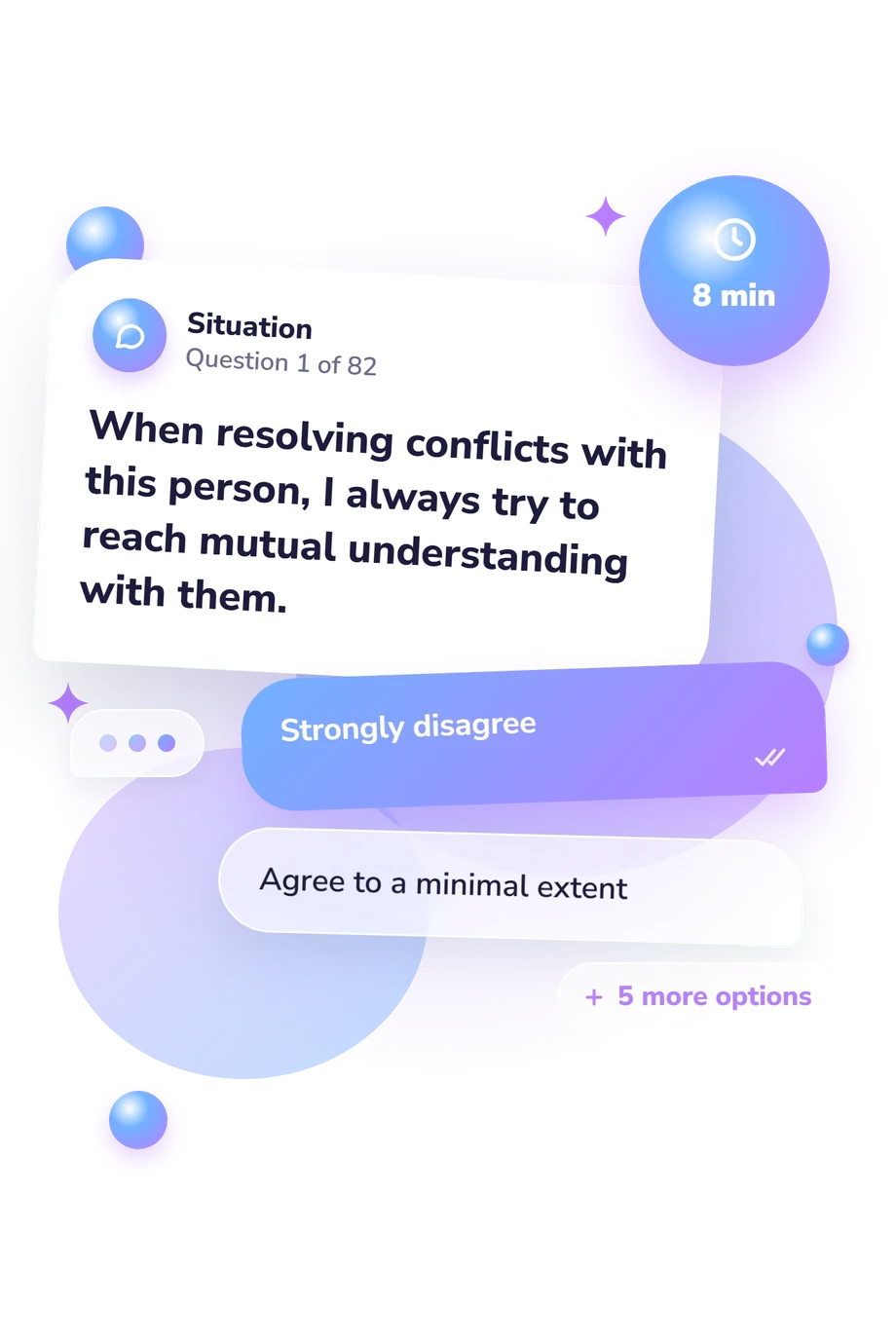
The format is an online relationship assessment questionnaire with a seven-point agreement scale, ranging from complete disagreement to complete agreement. Its statements address conflict resolution, disclosure, shared time, comfort, tension, trust, hurt, and efforts to understand the other person.
The result reports five displayed scale results with scale-specific directions: the behavioral dimension associates lower values with greater distance, while the emotional, communication, and cognitive dimensions associate higher values with greater closeness, trust, and understanding, respectively.
Interpretation is profile-based, describing one relationship at the time of completion rather than delivering a single verdict. Current context, expectations, memory, candor, and self-awareness can affect self-report. Related work by Dukhnovsky and Kulikov provides a conceptual framework for these dimensions.
- Dukhnovsky, S. V. (2012). Development of the Methodology “Determination of Socio-Psychological Distance in Interpersonal Relationships.” Bulletin of the South Ural State University. Series: Psychology, 19(278), 41-46.
- Dukhnovsky, S. V. (2012). Methodology “Determination of Socio-Psychological Distance in Interpersonal Relationships”: Manual. Ural State Pedagogical University, Yekaterinburg, 45 pp.
- Dukhnovsky, S. V., and Kulikov, L. V. (2009). Socio-Psychological Distance in Interpersonal Relationships: Factors and Regulation. Bulletin of Saint Petersburg University. Series 12: Psychology, Sociology, and Pedagogy, 2(1), 20-26.
Updated: