
Implicit Theories of Creativity Questionnaire Test
How the Scales are Structured
Who Usually Takes This Test?
See How You Compare
Below is a preview of how scores are typically distributed across each scale.
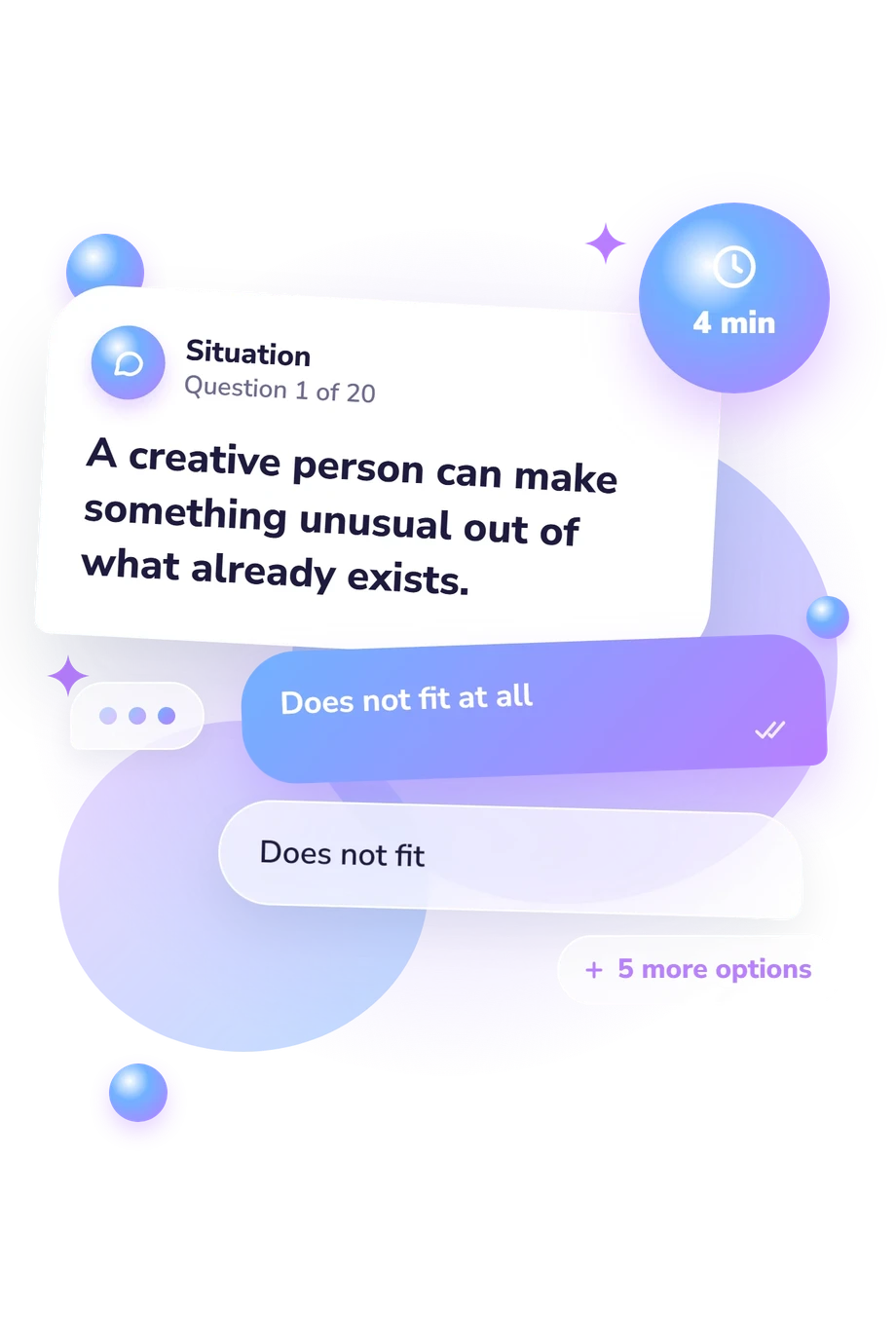
Example Questions From the Test
- Does not fit at all
- Does not fit
- Rather does not fit
- Neutral
- Rather fits
- Fits
- Completely fits
- Does not apply at all
- Does not apply
- Rather does not apply
- Neutral
- Rather applies
- Applies
- Applies completely
- Does not fit at all
- Does not fit
- Rather does not fit
- Neutral
- Rather fits
- Fits
- Fits completely
Implicit Theories of Creativity Questionnaire Test - Description and methodology of the test
People who want to examine how they understand creativity can use the Implicit Theories of Creativity Questionnaire Test as a structured self-report exercise. It is intended for readers reflecting on whether creativity seems connected with action, experimentation, intellectual resources, and unconventional thinking. Its results form a profile of creativity beliefs that can sharpen self-reflection without treating those beliefs as fixed abilities.
What This Assessment Measures
The assessment examines creativity beliefs rather than output.
Statements cover imagination, improvisation, openness, intellectual development, and novel solutions.
Dimensions:
- Activity (5-35) measures active engagement and interaction: Lower activity view (5-14); Moderate activity view (15-25); Higher activity view (26-35).
- Novelty (5-35) measures seeking new approaches and experimentation under uncertainty: Low novelty seeking (5-17); High novelty seeking (18-35).
- Intellectual and Personal Potential (5-35) captures creativity as intellectual and personal resources: Low IPP focus (5-14); Moderate IPP focus (15-24); High IPP focus (25-35).
- Originality (5-35) measures unconventional solutions in familiar situations and unique ideas: Lower originality (5-15); Moderate originality (16-25); Higher originality (26-35).
Profile shows which meanings of creativity the respondent endorses. It describes beliefs, not talent or achievement, and can guide reflection on learning, work, and problems.
Methodology and Evidence Base
Each statement uses a seven-point response scale running from the lowest fit, applicability, characteristic, or description rating through neutrality to the highest rating. The wording varies, but each answer records personal endorsement.
The profile groups responses into four dimensions. The online creativity test reports responses through the four displayed dimensions and their result bands. Because respondents assess themselves, the profile is most useful for comparing emphases within one result; it also offers a snapshot of how active engagement, experimentation, personal resources, and unconventional problem solving are valued.
Conceptually, the content is consistent with the Questionnaire of Implicit Theories of Creativity discussed by Pavlova (2014), and with Pavlova and Kornilova (2019), but this online version is not presented as that published instrument or a validated adaptation. Sternberg’s 1985 implicit-theories framework provides broader context for how people organize beliefs about creativity and intelligence.
Self-report makes scores sensitive to current mood, self-image, memory, and the wish to appear creative. Read the result as a snapshot of beliefs and compare it with concrete behavior.
- Pavlova, E. M. (2014). Implicit Theories and Self-Evaluation of Creativity in the Structure of Personal Self-Conception. Psychology. Journal of Higher School of Economics, 11(4), 75-94. (In Russian).
- Pavlova, E. M., & Kornilova, T. V. (2019). Implicit Theories and Self-Esteem of Creativity in the Structure of Self-Consciousness. In E. M. Pavlova & T. V. Kornilova (Eds.), Understanding Creativity: Past, Present and Future Perspectives (pp. 61-77). New York: Nova Science Publishers.
- Sternberg, R. J. (1985). Implicit Theories of Intelligence, Creativity, and Wisdom. Journal of Personality and Social Psychology, 49(3), 607-627. 10.1037/0022-3514.49.3.607
Updated: