
Bermond-Vorst Alexithymia Questionnaire (BVAQ) Test
How the Scales are Structured
Who Usually Takes This Test?
See How You Compare
Below is a preview of how scores are typically distributed across each scale.
Example Questions From the Test
- Definitely not true of me
- Partly untrue of me
- Neither true nor untrue of me
- Partly true of me
- Definitely true of me
- Definitely does not apply to me
- Somewhat untrue
- Neither true nor untrue
- Somewhat true
- Definitely applies to me
- Definitely does not apply to me
- Somewhat untrue
- Neither true nor untrue
- Somewhat true
- Definitely applies to me
Bermond-Vorst Alexithymia Questionnaire (BVAQ) Test - Description and methodology of the test
For people reflecting on emotional awareness, communication, or sensitivity in daily life, the Bermond-Vorst Alexithymia Questionnaire (BVAQ) Test offers a structured way to examine how emotions are identified, analyzed, expressed, and experienced. This emotional awareness test turns vague impressions into a profile of tendencies across inner experience, imagination, and interpersonal expression.
What This Assessment Explores
Alexithymia involves distinct ways of experiencing emotion. The questionnaire examines communication, emotional insight, imagination, and reactivity, creating a profile. The questionnaire's identification dimension functions as an emotion identification test, showing whether difficulty lies mainly in recognizing feelings, understanding reactions, or expressing them.
These scales define the profile:
- Verbalizing (E), 8-40, measures how readily a person describes emotions; Low 8-15; Moderate 16-29; High 30-40.
- Analyzing (D), 8-40, measures how a person explains reactions; Low analysis 8-19; Moderate analysis 20-29; High analysis 30-40.
- Identifying (C), 8-40, measures recognition of emotions; Low 8-13; Moderate 14-25; High 26-40.
- Fantasizing, 8-40, measures imaginative capacity; Low 8-10; Typical 11-24; High 25-40.
- Emotionality (A), 8-40, measures emotional arousability; Low emotional reactivity 8-14; Moderate emotional reactivity 15-24; High 25-40.
- Alexithymia Level, 40-200, summarizes emotional difficulty; Low 40-72; Moderate 73-110; High 111-200.
Methodology and Scientific Basis
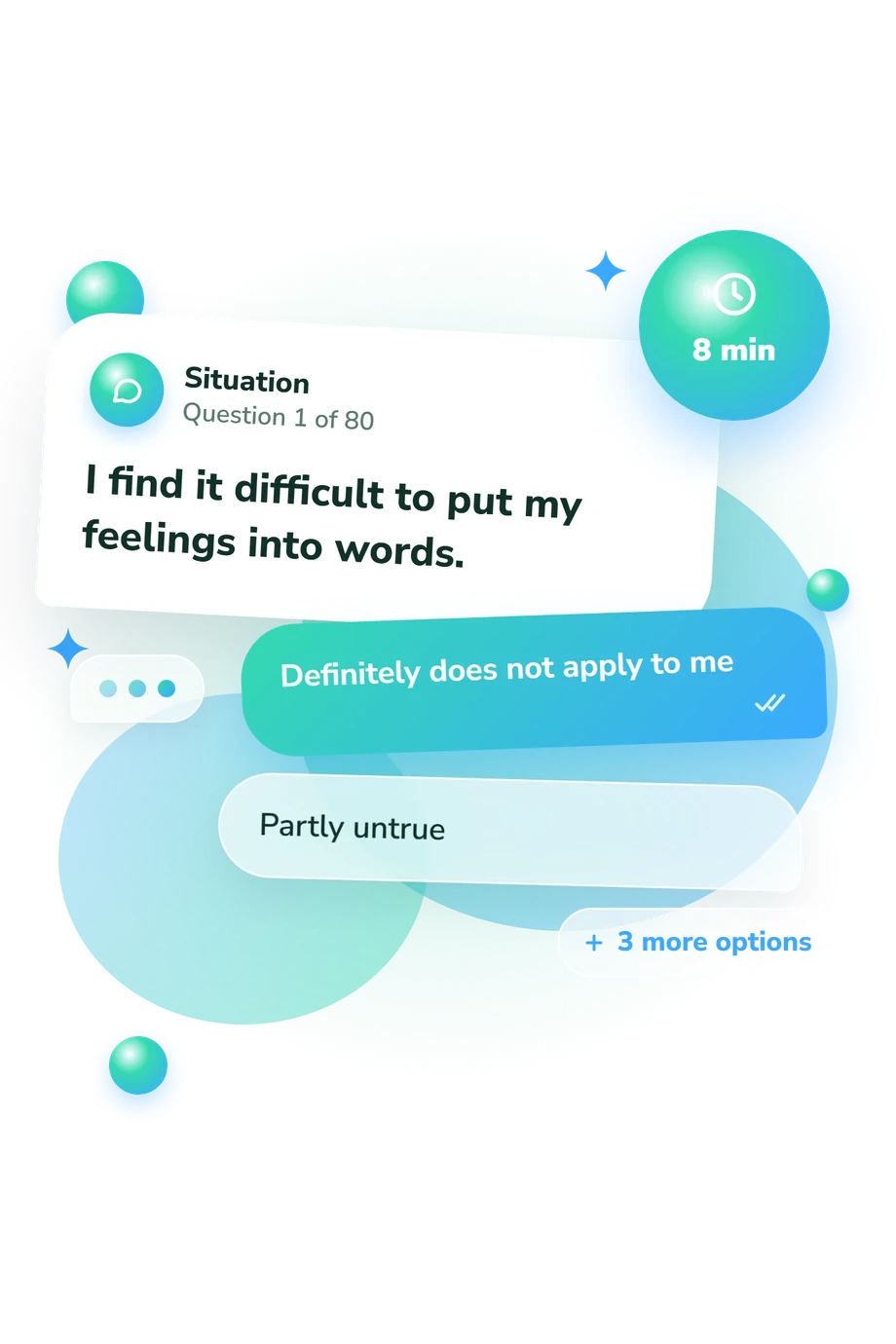
Each statement addresses emotional, interpersonal, and imaginative experiences, reactions, beliefs, preferences, or habitual tendencies. Five response options move from definite inaccuracy or non-application through neutral and intermediate choices to definite truth or application, so respondents indicate degree rather than choose yes or no.
The results report five component scales and an overall level. Higher overall scores may indicate greater difficulty identifying, analyzing, and expressing emotions; the component scales describe the separate tendencies outlined above. The displayed labels and ranges provide the interpretation for each result.
The evidence base begins with the Bermond-Vorst Alexithymia Questionnaire (BVAQ) examined by Vorst and Bermond (2001). This questionnaire is conceptually consistent with that instrument, not presented as an adaptation. Müller and colleagues (2004) examined its psychometric properties, and de Vroege and colleagues (2018) studied general and clinical populations. The cited studies concern the published BVAQ and do not, by themselves, validate or establish norms for this exact online presentation.
Self-report results can shift with current mood, self-awareness, and wording interpretation. The profile describes tendencies rather than causes and does not by itself establish a diagnosis.
- Vorst, H. C. M., & Bermond, B. (2001). Validity and reliability of the Bermond-Vorst Alexithymia Questionnaire. Personality and Individual Differences, 30(3), 413-434. 10.1016/S0191-8869(00)00033-7
- Müller, J., Bühner, M., & Ellgring, H. (2004). The assessment of alexithymia: psychometric properties and validity of the Bermond-Vorst alexithymia questionnaire. Personality and Individual Differences, 37(2), 373-391. 10.1016/j.paid.2003.09.010
- de Vroege, L., Emons, W. H. M., Sijtsma, K., & van der Feltz-Cornelis, C. M. (2018). Psychometric Properties of the Bermond-Vorst Alexithymia Questionnaire (BVAQ) in the General Population and a Clinical Population. Frontiers in Psychiatry, 9, 111. 10.3389/fpsyt.2018.00111
Updated: