
Oxford Happiness Questionnaire (OHQ) Test
How the Scales are Structured
Who Usually Takes This Test?
See How You Compare
Below is a preview of how scores are typically distributed across each scale.
Example Questions From the Test
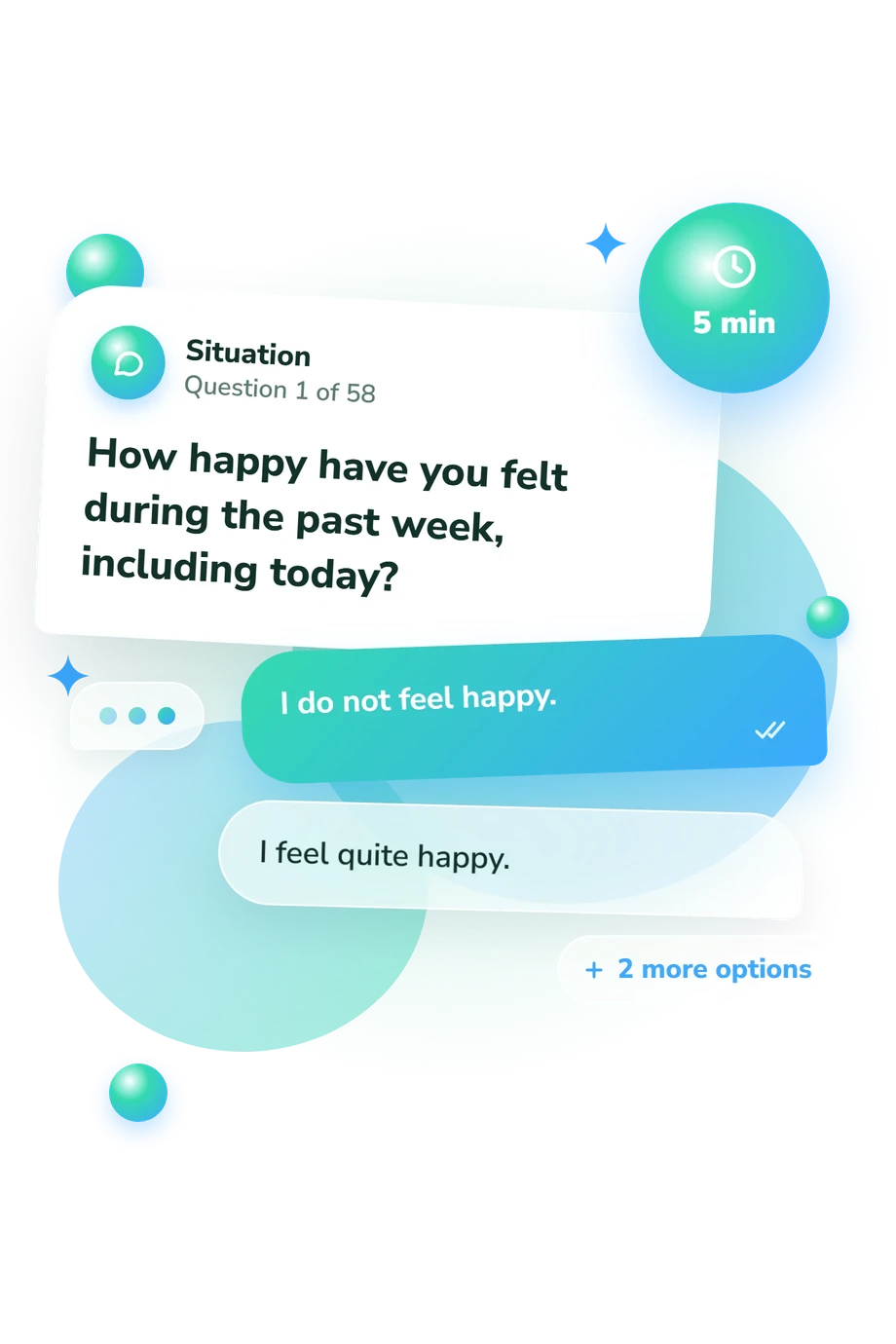
- I do not feel happy.
- I feel quite happy.
- I am very happy.
- I am incredibly happy.
- I look to the future without much optimism.
- I look to the future with optimism.
- It seems to me that the future holds a lot of good for me.
- I feel that the future is full of hope and promise.
- Nothing in my life really satisfies me.
- Some things in my life satisfy me.
- Many aspects of my life satisfy me.
- I am completely satisfied with everything in my life.
Oxford Happiness Questionnaire (OHQ) Test - Description and methodology of the test
People who want a clearer picture of their current well-being may use the Oxford Happiness Questionnaire (OHQ) Test to reflect on how they experience life, relationships, activity, and themselves. As a subjective well-being questionnaire, it organizes everyday feelings and self-evaluations into one broad estimate, while its item themes can guide reflection on experiences worth examining more closely.
What This Assessment Explores
It examines how positively a person evaluates life, rather than a single passing emotion. It suits people seeking structured self-reflection about everyday well-being. The questions touch on satisfaction, optimism, perceived control, energy, health, alertness, interest, activities, social warmth, belonging, purpose, amusement, and self-evaluation. This Oxford happiness questionnaire brings these themes together as contributors to one broad well-being estimate.
The result reflects several connected thematic areas that contribute to one broad well-being estimate:
- Life evaluation captures satisfaction, reward, and sense of purpose.
- Positive outlook shows hope, joy, beauty, and amusement in daily experience.
- Vitality and engagement indicate energy, health, alertness, initiative, and time organization.
- Social connection reflects interest, affection, belonging, encouragement, and enjoyment of company.
The result is reported on one Oxford Happiness Scale from 0-100: Lower well-being 0-39, Moderate well-being 40-79, and Higher well-being 80-100.
Methodology and Scientific Basis
For the OHQ test, each item offers four ordered choices, ranging from less to more positive descriptions. Respondents select the description that best matches their experience. The prompts sample mood, outlook, satisfaction, agency, energy, health, social connection, purpose, and engagement. The questionnaire displays one overall result on a single scale, not separate topic scores; it does not state how choices are converted into points.
The online questionnaire is conceptually consistent with the Oxford Happiness Inventory and literature on the published OHQ. Michael Argyle and colleagues describe the Inventory, while Peter Hills and Michael Argyle are associated with the published Questionnaire. Those studies concern those published instruments, not independent validation of this online implementation or its displayed bands.
Interpretation is strongest when the score is considered alongside current circumstances. A single happiness measure may not capture subjective well-being's full complexity. Mood, memory, self-awareness, and the wish to present oneself favorably can shape self-report answers, so the result is a starting point for reflection, not a complete account of functioning.
- Argyle, M., Martin, M., & Crossland, J. (1989). Happiness as a function of personality and social encounters. In J. P. Forgas & J. M. Innes (Eds.), Recent Advances in Social Psychology: An International Perspective (pp. 189–203). Amsterdam: Elsevier Science Publishers.
- Hills, P., & Argyle, M. (2002). The Oxford Happiness Questionnaire: A compact scale for the measurement of psychological well-being. Personality and Individual Differences, 33(7), 1073–1082. 10.1016/S0191-8869(01)00213-6
- Kashdan, T. B. (2004). The assessment of subjective well-being (issues raised by the Oxford Happiness Questionnaire). Personality and Individual Differences, 36(5), 1225–1232. 10.1016/S0191-8869(03)00213-7
Updated: