
Freudly+971 508685814hello@freudly.ai
Freudly
leadership

Leadership Qualities Questionnaire Test
Take the online Leadership Qualities Questionnaire Test - AI psychologist FreudlyYou can take Leadership Qualities Questionnaire Testhere. Online version of a simple and accurate psychological test with interpretation.en
See your leadership strengths in decision making, confidence, motivation, and teamwork in about 3 minutes. Get clear, actionable results from 14 quick items for coaching, training, or role fit.
Start Online Test
Questions: 143 minutes
08:30
October 2, 2025
October 2, 2025
Material has been updated
October 2, 2025
Material has been published
21,095 views
2,413 completions
1,938 likes
Verified by Daniel Hall
Psychologist with 25 years of experience
Share
Scale Explorer

How the Scales are Structured

example score
2/5
Empathic (E)
Measures the extent to which a leader understands and resonates with others’ feelings and motives to support effective interaction.
Low
Moderate
High
02: Low | 3: Moderate | 45: High
A score of 2 falls in the Low range, suggesting empathy may be less consistently used when interpreting others’ emotions and motivations.
example score
3/5
Sensitive (S)
Sensitivity reflects how well a leader notices and responds to others’ emotions and needs in interpersonal situations.
Low
Moderate
High
02: Low | 3: Moderate | 45: High
A score of 3 indicates a moderate level of sensitivity, suggesting generally adequate awareness of others’ feelings with room to become more consistently attuned in challenging interactions.
example score
3/5
Hardworking (H)
Measures diligence and sustained effort toward goals that a leader demonstrates and models for others.
Low
Moderate
High
02: Low | 3: Moderate | 45: High
A score of 3 suggests a moderate level of hardworking behavior, with generally consistent effort that may vary with task demands or motivation.
example score
1/5
Conscientiousness (C)
This scale measures how responsible, organized, and detail-oriented a person is in ways that support reliable leadership behavior.
Low
Moderate
High
02: Low | 3: Moderate | 45: High
A score of 1 falls in the Low range, suggesting a tendency toward less consistent organization and follow-through compared with higher scorers.
example score
3/5
Sociability (S)
Measures how readily a person communicates and builds working relationships within a team setting.
Low
Moderate
High
02: Low | 3: Moderate | 45: High
A score of 3 indicates moderate sociability, suggesting a generally adequate ability to engage with others while leaving room to strengthen proactive communication.
example score
2/5
Benevolent (B)
Kind-heartedness reflects how readily a person builds warm, supportive relationships that foster trust and cooperation in a team.
Reserved
Approachable
Very kind-hearted
02: Reserved | 3: Approachable | 45: Very kind-hearted
A score of 2 falls in the Reserved range, suggesting kindness may be expressed more selectively and rapport-building may take more time in leadership situations.
example score
2/5
Reliability (R)
Measures how consistently a person is perceived as dependable and trustworthy in leadership interactions with a team.
Needs strengthening
Adequate
Strong
02: Needs strengthening | 3: Adequate | 45: Strong
A score of 2 falls in the “Needs strengthening” range, suggesting reliability may be inconsistent and could benefit from focused development in follow-through and dependability.
example score
3/5
Sincerity (S)
Measures the degree of honesty and openness in communication that helps build trust and authority as a leader.
Low
Moderate
High
02: Low | 3: Moderate | 45: High
A score of 3 indicates a moderate level of sincerity, suggesting generally honest communication with some room to be more consistently open and transparent.
example score
2/5
Decisive (D)
This scale measures how decisively a person makes timely decisions and takes action in challenging situations.
Low
Moderate
High
02.9: Low | 33.9: Moderate | 45: High
A score of 2 indicates a lower level of decisiveness, suggesting decisions may be made more cautiously or with more hesitation in challenging situations.
example score
2/5
Persevering (P)
Measures how consistently a person persists through obstacles to reach goals and maintain effort over time.
Low persistence
Moderate persistence
High persistence
02: Low persistence | 3: Moderate persistence | 45: High persistence
A score of 2 indicates low persistence, suggesting effort may drop when facing setbacks and long-term goal follow-through may be inconsistent.
example score
1/5
Integrity (I)
Measures the stability and consistency of a leader’s values and principles that support trustworthiness.
Low integrity
Moderate integrity
High integrity
02: Low integrity | 3: Moderate integrity | 45: High integrity
A score of 1 falls in the Low integrity range, suggesting less stable personal principles and potential uncertainty about core values in leadership situations.
example score
2/5
Self-Confident (SC)
Measures self-confidence in making decisions and taking responsibility in leadership situations.
Developing confidence
Confident
Highly confident
02: Developing confidence | 3: Confident | 45: Highly confident
A score of 2 suggests confidence may be developing, with decisions and responsibility-taking feeling less consistent in leadership situations.
example score
3/5
Insightful (I)
Measures how well a person quickly grasps situations, notices nuances, and uses analysis to make informed leadership decisions.
Developing insight
Solid insight
High insight
02: Developing insight | 3: Solid insight | 45: High insight
A score of 3 suggests a solid ability to grasp what is happening and use analysis to guide decisions, with room to further sharpen nuance recognition.
example score
2/5
Articulates Thoughts Clearly (ATC)
Measures how clearly you can formulate and communicate your thoughts in leadership-related situations.
Needs improvement
Adequate
Strong
02: Needs improvement | 3: Adequate | 45: Strong
A score of 2 suggests you may sometimes struggle to express ideas clearly and could benefit from more practice in structured communication situations.
Start Online Test
just completed the test
DATA-BASED USER COHORTS

Who Usually Takes This Test?

New and aspiring managers
41%OF USERS
People stepping into leadership roles use it to quickly gauge decision-making, confidence, and influence skills and spot growth areas.
HR and team leads
34%OF USERS
Recruiters and supervisors take it (or give it to staff) to support hiring, role fit, and targeted leadership development plans.
Students and trainees
25%OF USERS
Learners in business, psychology, or leadership programs use it to benchmark their current strengths and track progress after training.
BASED ON AGGREGATED, ANONYMIZED DATA FROM TENS OF THOUSANDS OF FREUDLY USERS.
Benchmarking

See How You Compare

Once you complete the test, your results are compared with real-world data from people in your country.
Below is a preview of how scores are typically distributed across each scale.
Empathic (E)
Empathic (E)
Average
2.1
Normal range
1.23
min.
0
max.
5
This curve shows how scores are typically distributed.
Once you complete the test, your result will appear on the scale so you can see how you compare.
Sensitive (S)
Sensitive (S)
Average
1.4
Normal range
0.82
min.
0
max.
5
This curve shows how scores are typically distributed.
Once you complete the test, your result will appear on the scale so you can see how you compare.
Hardworking (H)
Hardworking (H)
Average
2.6
Normal range
23.2
min.
0
max.
5
This curve shows how scores are typically distributed.
Once you complete the test, your result will appear on the scale so you can see how you compare.
Conscientious (C)
Conscientious (C)
Average
3.1
Normal range
2.43.7
min.
0
max.
5
This curve shows how scores are typically distributed.
Once you complete the test, your result will appear on the scale so you can see how you compare.
Sociable (S)
Sociable (S)
Average
3.6
Normal range
34.3
min.
0
max.
5
This curve shows how scores are typically distributed.
Once you complete the test, your result will appear on the scale so you can see how you compare.
Kind-hearted (K)
Kind-hearted (K)
Average
2.5
Normal range
1.63.5
min.
0
max.
5
This curve shows how scores are typically distributed.
Once you complete the test, your result will appear on the scale so you can see how you compare.
Reliable (R)
Reliable (R)
Average
2.3
Normal range
1.43.2
min.
0
max.
5
This curve shows how scores are typically distributed.
Once you complete the test, your result will appear on the scale so you can see how you compare.
Sincere (S)
Sincere (S)
Average
1.4
Normal range
0.52.3
min.
0
max.
5
This curve shows how scores are typically distributed.
Once you complete the test, your result will appear on the scale so you can see how you compare.
Determined (D)
Determined (D)
Average
3.2
Normal range
2.63.8
min.
0
max.
5
This curve shows how scores are typically distributed.
Once you complete the test, your result will appear on the scale so you can see how you compare.
Persistent (P)
Persistent (P)
Average
3.2
Normal range
2.54
min.
0
max.
5
This curve shows how scores are typically distributed.
Once you complete the test, your result will appear on the scale so you can see how you compare.
Holistic Personality (HP)
Average
3.4
Normal range
2.64.2
min.
0
max.
5
This curve shows how scores are typically distributed.
Once you complete the test, your result will appear on the scale so you can see how you compare.
Confident (C)
Confident (C)
Average
3.4
Normal range
2.74.1
min.
0
max.
5
This curve shows how scores are typically distributed.
Once you complete the test, your result will appear on the scale so you can see how you compare.
Insightful (I)
Insightful (I)
Average
2.6
Normal range
1.73.5
min.
0
max.
5
This curve shows how scores are typically distributed.
Once you complete the test, your result will appear on the scale so you can see how you compare.
Clearly formulates their thoughts (Cftt)
Average
2.4
Normal range
1.63.1
min.
0
max.
5
This curve shows how scores are typically distributed.
Once you complete the test, your result will appear on the scale so you can see how you compare.
Featured On
SAMPLE QUESTIONS

Example Questions From the Test

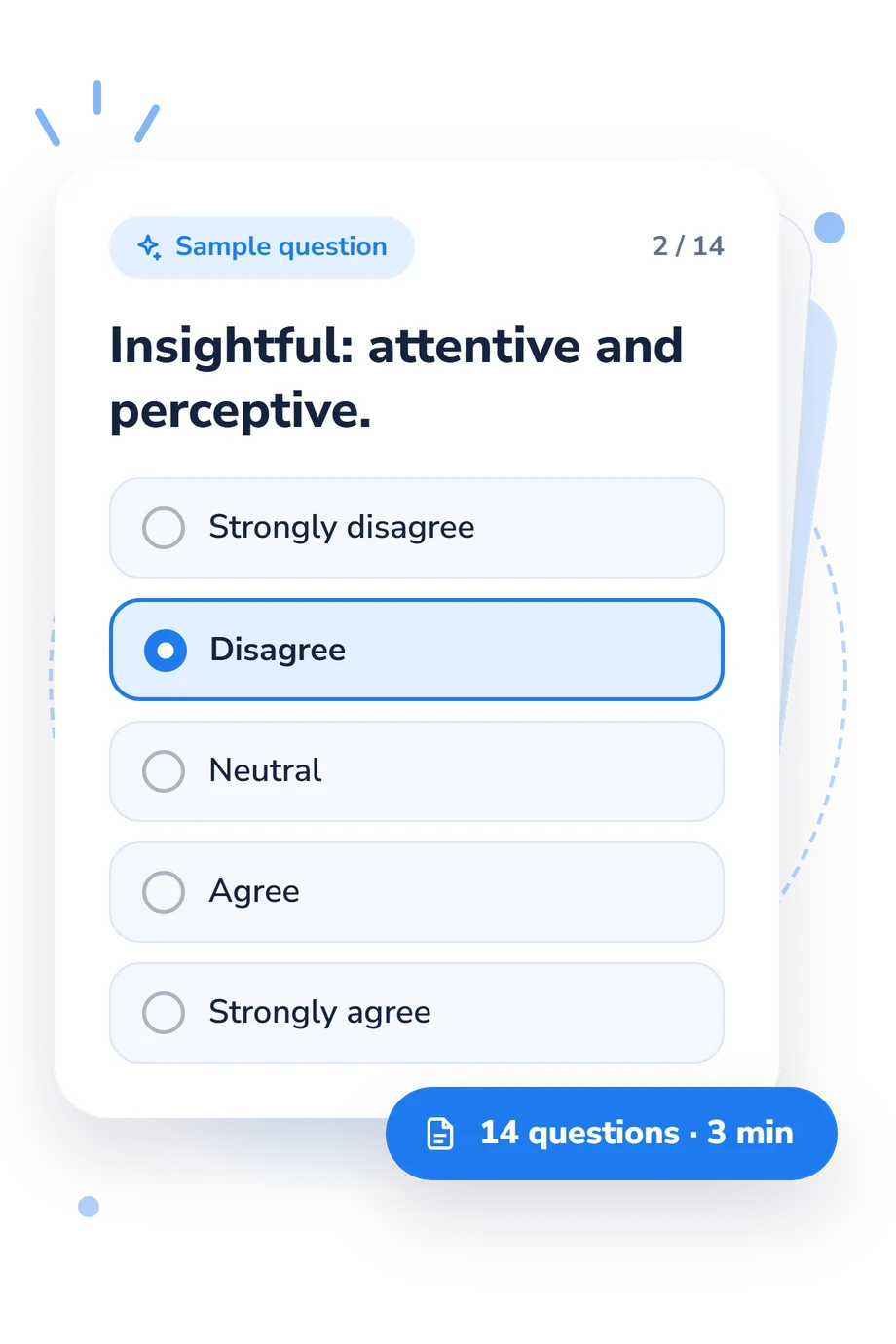
Please read all 14 items carefully. To what extent does each item correspond to your view of yourself as a leader? Indicate your response by selecting one of five options. Then ask five people you know (e.g., a roommate, coworkers, relatives, friends, etc.) to complete this questionnaire. Obtain their ratings of your leadership qualities.
    • Strongly disagree
    • Disagree
    • Neutral
    • Agree
    • Strongly agree
    • Strongly disagree
    • Disagree
    • Neutral
    • Agree
    • Strongly agree
    • Strongly disagree
    • Disagree
    • Neutral
    • Agree
    • Strongly agree
WHAT THE TEST MEASURES
About This Assessment
Questionnaire for Assessing Leadership Qualities Test

Leadership Qualities Questionnaire Test - Symptoms and Signs

leadership

This brief self-report measure is designed to screen for leadership-related personal qualities and typical behavioral tendencies. The Leadership Qualities Questionnaire can be used as a structured starting point for discussing perceived strengths and areas for development in leadership contexts.

The measure consists of 14 items and typically requires about 3 minutes to complete. Items ask respondents to rate their usual reactions in situations involving influence, decision-making, and working with others.

Results from the Leadership Qualities Questionnaire should be interpreted as descriptive and hypothesis-generating, and considered alongside collateral information (e.g., observed performance, supervisor feedback, or other validated measures). Author: Bruce J. Avolio.

Author: Bernard M. Bass, Bruce J. Avolio
Literature: Northouse, P. G. Leadership: Theory and practice. SAGE Publications. 2022.
Popular tests
Comments
Leave a Comment