
Creative Activity Assessment Test
How the Scales are Structured
Who Usually Takes This Test?
See How You Compare
Below is a preview of how scores are typically distributed across each scale.
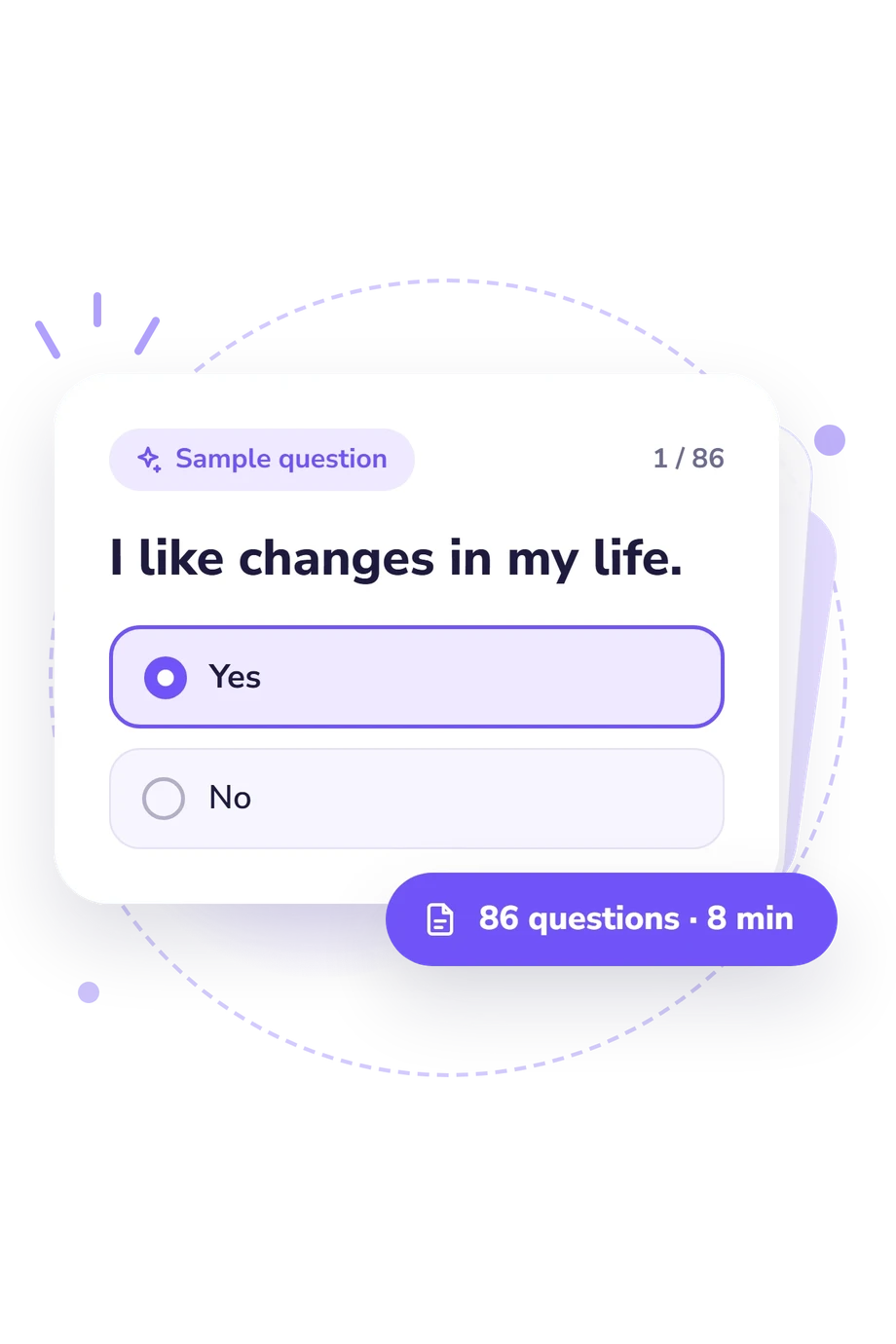
Example Questions From the Test
- Yes
- No
- Yes
- No
- Yes
- No
Creative Activity Assessment Test - Description and methodology of the test
People who want to understand how they approach novelty, learning, and problem solving may find the Creative Activity Assessment Test useful. It is intended for readers reflecting on their educational, professional, or everyday behavior, especially when they regularly face open-ended tasks. The result offers a practical lens on creative problem solving and original responses rather than measuring artistic skill alone.
What This Assessment Explores
The questionnaire examines creative activity through choices, interests, and habits. Items address change, curiosity, varied experiences, initiative, cross-disciplinary learning, hands-on making, and responses to difficulty. It suits people reflecting on how they learn, work, teach, or handle unfamiliar demands.
The result offers an assessment of original thinking through one score, Personal Creative Activity (A), 0-10. The displayed bands are Low 0-4, Moderate 5-7, and High 8-10. A higher band indicates stronger signs of novelty-seeking, initiative, flexible thinking, and creative self-expression in the situations covered.
The questions touch on these recurring areas:
- Openness to change shows how readily a person welcomes variety and unfamiliar experiences.
- Curiosity and breadth of interest indicate movement beyond routine or narrow concerns.
- Applied initiative reflects willingness to start new work and use nontraditional methods.
- Flexible problem solving captures noticing hidden problems and considering possible solutions.
Methodology and Scientific Basis
Shown items present statements about preferences, habits, or behaviors with Yes/No response options. Answers are combined into the displayed score; only the total scale and displayed bands are defined, so individual item contributions cannot be inferred.
The closest named source is Teacher Creative Activity Methodology (Rakitskaya & Kashapov, 2001). The questionnaire is conceptually consistent with that work, but that source does not establish this online version as the same standardized instrument. Torrance's framework examines creativity through observable responses, while self-report cannot capture every aspect of creative performance.
Research by Donina & Khachaturova (2021) and Kashapov & Dudyreva (2013) links teacher creativity with changing educational practice and support for gifted learners. These studies clarify the relevance of initiative, flexibility, curiosity, and nonstandard solutions, but provide no norms for this result.
The questionnaire provides an indication of creative potential, not a complete account of ability. Mood, context, self-awareness, and response bias can affect answers. Its displayed bands describe this score, not external normative or clinical cutoffs; interpret the result alongside real-life examples or broader assessment.
- Rakitskaya, O. N., & Kashapov, M. M. (2001). Methodology for determining the creative activity of the teacher's personality. Vash Psikholog (Your Psychologist).
- Donina, I. A., & Khachaturova, K. R. (2021). Creativity of teacher in conditions of digital transformation of education. In D. Y. Krapchunov, S. A. Malenko, V. O. Shipulin, E. F. Zhukova, A. G. Nekita, & O. A. Fikhtner (Eds.), Perishable and Eternal: Mythologies and Social Technologies of Digital Civilization, vol. 120, European Proceedings of Social and Behavioural Sciences (pp. 824-831). European Publisher. 10.15405/epsbs.2021.12.03.109
- Kashapov, M. M., & Dudyreva, N. V. (2013). Structure of the psychological readiness of a teacher to work with gifted children. Bulletin of Kostroma State University, 19(2), 29-33.
- Torrance, E. P. (1988). Creativity as manifest in testing. In R. J. Sternberg (Ed.), The Nature of Creativity: Contemporary Psychological Perspectives (pp. 43-75). Cambridge University Press.
Updated: