
Eyberg Child Behavior Inventory (ECBI) Test
How the Scales are Structured
Who Usually Takes This Test?
See How You Compare
Below is a preview of how scores are typically distributed across each scale.
Example Questions From the Test
- 1 : Never
- 2: Rarely
- 3
- 4 : Sometimes
- 5
- 6 : Often
- 7 : Always
- Yes
- No
- 1 : Never
- 2 : Rarely
- 3
- 4 : Sometimes
- 5
- 6: Often
- 7: Always
Eyberg Child Behavior Inventory (ECBI) Test - Description and methodology of the test
Parents and caregivers who want a structured view of a child’s everyday conduct may find the Eyberg Child Behavior Inventory (ECBI) Test useful for organizing concerns that can otherwise feel scattered. It focuses on behavior as observed in ordinary family and peer situations, helping the respondent compare perceived difficulty with how often particular behaviors occur. This inventory’s child behavior profile can support clearer conversations about patterns that deserve attention.
What This Assessment Measures
Used as a child behavior assessment, it samples routines, rules, emotional reactions, aggression, peer relations, attention, activity, and self-care. The respondent rates observed behavior, so the result reflects an adult’s view of the child in everyday context.
The two displayed scales describe complementary parts of that profile:
- The Problem Scale (0-36) reflects how problematic the parent finds the behavior: Low concern (0-14) suggests no pronounced difficulty, while Elevated concern (15-36) signals greater adult concern.
- The Intensity Scale (36-252) reflects how often behavior problems occur: Normal range (36-126) indicates low-to-moderate frequency, while Elevated (127-252) indicates more frequent difficulties.
Together, the results can show whether concern relates mainly to perceived problem level, behavior frequency, or both. The assessment suits adults who know the child well and can consider recurring patterns rather than one unusually difficult event.
Methodology and Scientific Basis
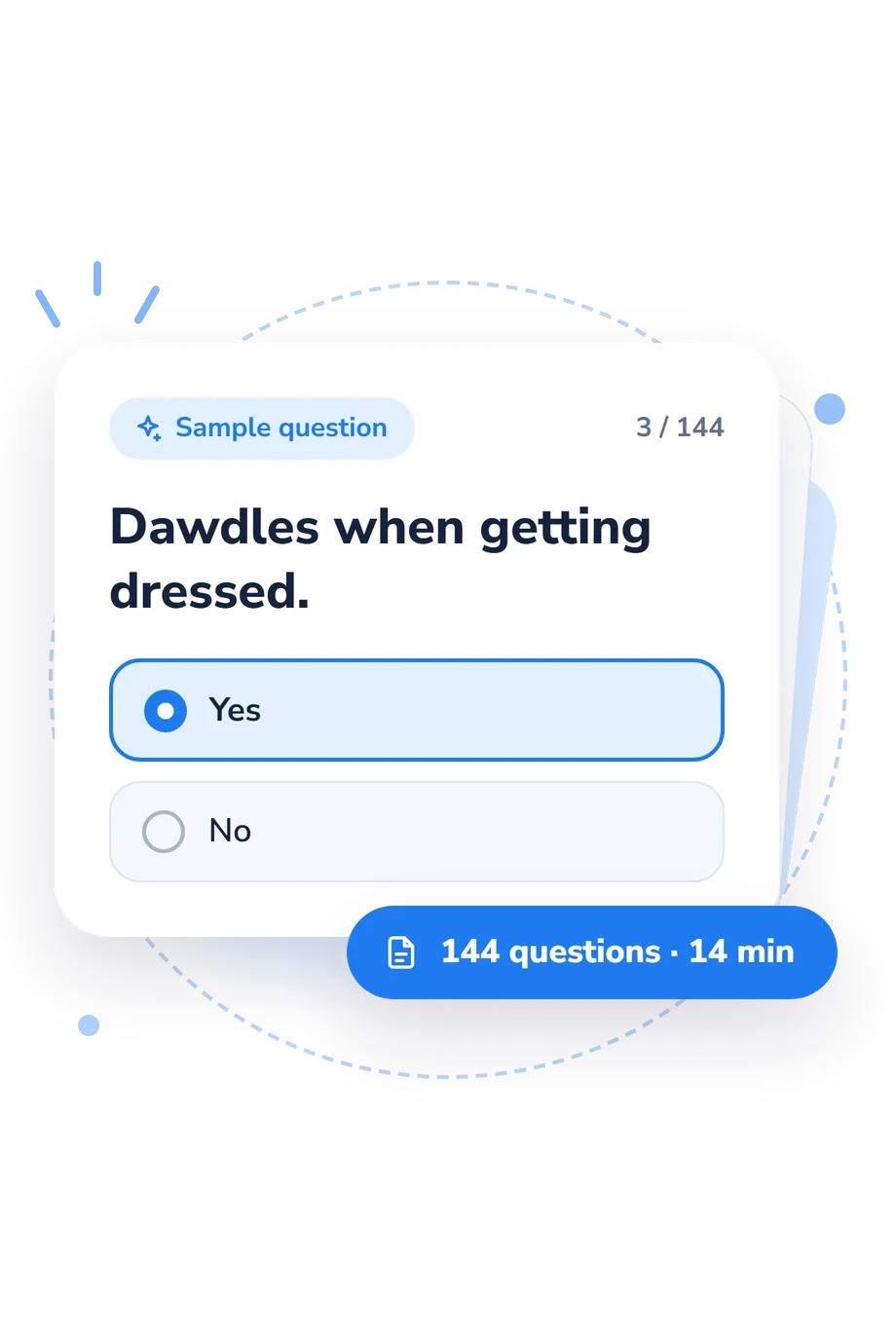
The response format mixes two kinds of prompts. Some statements ask how often a behavior occurs, with choices from Never to Always; others use a Yes/No response. This structured parent-report method captures frequency and the presence of specific behaviors without requiring a narrative. An ECBI assessment therefore depends on consistent, honest observation across routines and settings.
Responses are summarized into two displayed scores. Higher values on the first reflect greater parental concern, while higher values on the second reflect more frequent behavior problems. The frequency-related result can help monitor change across repeated administrations; the displayed bands are not universal clinical cutoffs.
The evidence base includes the original ECBI validation study by Eyberg and Ross, the professional manual by Eyberg and Pincus, and later work by Rich and Eyberg on discriminative and predictive usefulness. This online questionnaire is conceptually consistent with the published ECBI, but it is not a separately standardized online version. Current stress, recall, expectations, and context can shape self-report, so interpret the result alongside the child’s circumstances and broader assessment.
- Eyberg, S. M., & Ross, A. W. (1978). Assessment of child behavior problems: The validation of a new inventory. Journal of Clinical Child Psychology, 7(2), 113-116. 10.1080/15374417809532835
- Eyberg, S. M., & Pincus, D. (1999). Eyberg Child Behavior Inventory and Sutter-Eyberg Student Behavior Inventory-Revised: Professional manual. Odessa, FL: Psychological Assessment Resources.
- Rich, B. A., & Eyberg, S. M. (2001). Accuracy of assessment: The discriminative and predictive power of the Eyberg Child Behavior Inventory. Ambulatory Child Health, 7(3-4), 249-257. 10.1046/j.1467-0658.2001.00141.x
Updated: