
Multidimensional Scale of Perceived Social Support (MSPSS) Test
How the Scales are Structured
Who Usually Takes This Test?
See How You Compare
Below is a preview of how scores are typically distributed across each scale.
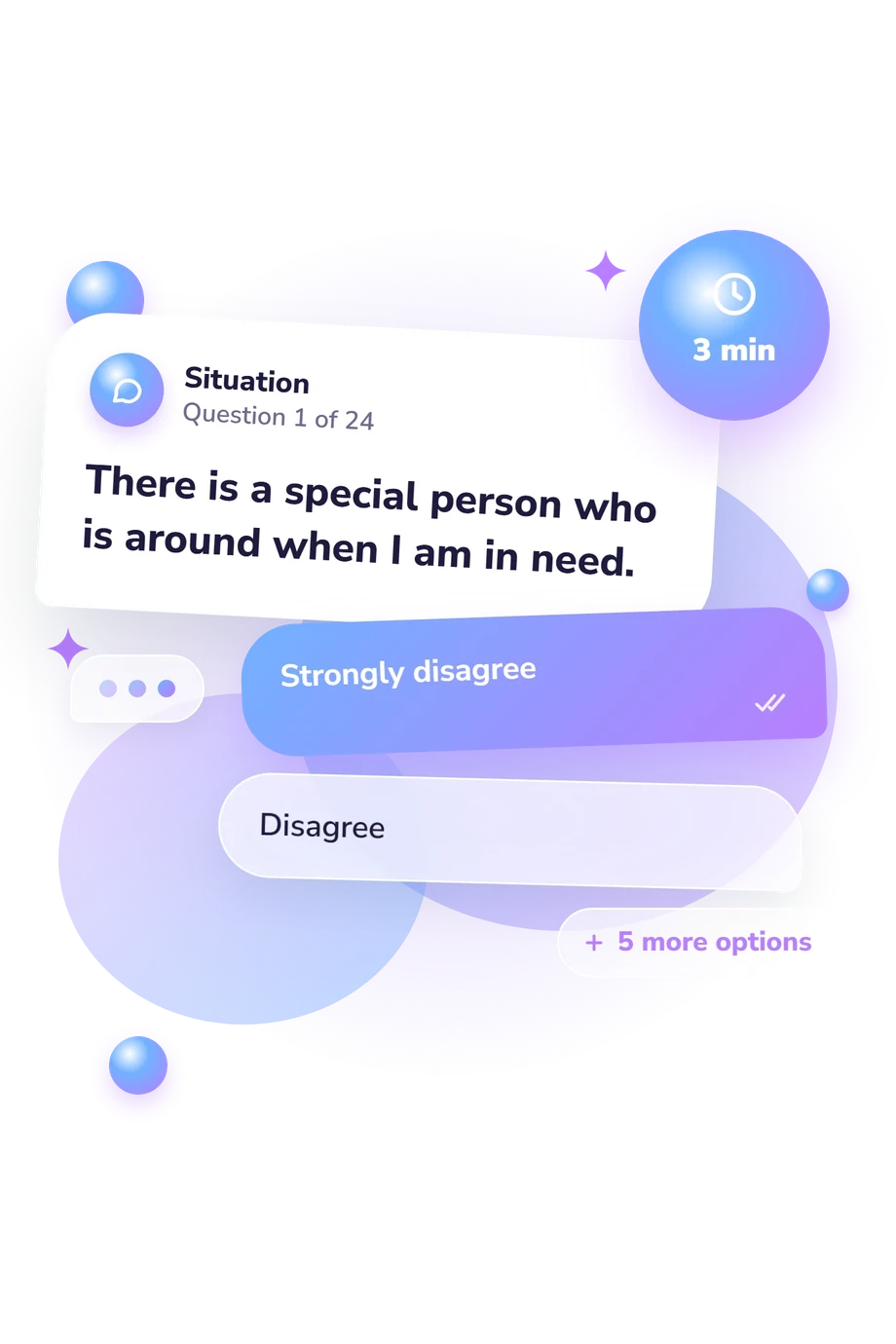
Example Questions From the Test
- Very strongly disagree
- Disagree
- Somewhat disagree
- Neutral
- Somewhat agree
- Agree
- Very strongly agree
- Very strongly disagree
- Disagree
- Mildly disagree
- Neutral
- Mildly agree
- Agree
- Strongly agree
- Very strongly disagree
- Strongly disagree
- Somewhat disagree
- Neither agree nor disagree
- Somewhat agree
- Strongly agree
- Very strongly agree
Multidimensional Scale of Perceived Social Support (MSPSS) Test - Description and methodology of the test
People who want to understand how supported they feel in everyday relationships can use this tool to organize perceptions that may otherwise remain unclear. The Multidimensional Scale of Perceived Social Support (MSPSS) Test offers structured reflection when someone considers what their current sense of support means for self-understanding or a relationship conversation. This questionnaire is a perceived social support test that turns a vague impression into a clearer starting point for reflection.
What This Assessment Explores
The questionnaire examines perceived emotional and practical support from three sources. Items ask whether someone is available in need, whether problems can be discussed, joys and sorrows shared, feelings cared about, or decisions supported. The MSPSS questionnaire measures perceived access to support, not contacts or relationship quality.
The result is organized into these dimensions:
- Friend Support (1-7) shows how much the respondent can rely on friends; Low support is 1-3.6 and High support is 3.7-7.
- Significant Other Support (1-7) reflects perceived care from a partner, mentor, or another significant person; Low support is 1-3.7 and High support is 3.8-7.
- Family Support (1-7) describes perceived help, emotional support, and decision-making assistance from family; Low is 1-3.9 and High is 4-7.
Together, the scores form a profile of stronger and weaker perceived support sources.
Methodology and Scientific Basis
Each statement uses a seven-point agreement scale with a neutral midpoint, but labels vary: items use very strongly, strongly, or mildly before agree or disagree, and some say neither agree nor disagree. Responses are grouped by relationship source, and higher values indicate greater perceived support on each dimension. This social support assessment creates a comparative profile rather than a single overall score.
Its structure is conceptually consistent with Multidimensional Scale of Perceived Social Support (Zimet et al., 1988), which separates family, friends, and a significant person. This online questionnaire is not presented as an adaptation of that published instrument. Zimet et al. (1990) examined its psychometric characteristics, while Dambi et al. (2018) reviewed evidence from cross-cultural translations and adaptations. Published MSPSS findings and norms do not automatically apply to this online questionnaire or its displayed scoring.
For interpretation, read each band alongside the item wording and current circumstances. The bands are descriptive categories, not clinical cutoffs; mood, recent conflict, self-awareness, and the meaning assigned to a significant relationship can affect self-report. The result identifies perceived patterns but cannot explain their causes or establish the objective quality of a relationship.
- Zimet, Gregory D., Nancy W. Dahlem, Sara G. Zimet, and Gordon K. Farley. "The Multidimensional Scale of Perceived Social Support." Journal of Personality Assessment, 52(1), 30–41 (1988). 10.1207/s15327752jpa5201_2
- Zimet, Gregory D., Susan S. Powell, Gordon K. Farley, Susan Werkman, and Kathleen A. Berkoff. "Psychometric Characteristics of the Multidimensional Scale of Perceived Social Support." Journal of Personality Assessment, 55(3–4), 610–617 (1990). 10.1080/00223891.1990.9674095
- Dambi, Jermaine M., Lieselotte Corten, Matthew Chiwaridzo, Helen Jack, Tecla Mlambo, and Jennifer Jelsma. "A Systematic Review of the Psychometric Properties of the Cross-Cultural Translations and Adaptations of the Multidimensional Perceived Social Support Scale (MSPSS)." Health and Quality of Life Outcomes, 16, Article 80 (2018). 10.1186/s12955-018-0912-0
Updated: