
Self-Control Questionnaire Test
How the Scales are Structured
Who Usually Takes This Test?
See How You Compare
Below is a preview of how scores are typically distributed across each scale.
Example Questions From the Test
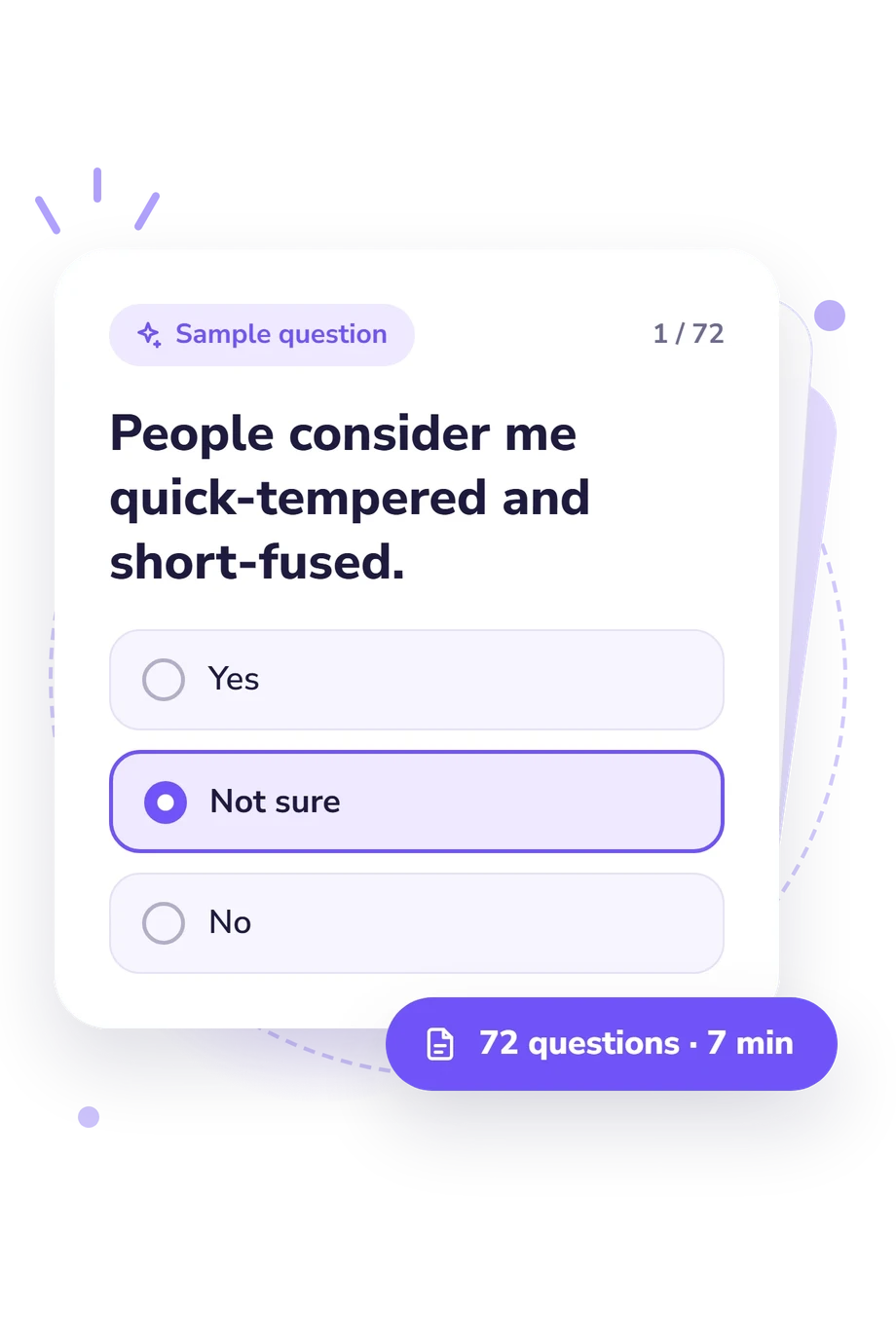
- Yes
- Not sure
- No
- In any case
- Sometimes
- Only if someone insists
- Always
- Sometimes
- Rarely
Self-Control Questionnaire Test - Description and methodology of the test
People who want to understand how they regulate conduct, feelings, and everyday demands can use the Self-Control Questionnaire Test. As a self-control assessment, it supports focused reflection on communication, work habits, planning, emotional expression, and reactions under pressure. The resulting profile highlights areas that appear more developed and situations in which deliberate monitoring may be useful.
What This Assessment Explores
Across everyday situations, this self-control evaluation examines regulation of conduct, emotions, communication, planning, work monitoring, orderliness, and impulsive reactions. The profile suits readers seeking a structured picture of everyday self-regulation across social and task situations.
The four displayed dimensions describe the following parts of the profile:
- Social Self-Control (0-24) measures regulation in interactions; bands: Lower social self-control (0-8), Moderate social self-control (9-16), and Higher social self-control (17-24).
- Self-Control in Activities (0-24) measures forecasting, planning, monitoring, and review; bands: Low (0-8), Moderate (9-16), High (17-24).
- Emotional Self-Control (0-24) measures management of feelings and expression; bands: Low (0-11), Moderate (12-17), High (18-24).
- Self-Control Level (0-72) summarizes action, emotion, and behavior regulation; bands: Low (0-24), Moderate (25-48), High (49-72).
Methodology and Evidence Base
The representative items use first-person statements with three alternatives expressing frequency, agreement, certainty, or a preferred response. The items cover social conduct, activity planning and monitoring, and emotional expression. As a questionnaire for self-control, it captures reported habits, so interpretation depends partly on accurate self-observation.
The questionnaire reports the displayed dimensions, but the answer-to-score calculation is not specified. The bands describe low, moderate, or high results; the score ranges alone do not show how many points each answer contributes.
The closest published reference is the self-control questionnaire published by Nikiforov, Vasilyev, and Firsova in 1989. This online questionnaire is conceptually consistent with that instrument, but it is neither an adaptation nor a verbatim reproduction, and it has not been validated as that instrument. Ilyin (2009) supplies a compatible account of volitional regulation, and Podkorytova and colleagues (2023) connect self-regulation with planning, monitoring, and professional development.
Read the result as a structured snapshot of tendencies, not a fixed ability. Self-report varies with current mood, context, self-awareness, and candor; the displayed bands are descriptive categories rather than population norms or diagnostic thresholds.
- Nikiforov, G. S. (1989). Human Self-Control. Leningrad: Leningrad University Press, 192 pp. ISBN 5-288-00270-3.
- Ilyin, E. P. (2009). Psychology of Will (2nd ed., revised and expanded). Saint Petersburg: Piter, 368 pp. ISBN 978-5-388-00269-3.
- Podkorytova, L., Havrylkevych, V., Romanovska, L., Kravchyna, T., Chovgan, O., & Oliynyk, K. (2023). Development of Psychology Students’ Self-Regulation in the Process of Professional Training. Pertanika Journal of Social Sciences and Humanities, 31(1), 161-181. 10.47836/pjssh.31.1.09
Updated: