
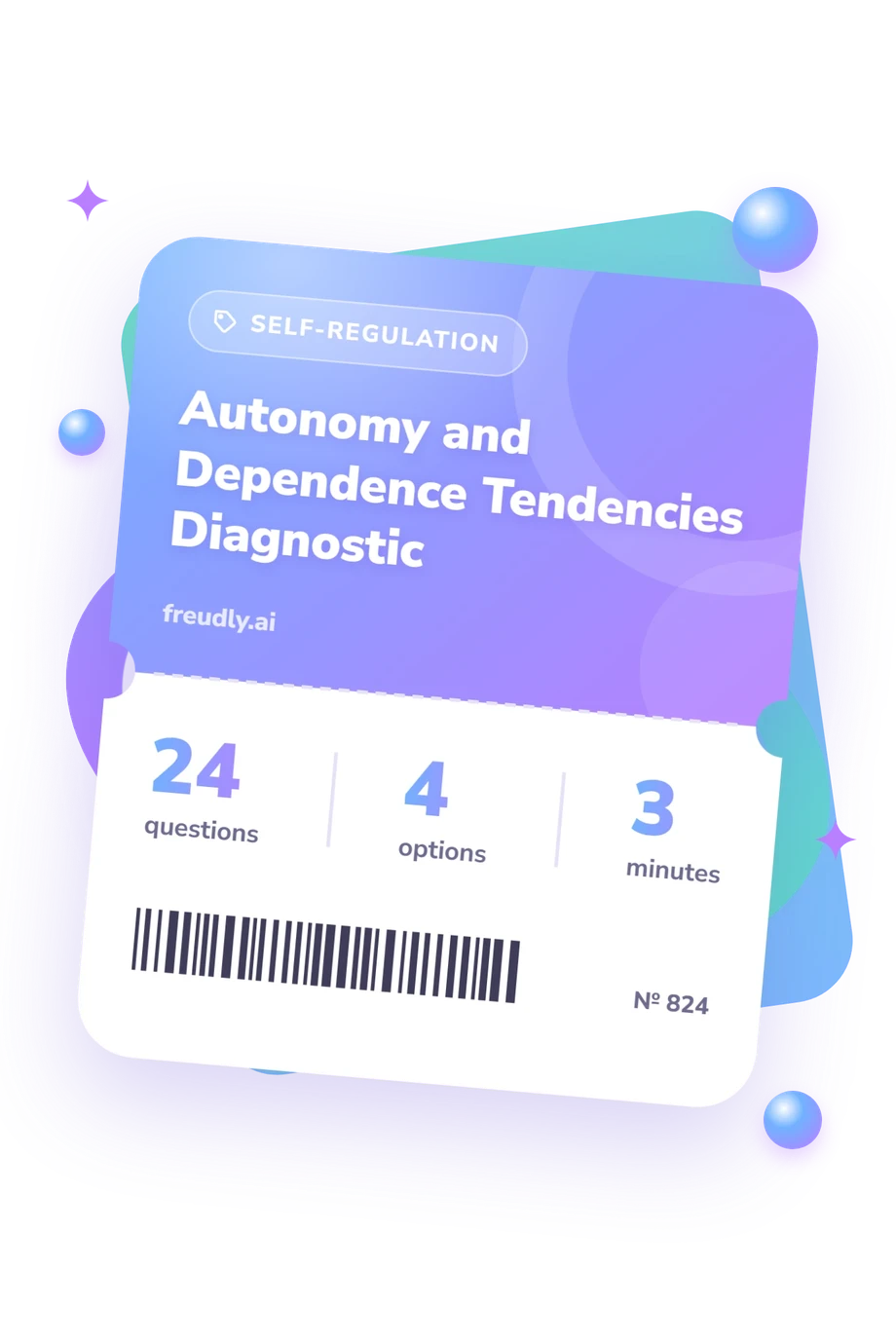
Autonomy and Dependence Tendencies Diagnostic Test
How the Scales are Structured
Who Usually Takes This Test?
See How You Compare
Below is a preview of how scores are typically distributed across each scale.
Example Questions From the Test
- Yes
- Probably yes
- Probably no
- No
- Yes
- Probably yes
- Probably no
- No
- Yes
- Probably yes
- Probably no
- No
Autonomy and Dependence Tendencies Diagnostic Test - Description and methodology of the test
People who want to understand how they approach choices, obligations, and outside guidance can use this assessment to examine everyday patterns. The Autonomy and Dependence Tendencies Diagnostic Test considers whether behavior appears more self-directed or more reliant on external direction. It offers a practical starting point for reflecting on decision-making tendencies, responsibility, and task management.
What This Assessment Explores
The result describes a tendency rather than a fixed identity. Higher autonomy reflects greater independence and self-reliance in decisions and tasks, while lower scores reflect dependence on external advice and direction. A mixed result represents an intermediate pattern between dependence and autonomy.
The questionnaire addresses commitment, responsibility, correction of poor work, reactions to others’ opinions, fear of consequences, rest, and competing demands. It suits readers examining everyday functioning and personal responsibility.
The questions bring together four themes:
- Decision confidence shows how readily a person chooses without avoiding possible consequences.
- Responsibility reflects responses to promises, duties, deadlines, and poorly completed work.
- Self-management indicates how activities, planned tasks, and rest are balanced.
- Social independence captures the role of others’ opinions in judging one’s actions.
Autonomy-Dependence Scale ranges from 0-12. Bands are Dependent 0-4, Mixed 5-8, and Autonomous 9-12.
Methodology and Scientific Basis
Each item uses four choices: Yes, Probably yes, Probably no, and No. The statements ask for self-judgments about decision-making independence, keeping promises, study and household tasks, rest, social opinions, and competing activities. They describe perceived behavior, not performance.
It produces a combined result. Because the point assigned to each answer and reverse-scoring procedure are undocumented, the displayed bands should not be converted into a percentage or assumed four-point formula.
Its closest source is the Autonomy-Dependence Questionnaire (Prygin, 2009). This online questionnaire is conceptually consistent with that work, but this questionnaire has no stated standardized norms, reliability estimates, or reproduced validation data; its displayed bands are descriptive catalogue categories. Prygin (1984) discusses autonomy and dependence in study, while Burykina and Dorontsova (2017) connect autonomy with self-management.
Deci and Ryan (2000) provide context for self-directed regulation and external pressure; this does not show that self-determination theory is measured fully. The result makes this tendency visible for reflection. Self-report may shift with context, fear of consequences, social desirability, and self-awareness, so the score is a self-reflection tool rather than a diagnosis.
- Prygin, G. S. (2009). Psychology of Independence: Monograph. Izhevsk and Naberezhnye Chelny: Institute of Management Press, 408 pp.
- Burykina, M. Yu., & Dorontsova, O. A. (2017). Comparative Analysis of Behavior Self-Management and Self-Regulation in Adolescents with Different Levels of Autonomy. Izvestiya of Saratov University. Educational Acmeology. Developmental Psychology, 6(3), 239-243. 10.18500/2304-9790-2017-6-3-239-243
- Prygin, G. S. (1984). The Manifestation of the Autonomy-Dependence Phenomenon in Educational Activity. New Research in Psychology, 2, 48-52.
- Deci, E. L., & Ryan, R. M. (2000). The “What” and “Why” of Goal Pursuits: Human Needs and the Self-Determination of Behavior. Psychological Inquiry, 11(4), 227-268. 10.1207/S15327965PLI1104_01
Updated: