
Ontological Security Test
How the Scales are Structured
Who Usually Takes This Test?
See How You Compare
Below is a preview of how scores are typically distributed across each scale.
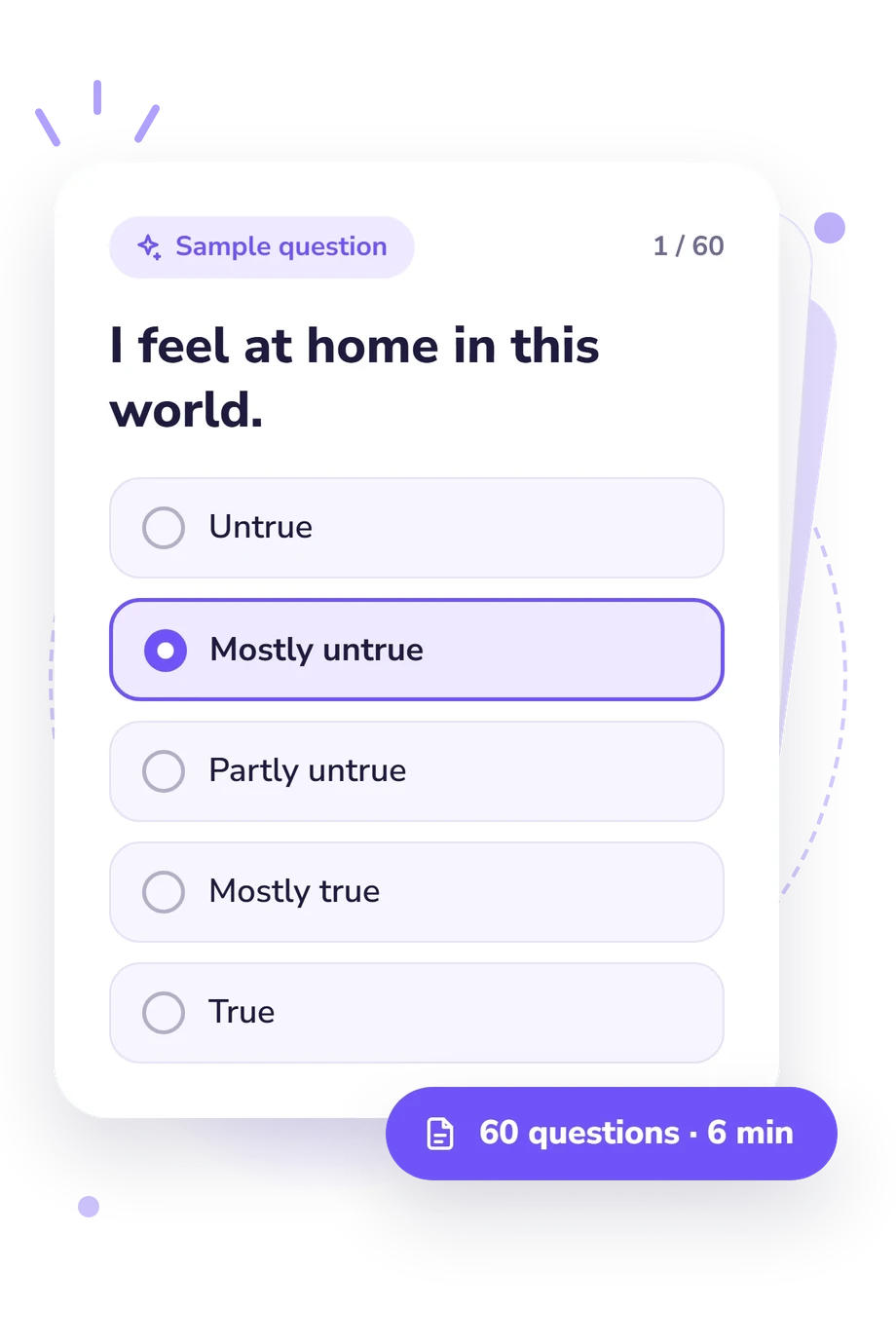
Example Questions From the Test
- Not true
- Mostly untrue
- Partly untrue
- Mostly true
- True
- Untrue
- Mostly untrue
- Partly untrue
- Mostly true
- True
- Untrue
- Mostly untrue
- Partly untrue
- Mostly true
- True
Ontological Security Test - Description and methodology of the test
People seeking a structured way to reflect on their inner experience may benefit from the Ontological Security Test, especially when they want a more organized view than free-form journaling provides. This questionnaire is an ontological security questionnaire that returns a profile across several areas rather than a single verdict. It can help readers identify which parts of their current experience deserve closer attention.
What This Assessment Explores
This ontological insecurity test organizes authenticity, agency, connection, and safety across self, relationships, and surroundings.
- False Self (8-40): higher scores reflect insecurity, alienation, and possible fragmentation; Low 8-18, Moderate 19-29, High 30-40.
- Autonomy (7-35): higher scores indicate independent decisions and internal freedom; Low autonomy 7-16, Moderate autonomy 17-26, High autonomy 27-35.
- Vital Interpersonal Contact (8-40): higher scores indicate interest in others, dialogue, and trusting connection; Low 8-18, Moderate 19-29, High 30-40.
- Vital Contact With the World (7-35): higher scores indicate life satisfaction, a reliable world, and safety; Low vital connection 7-16, Moderate vital connection 17-25, High vital connection 26-35.
- Overall Ontological Security (-18-102): higher scores indicate greater autonomy, harmony, connectedness, and confidence in existence; Low -18-22, Moderate 23-62, High 63-102.
Methodology and Scientific Basis
The items are short first-person statements about self-experience, relationships, decisions, life satisfaction, and security. Most use five ordered choices from untrue to true, with intermediate options such as mostly or partly true. Positive and insecurity-focused statements both appear, asking how closely each fits the respondent.
Responses are grouped into thematic dimensions and an overall result. The questionnaire does not state item weighting or reverse-keying clearly enough to reconstruct point-by-point scoring, so ranges should not be used to infer how each answer contributes.
The conceptual basis is R. D. Laing's account of ontological security and insecurity, centered on a stable self, agency, and contact with reality and others. It is conceptually consistent with the OS (PM) psychometric method described by Kopteva in 2013, but is not a direct reproduction.
Read as an ontological security assessment, this result offers a snapshot of lived experience. The displayed bands should not be treated as established population norms or diagnostic thresholds; current context, self-awareness, and impression management can affect responses, so the result is best read as reflection rather than a clinical conclusion.
- Kopteva, Natalia Vasil'evna, and Aleksej Yur'evich Kalugin. "Revisiting the Values Which Correspond to the Ontological Security." Biosciences Biotechnology Research Asia, vol. 12, no. 1, 2015, pp. 815-822. 10.13005/bbra/1727.
- Kopteva, Natalia Vasiljevna. "R. D. Laing's Conception of Ontological Insecurity-Security." Siberian Psychological Journal, no. 37, 2010, pp. 66-70.
- Laing, R. D. The Divided Self: A Study of Sanity and Madness. Tavistock Publications, London, 1960.
Updated: