
Freudly+971 508685814hello@freudly.ai
Freudly
family

Adolescent Crisis Symptom Severity Questionnaire Test
Take the online Adolescent Crisis Symptom Severity Questionnaire Test - AI psychologist FreudlyYou can take Adolescent Crisis Symptom Severity Questionnaire Testhere. Online version of a simple and accurate psychological test with interpretation.en
Understand the intensity and types of adolescent crisis symptoms in about 9 minutes. With 44 items, it supports quick decisions, tracking progress, and planning next steps for teens ages 10 to 15.
Start Online Test
Questions: 449 minutes
08:30
October 2, 2025
October 2, 2025
Material has been updated
October 2, 2025
Material has been published
30,088 views
3,141 completion
2,715 likes
Verified by Daniel Hall
Psychologist with 25 years of experience
Share
Scale Explorer

How the Scales are Structured

example score
5/12
Interest in the Inner World (IitIW)
Measures a teenager’s tendency toward self-reflection and interest in understanding their own feelings and experiences.
Low
Moderate
High
04: Low | 58: Moderate | 912: High
A score of 5 falls in the Moderate range, suggesting a noticeable but not strongly pronounced interest in self-exploration and reflection.
example score
5/12
Hobby-Related Reactions (HRR)
Measures how strongly a teenager engages in hobbies and activities as a constructive outlet during adolescence-related stress.
Low engagement
Moderate engagement
High engagement
04: Low engagement | 58: Moderate engagement | 912: High engagement
A score of 5 falls in the Moderate engagement range, suggesting the teenager shows some constructive involvement in hobbies that may help regulate crisis-related experiences.
example score
9/12
Spatial Autonomy (SA)
Spatial autonomy measures a teenager’s need for personal space and independence in organizing daily life.
Low
Moderate
High
04: Low | 58: Moderate | 912: High
A score of 9 falls in the High range, suggesting a pronounced preference for privacy, solitude, and self-directed independence.
example score
6/12
Behavioral Emancipation (BE)
Behavioral Emancipation measures how strongly an adolescent strives for independence in actions and decision-making.
Low
Moderate
High
04: Low | 58: Moderate | 912: High
A score of 6 falls in the Moderate range, suggesting a noticeable but balanced tendency toward independent behavior and decision-making.
example score
4/12
Normative Emancipation (NE)
Measures the adolescent’s tendency toward independence and autonomy expressed within accepted social and family norms.
Low
Moderate
High
04: Low | 58: Moderate | 912: High
A score of 4 falls in the Low range, suggesting relatively limited normative independence and a stronger reliance on adult guidance within expected rules.
example score
5/12
Emotional Emancipation (EE)
This scale measures how strongly a teenager seeks emotional independence from parents and other adults.
Low
Moderate
High
04: Low | 58: Moderate | 912: High
A score of 5 falls in the Moderate range, suggesting a noticeable but not extreme preference for emotional autonomy from adults.
example score
4/12
Grouping Reaction (GR)
Measures the adolescent’s tendency to seek belonging, support, and recognition within a peer group.
Low
Moderate
High
04: Low | 58: Moderate | 912: High
A score of 4 falls in the Low range, suggesting a relatively limited current drive to join or rely on a peer group for support and recognition.
example score
6/12
Overcompensation Reaction (OR)
Measures the tendency to cope with perceived weaknesses by overachieving, excessive activity, or demonstrative displays of strength to assert oneself.
Low
Moderate
High
04: Low | 58: Moderate | 912: High
A score of 6 falls in the Moderate range, suggesting a noticeable but not dominant tendency toward hypercompensation through heightened effort or self-assertive behavior.
example score
5/12
Oppositional Reaction (OR)
Assesses the severity of an adolescent’s tendency to resist adult demands and established rules.
Low
Moderate
High
04: Low | 58: Moderate | 912: High
A score of 5 falls in the Moderate range, suggesting occasional oppositional responses and some difficulty accepting adult direction or rules.
example score
8/12
Imitation Response (IR)
Measures how strongly a teenager tends to imitate others, follow trends, or defer to authorities rather than act independently.
Low
Moderate
High
04: Low | 58: Moderate | 912: High
A score of 8 falls in the Moderate range, suggesting a noticeable but not extreme tendency to adopt others’ opinions or behaviors when responding to adolescent challenges.
example score
4/12
Affect of Inadequacy (AoI)
Measures the intensity of feelings of personal failure, insecurity, and inadequacy that can arise during adolescence.
Low
Moderate
High
04: Low | 58: Moderate | 912: High
A score of 4 falls in the Low range, suggesting relatively mild feelings of inadequacy and insecurity in current reactions.
example score
53/100
Overall Crisis Index (OCI)
Measures the overall cumulative severity of crisis-related symptoms and adaptation difficulties during adolescence.
Low
Moderate
High
033: Low | 3466: Moderate | 67100: High
A score of 53 falls in the Moderate range, indicating a noticeable but not extreme overall level of crisis manifestations that may warrant attentive monitoring and supportive planning.
Start Online Test
just completed the test
DATA-BASED USER COHORTS

Who Usually Takes This Test?

School psychologists
46%OF USERS
Use it to quickly gauge crisis symptom severity in students aged 10–15 and plan school-based support or referrals.
Parents seeking clarity
33%OF USERS
Take it to better understand a teen’s intense mood or behavior changes and decide what kind of help is needed.
Social workers and educators
21%OF USERS
Use it to screen for risky crisis reactions and track changes over time within youth support programs.
BASED ON AGGREGATED, ANONYMIZED DATA FROM TENS OF THOUSANDS OF FREUDLY USERS.
Benchmarking

See How You Compare

Once you complete the test, your results are compared with real-world data from people in your country.
Below is a preview of how scores are typically distributed across each scale.
Interest in the Inner World (IitIW)
Average
8.4
Normal range
6.510.2
min.
0
max.
12
This curve shows how scores are typically distributed.
Once you complete the test, your result will appear on the scale so you can see how you compare.
Hobby-Reactions (H)
Hobby-Reactions (H)
Average
4.4
Normal range
2.96
min.
0
max.
12
This curve shows how scores are typically distributed.
Once you complete the test, your result will appear on the scale so you can see how you compare.
Spatial autonomy (Sa)
Average
6.1
Normal range
4.57.7
min.
0
max.
12
This curve shows how scores are typically distributed.
Once you complete the test, your result will appear on the scale so you can see how you compare.
Behavioral Emancipation (BE)
Average
5.9
Normal range
47.7
min.
0
max.
12
This curve shows how scores are typically distributed.
Once you complete the test, your result will appear on the scale so you can see how you compare.
Legal Emancipation (LE)
Average
8.4
Normal range
6.710.2
min.
0
max.
12
This curve shows how scores are typically distributed.
Once you complete the test, your result will appear on the scale so you can see how you compare.
Emotional emancipation (Ee)
Average
5.4
Normal range
3.77.1
min.
0
max.
12
This curve shows how scores are typically distributed.
Once you complete the test, your result will appear on the scale so you can see how you compare.
Grouping reaction (Gr)
Average
5
Normal range
3.46.6
min.
0
max.
12
This curve shows how scores are typically distributed.
Once you complete the test, your result will appear on the scale so you can see how you compare.
Hypercompensation Reaction (HR)
Average
7
Normal range
59
min.
0
max.
12
This curve shows how scores are typically distributed.
Once you complete the test, your result will appear on the scale so you can see how you compare.
Opposition Reaction (OR)
Average
5.2
Normal range
37.3
min.
0
max.
12
This curve shows how scores are typically distributed.
Once you complete the test, your result will appear on the scale so you can see how you compare.
Imitation Response (IR)
Average
7.8
Normal range
5.79.8
min.
0
max.
12
This curve shows how scores are typically distributed.
Once you complete the test, your result will appear on the scale so you can see how you compare.
Affect of Inadequacy (AoI)
Average
3.9
Normal range
1.76.1
min.
0
max.
12
This curve shows how scores are typically distributed.
Once you complete the test, your result will appear on the scale so you can see how you compare.
Overall Crisis Indicator (OCI)
Average
68.5
Normal range
55.381.7
min.
0
max.
100
This curve shows how scores are typically distributed.
Once you complete the test, your result will appear on the scale so you can see how you compare.
Featured On
SAMPLE QUESTIONS

Example Questions From the Test

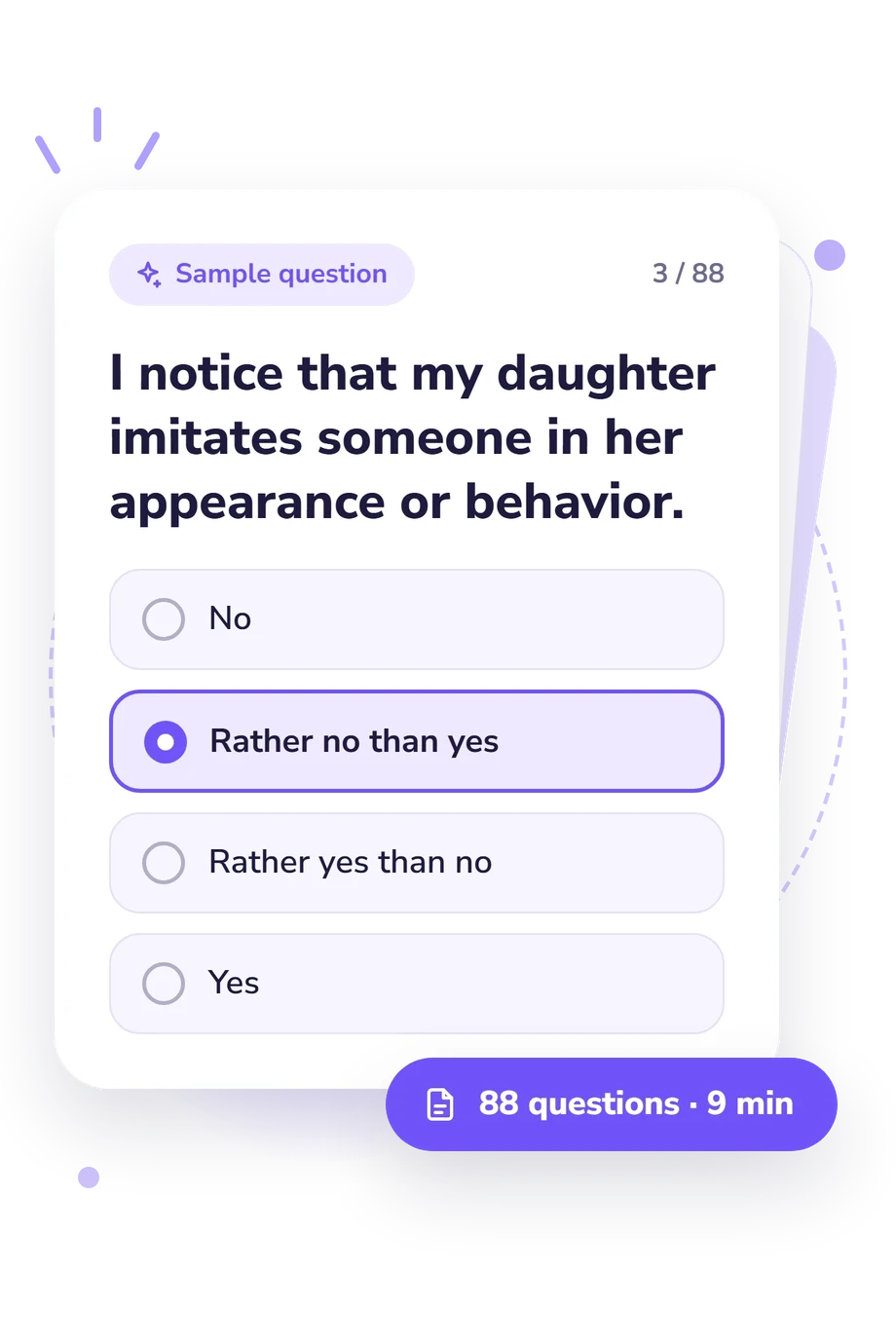
Dear Parents, Please review the statements below and rate the extent to which they describe your child’s behavior over the past 6–12 months. Please respond as objectively as possible.
    • No
    • Rather no than yes
    • Rather yes than no
    • Yes
    • No
    • No, rather than yes
    • Yes, rather than no
    • Yes
    • No
    • More likely no than yes
    • More likely yes than no
    • Yes
WHAT THE TEST MEASURES
About This Assessment
Questionnaire on the Severity of Adolescent Crisis Symptoms Test

Adolescent Crisis Symptom Severity Questionnaire Test - Symptoms and Signs

family
life crisis

This questionnaire is designed to support structured screening of crisis-related symptoms and behavioral responses in adolescents. The Adolescent Crisis Symptom Severity Questionnaire provides a brief, standardized way to summarize the severity and pattern of self-reported difficulties that may arise during developmental transitions.

It consists of 44 items and typically requires about 9 minutes to complete. Item content focuses on common domains of adolescent crisis reactions and can be used to inform clinical interviewing, school-based consultation, and decisions about monitoring or referral. The Adolescent Crisis Symptom Severity Questionnaire was developed by Michael Rutter and is intended to complement, not replace, comprehensive assessment and diagnostic evaluation.

Author: Michael Rutter
Literature: Steinberg, L. Adolescence. McGraw-Hill Education. 2011.; Pfeiffer, S. I. Handbook of giftedness in children: Psychoeducational theory, research, and best practices. Springer. 2018.
Popular tests
Comments
Leave a Comment