
Online Disembodiment Test
How the Scales are Structured
Who Usually Takes This Test?
See How You Compare
Below is a preview of how scores are typically distributed across each scale.
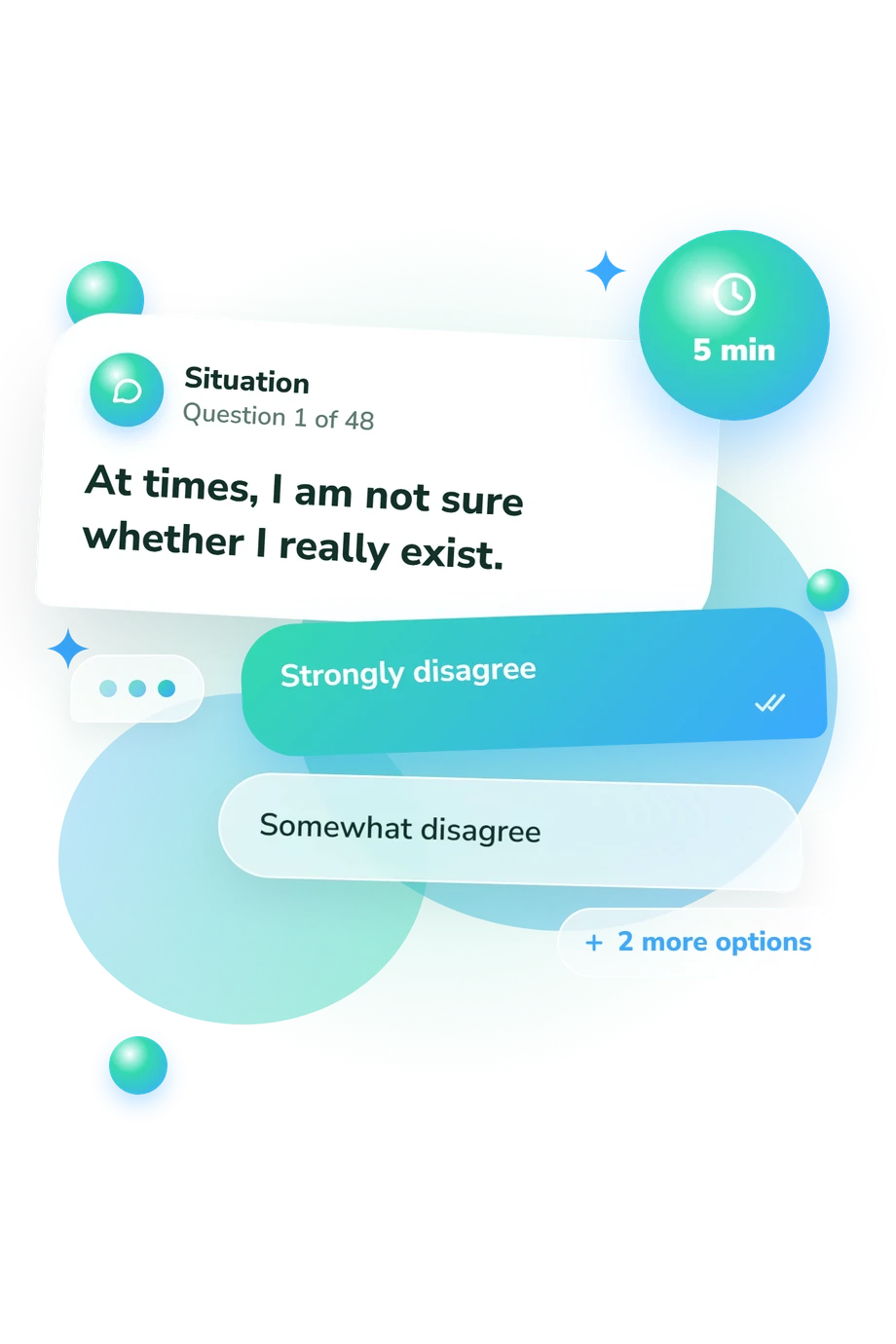
Example Questions From the Test
- Completely disagree
- Somewhat disagree
- Somewhat agree
- Completely agree
- Strongly disagree
- Somewhat disagree
- Somewhat agree
- Strongly agree
- Strongly disagree
- Rather disagree
- Rather agree
- Strongly agree
Online Disembodiment Test - Description and methodology of the test
People deciding whether the Online Disembodiment Test relates to their online experience can use it as a structured reflection on anonymity, virtual presence, and distance from the physical body. It helps readers judge whether questions about physical distance, unreality, and offline functioning fit what they want to explore. This online disembodiment questionnaire makes these patterns easier to describe without reducing them to one label.
What This Assessment Explores
Online experience is considered alongside offline vitality and reality. Questions touch on bodily distance, health, coping, appearance, and unreality. This online disembodiment assessment yields a multidimensional profile.
These scales show what each part of the result represents:
- Preference for Technological Disembodiment (6-24) reflects experiences of online disembodiment, positive appraisal of them, and potential physical-self detachment; Low 6-11, Moderate 12-18, High 19-24.
- Embodied Self Vitality (6-24) reflects fullness of life, activity, vitality, and offline adaptability; Low vitality 6-12, Moderate vitality 13-18, High vitality 19-24.
- Embodied, Integrated Self (6-24) reflects fitness, health care, active living, appearance satisfaction, and absence of excessive-use problems; Low embodiment 6-12, Moderate embodiment 13-18, High embodiment 19-24.
- Disembodiment as Virtualization (6-24) reflects unreality, questioning or problematizing the disembodied self and surrounding reality, and a general sense of existence; Low virtualization 6-11, Moderate virtualization 12-18, High virtualization 19-24.
Methodology and Scientific Basis
Each statement uses a four-step agreement response, moving from disagreement to agreement. Results are reported through four displayed scale totals and their result bands; individual response weighting is not specified, and the output is not a pass/fail score.
The closest evidence base is Unembodiment on the Internet (Kopteva et al., 2023), a refined questionnaire examined through psychometric verification. Earlier work by Kopteva, Kalugin, and Dorfman connects the construct with embodiment, online experience, and perceived reality. The questionnaire is conceptually consistent with that research, but this online version should not be assumed to be the published instrument or to inherit its validation evidence or norms.
To interpret online disembodiment results, focus on patterns across online and offline life. Higher or lower results describe a reported tendency within the stated scale, not a diagnosis or fixed identity. The displayed scoring does not establish population norms, diagnostic cutoffs, or clinical classification.
Self-report depends on self-awareness, honesty, current mood, and online context, so results can shift with circumstances and should be considered alongside broader information when experiences are persistent or distressing.
- Kopteva, Natalia V., Alexey Yu. Kalugin, and Lyubov A. Kozlova. “Psychometric Verification of a Refined Version of the ‘Unembodiment on the Internet’ Questionnaire.” Clinical Psychology and Special Education, 2023, vol. 12, no. 3, pp. 165-187. 10.17759/cpse.2023120308
- Kopteva, Natalia V., Alexey Yu. Kalugin, and Leonid Ya. Dorfman. “Unembodiment in the Internet. Part 2. Psychometric Verification of the Questionnaire.” Clinical Psychology and Special Education, 2021, vol. 10, no. 4, pp. 205-233. 10.17759/cpse.2021100410
- Kopteva, Natalia V., Alexey Yu. Kalugin, and Leonid Ya. Dorfman. “Unembodiment on the Internet. Part 1: Theoretical Basis and Construct.” Clinical Psychology and Special Education, 2021, vol. 10, no. 3, pp. 31-48. 10.17759/cpse.2021100303
Updated: