
Freudly+971 508685814hello@freudly.ai
Freudly
family

Three-Year Crisis Symptom Severity Questionnaire Test
Take the online Three-Year Crisis Symptom Severity Questionnaire Test - AI psychologist FreudlyYou can take Three-Year Crisis Symptom Severity Questionnaire Testhere. Online version of a simple and accurate psychological test with interpretation.en
In about 6 minutes, it helps you understand what’s behind your toddler’s tantrums and shifting behavior. Clear results flag key symptom patterns to guide support and inform conversations with a child psychologist.
Start Online Test
Questions: 326 minutes
08:30
October 2, 2025
October 2, 2025
Material has been updated
October 2, 2025
Material has been published
29,966 views
2,940 completions
2,582 likes
Verified by Daniel Hall
Psychologist with 25 years of experience
Share
Scale Explorer

How the Scales are Structured

example score
2/6
Stubbornness (S)
Measures how strongly a child persists in their own wishes or opinions even when they conflict with adult demands.
Low
Moderate
High
02: Low | 34: Moderate | 56: High
A score of 2 indicates a low level of stubbornness, with occasional persistence that typically remains manageable in everyday interactions.
example score
4/6
Defiance (D)
Measures the child’s general tendency toward obstinate resistance and refusal to comply across situations, not tied to a specific trigger.
Low
Moderate
High
02: Low | 34: Moderate | 56: High
A score of 4 falls in the Moderate range, suggesting a noticeable but not extreme pattern of oppositional refusals and resistance in everyday interactions.
example score
3/6
Psychosomatic Reactions (PR)
Measures the extent of psychosomatic symptoms in the child that appear against a background of emotional tension.
Low
Moderate
High
02: Low | 34: Moderate | 56: High
A score of 3 falls in the Moderate range, suggesting occasional psychosomatic reactions associated with emotional strain.
example score
3/6
Somatic Reactions (SR)
Assesses the extent of physical signs of stress in the child, such as unexplained complaints of feeling unwell.
Low
Moderate
High
02: Low | 34: Moderate | 56: High
A score of 3 indicates a moderate level of somatic reactions, suggesting occasional physical stress signs without clear objective causes.
example score
2/6
Emotional Excitability (EE)
Measures the child’s level of emotional instability and tendency toward intense affective reactions.
Low
Moderate
High
02: Low | 34: Moderate | 56: High
A score of 2 indicates low emotional excitability, with relatively stable emotions and infrequent intense reactions.
example score
2/6
Speech Difficulties (SD)
Assesses the presence and intensity of speech difficulties that may reflect emotional stress in the child.
Minimal/none
Moderate
High
02: Minimal/none | 34: Moderate | 56: High
A score of 2 falls in the Minimal/none range, suggesting speech difficulties are absent or mild in this context.
example score
3/6
Signs of Psychological Tension (SoPT)
Measures the intensity of a child’s psychological stress signs such as irritability and anxiety.
Low
Moderate
High
02: Low | 34: Moderate | 56: High
A score of 3 indicates a moderate level of psychological stress signs, suggesting noticeable but not pronounced irritability or anxiety.
example score
3/6
Restless Sleep and Fears (RSaF)
Assesses the frequency and intensity of the child’s restless sleep and fear-related signs during the developmental crisis period.
Low
Moderate
High
02: Low | 34: Moderate | 56: High
A score of 3 falls in the Moderate range, indicating noticeable but not extreme signs of restless sleep and fears.
example score
60/100
Neurotic Reactions (NR)
Measures the intensity of anxiety-related, emotionally unstable, and psychosomatic-like reactions shown by a child during the three-year crisis period.
Low
Moderate
High
04: Low | 529: Moderate | 30100: High
A score of 60 falls in the High range, suggesting relatively pronounced neurotic-type reactions such as anxiety and emotional instability during this period.
example score
2/6
Changes in Self-Attitude (CiSA)
Assesses changes in the child’s self-esteem and self-perception alongside emerging independence behaviors typical for the three-year developmental transition.
Low expression
Moderate expression
High expression
02: Low expression | 34: Moderate expression | 56: High expression
A score of 2 indicates a low expression of changes in self-attitude, suggesting these self-perception and independence shifts are present only slightly or inconsistently.
example score
2/6
Change in Attitudes Toward Adults (CiATA)
Measures how the child’s communication and interaction with adults is changing, including openness, cooperation, and resistance.
Minimal change
Moderate change
Marked change
02: Minimal change | 34: Moderate change | 56: Marked change
A score of 2 suggests minimal change in the child’s attitude toward adults, with generally stable interaction patterns and limited shifts in communication.
example score
3/6
Change in Relation to the Object World (CiRttOW)
Assesses how the child’s interest in and interaction with the physical world and objects is changing.
Low change
Moderate change
High change
02: Low change | 34: Moderate change | 56: High change
A score of 3 indicates a moderate shift in interest and new ways of engaging with objects, suggesting emerging exploration without being strongly pronounced.
example score
30/100
Constructive Symptoms (CS)
Measures positive, developmentally constructive behaviors linked to growing independence and new ways of interacting with others during the three-year crisis period.
Low
Moderate
High
040: Low | 4175: Moderate | 76100: High
A score of 30 falls in the Low range, suggesting constructive signs of independence and adaptive interaction are currently less pronounced.
example score
2/6
Despotism and Jealousy (DaJ)
This scale measures a child's tendency to dominate close relationships and show jealousy over adult attention.
Low
Moderate
High
02: Low | 34: Moderate | 56: High
A score of 2 falls in the Low range, suggesting despotism-jealousy behaviors are minimal or occasional in close relationships.
example score
3/6
Devaluation Symptom (DS)
Measures how strongly the child devalues adults’ authority, requests, or previously important objects and activities.
Low
Moderate
High
02: Low | 34: Moderate | 56: High
A score of 3 indicates a moderate tendency to dismiss adult requests or downplay the importance of things that used to matter to them.
example score
4/6
Protest and Rebellion (PaR)
Measures the child’s tendency toward active resistance and overt protest in response to restrictions and demands.
Low
Moderate
High
02: Low | 34: Moderate | 56: High
A score of 4 suggests a moderate level of protest-revolt behaviors, with fairly frequent overt resistance when the child encounters limits or demands.
example score
4/6
Defiance and Willfulness (DaW)
Assesses how strongly a child insists on acting independently according to their own will despite adults' opinions.
Low
Moderate
High
02: Low | 34: Moderate | 56: High
A score of 4 indicates a moderate level of willfulness, with independence expressed regularly but not dominating most interactions.
example score
3/6
Negativism (N)
Assesses how strongly the child tends to resist adult demands and refuse to comply with requests.
Low
Moderate
High
02: Low | 34: Moderate | 56: High
A score of 3 indicates a moderate level of negativism, with noticeable but not pervasive resistance to adult requests.
example score
28/100
Negativistic Symptoms (NS)
Measures the severity of negativistic behaviors such as stubbornness, resistance, defiance, and despotism during the three-year crisis period.
Low
Moderate
High
031: Low | 3266: Moderate | 67100: High
A score of 28 falls in the Low range, suggesting negative reactions are present but generally mild and less frequent or intense.
example score
28/100
Overall Crisis Index (OCI)
Measures the combined intensity of three-year crisis symptoms based on parent-reported behaviors and emotional reactions.
Mild
Typical
Pronounced
027: Mild | 2850: Typical | 51100: Pronounced
A score of 28 falls in the Typical range, suggesting a moderate, developmentally common level of overall crisis-related symptoms.
Start Online Test
just completed the test
DATA-BASED USER COHORTS

Who Usually Takes This Test?

Concerned toddler parents
46%OF USERS
Parents of 2.5–4-year-olds who see frequent tantrums, defiance, or mood swings and want to understand whether it fits the age norm.
Parents in counseling
32%OF USERS
Parents preparing for or already attending a child psychologist consultation who need a structured snapshot of symptom intensity to discuss.
Early childhood professionals
22%OF USERS
Child psychologists, educators, and pediatric support staff who use parent-reported checklists to screen development and plan guidance.
BASED ON AGGREGATED, ANONYMIZED DATA FROM TENS OF THOUSANDS OF FREUDLY USERS.
Benchmarking

See How You Compare

Once you complete the test, your results are compared with real-world data from people in your country.
Below is a preview of how scores are typically distributed across each scale.
Stubbornness (S)
Stubbornness (S)
Average
2.4
Normal range
1.43.3
min.
0
max.
6
This curve shows how scores are typically distributed.
Once you complete the test, your result will appear on the scale so you can see how you compare.
Rebelliousness (R)
Rebelliousness (R)
Average
1.8
Normal range
12.6
min.
0
max.
6
This curve shows how scores are typically distributed.
Once you complete the test, your result will appear on the scale so you can see how you compare.
Psychosomatic Reactions (PR)
Average
2.9
Normal range
23.7
min.
0
max.
6
This curve shows how scores are typically distributed.
Once you complete the test, your result will appear on the scale so you can see how you compare.
Somatic Reactions (SR)
Average
2.3
Normal range
1.43.2
min.
0
max.
6
This curve shows how scores are typically distributed.
Once you complete the test, your result will appear on the scale so you can see how you compare.
Emotional Excitability (EE)
Average
2.9
Normal range
1.93.9
min.
0
max.
6
This curve shows how scores are typically distributed.
Once you complete the test, your result will appear on the scale so you can see how you compare.
Speech difficulties (Sd)
Average
1.9
Normal range
0.92.8
min.
0
max.
6
This curve shows how scores are typically distributed.
Once you complete the test, your result will appear on the scale so you can see how you compare.
Signs of Psychological Stress (SoPS)
Average
3.7
Normal range
2.94.4
min.
0
max.
6
This curve shows how scores are typically distributed.
Once you complete the test, your result will appear on the scale so you can see how you compare.
Restless sleep, fears (Rsf)
Average
3.5
Normal range
2.84.3
min.
0
max.
6
This curve shows how scores are typically distributed.
Once you complete the test, your result will appear on the scale so you can see how you compare.
Neurotic Reactions (NR)
Average
62.1
Normal range
4975.1
min.
0
max.
100
This curve shows how scores are typically distributed.
Once you complete the test, your result will appear on the scale so you can see how you compare.
Attitude toward oneself (Ato)
Average
4.4
Normal range
3.35.4
min.
0
max.
6
This curve shows how scores are typically distributed.
Once you complete the test, your result will appear on the scale so you can see how you compare.
Attitude towards adults (Ata)
Average
2.1
Normal range
1.13.1
min.
0
max.
6
This curve shows how scores are typically distributed.
Once you complete the test, your result will appear on the scale so you can see how you compare.
Attitude toward the subject world (Attsw)
Average
2.2
Normal range
1.33
min.
0
max.
6
This curve shows how scores are typically distributed.
Once you complete the test, your result will appear on the scale so you can see how you compare.
Constructive Symptoms (CS)
Average
39.9
Normal range
24.555.2
min.
0
max.
100
This curve shows how scores are typically distributed.
Once you complete the test, your result will appear on the scale so you can see how you compare.
Despotism-Jealousy (D)
Average
3.3
Normal range
2.54
min.
0
max.
6
This curve shows how scores are typically distributed.
Once you complete the test, your result will appear on the scale so you can see how you compare.
Symptom of Devaluation (SoD)
Average
3.5
Normal range
2.64.4
min.
0
max.
6
This curve shows how scores are typically distributed.
Once you complete the test, your result will appear on the scale so you can see how you compare.
Protest-Revolt (P)
Protest-Revolt (P)
Average
3
Normal range
2.23.8
min.
0
max.
6
This curve shows how scores are typically distributed.
Once you complete the test, your result will appear on the scale so you can see how you compare.
Willfulness, self-will (Ws)
Average
4
Normal range
3.24.7
min.
0
max.
6
This curve shows how scores are typically distributed.
Once you complete the test, your result will appear on the scale so you can see how you compare.
Negativism (N)
Negativism (N)
Average
4.2
Normal range
3.15.3
min.
0
max.
6
This curve shows how scores are typically distributed.
Once you complete the test, your result will appear on the scale so you can see how you compare.
Negative symptoms (Ns)
Average
64.4
Normal range
47.681.2
min.
0
max.
100
This curve shows how scores are typically distributed.
Once you complete the test, your result will appear on the scale so you can see how you compare.
Overall Crisis Indicator (OCI)
Average
40.1
Normal range
22.657.6
min.
0
max.
100
This curve shows how scores are typically distributed.
Once you complete the test, your result will appear on the scale so you can see how you compare.
Featured On
SAMPLE QUESTIONS

Example Questions From the Test

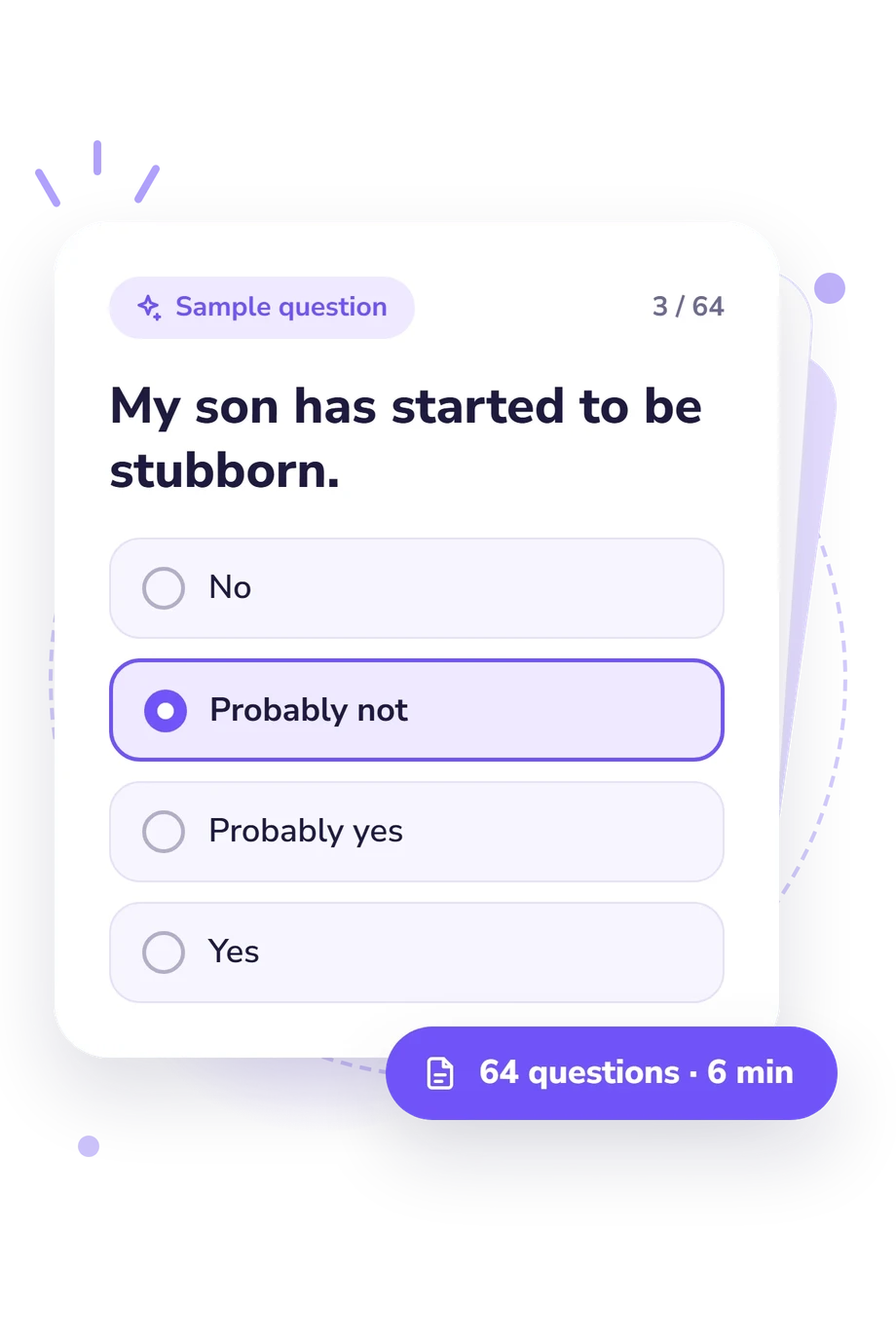
Dear Parents, Please review the statements below and rate the extent to which they describe your child’s behavior over the past 3 months. The behavioral characteristics addressed are typical for this age. Please respond as objectively as possible.
    • No
    • No, rather than yes
    • Yes, rather than no
    • Yes
    • No
    • Probably not
    • Probably yes
    • Yes
    • No
    • More no than yes
    • More yes than no
    • Yes
WHAT THE TEST MEASURES
About This Assessment
Three-Year Crisis Symptom Severity Questionnaire Test

Three-Year Crisis Symptom Severity Questionnaire Test - Symptoms and Signs

family
life crisis

This questionnaire is a parent-report measure designed to rate the severity of behavioral and emotional features commonly associated with developmental challenges around age 3. The Three-Year Crisis Symptom Severity Questionnaire is intended to support clinical screening and case formulation by organizing observations into symptom domains.

The instrument includes 32 items and typically takes about 6 minutes to complete. It may be used in pediatric behavioral health or early childhood consultation settings to summarize concerns and guide follow-up assessment.

Scores from the Three-Year Crisis Symptom Severity Questionnaire can be used to describe overall symptom burden and relative elevations across domains, helping clinicians identify areas where additional evaluation, monitoring, or parent guidance may be indicated. The authorship is attributed to Arnold Gesell.

Author: Arnold Gesell
Literature: Achenbach, T. M., & Rescorla, L. A. Manual for the ASEBA preschool forms & profiles. University of Vermont, Research Center for Children, Youth, & Families. 2000.; Sameroff, A. J. (Ed.). The transactional model of development: How children and contexts shape each other. American Psychological Association. 2009.
Popular tests
Comments
Leave a Comment