
Social Media Addiction Questionnaire Test
How the Scales are Structured
Who Usually Takes This Test?
See How You Compare
Below is a preview of how scores are typically distributed across each scale.
Example Questions From the Test
- Constantly
- Very often
- Often
- Sometimes
- Very rarely
- Constantly
- Very often
- Often
- Sometimes
- Very rarely
- Constantly
- Very often
- Often
- Sometimes
- Very rarely
Social Media Addiction Questionnaire Test - Description and methodology of the test
People deciding whether online networking warrants closer attention can use the Social Media Addiction Questionnaire Test to weigh how its result relates to daily routines. It may suit anyone considering a change to access, sleep, work, school, or relationship routines, especially when social media competes with responsibilities. This social media addiction test serves as a structured prompt for deciding whether closer review or a practical change is warranted.
What This Assessment Measures
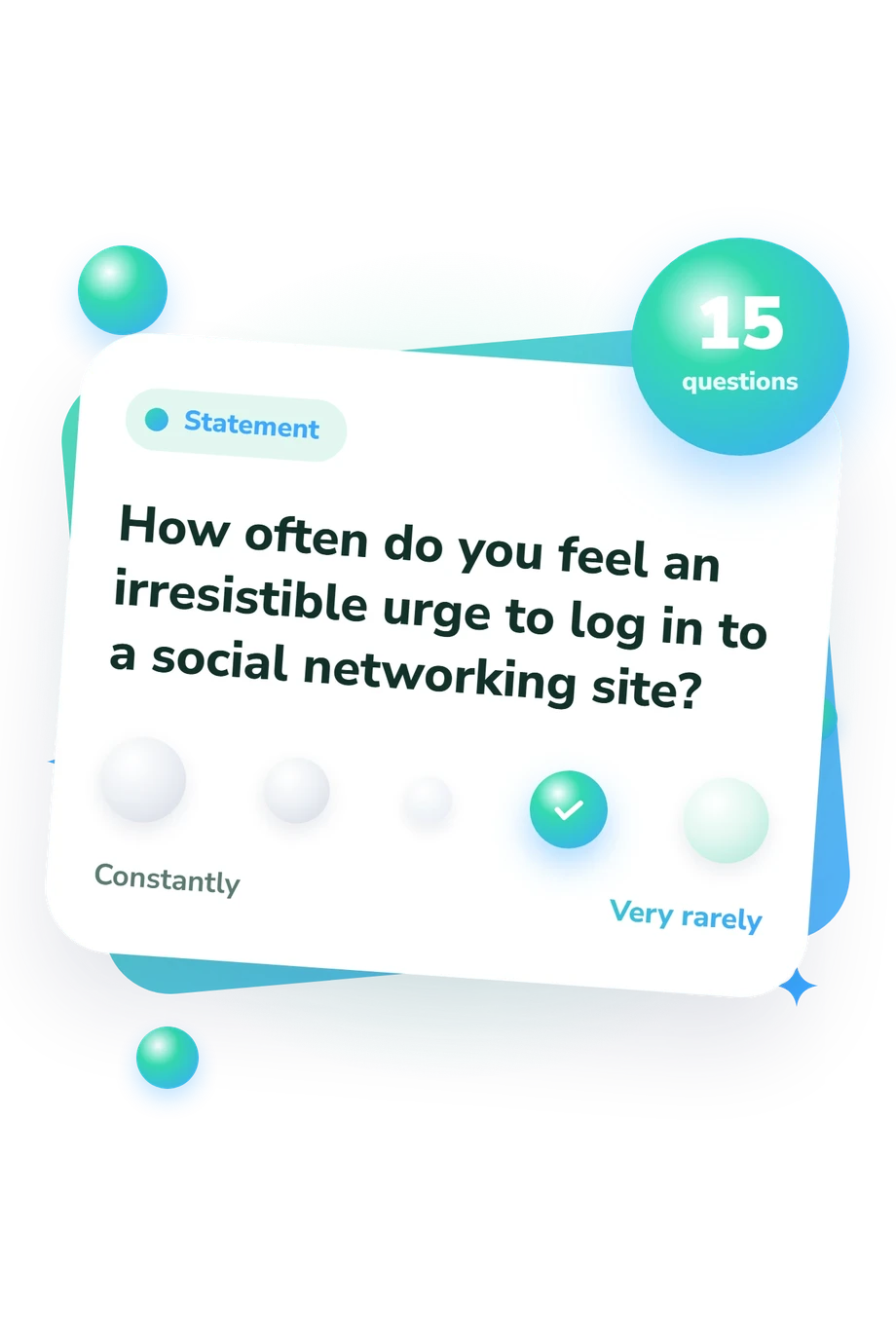
Rather than asking whether platforms are enjoyable, the questionnaire focuses on excessive or poorly controlled use. Items cover preoccupation with networking sites, urges to log in, frequent checking, profile activity, mood improvement, and using platforms to escape personal problems. Prompts address irritability without access, difficulty cutting down, and consequences including missed work or school.
The result is organized as one overall scale:
- Social Media Addiction: 15-75 measures apparent severity of problematic, excessive use and possible difficulty controlling time online; Low 15-21, Moderate 22-38, and High 39-75 are the displayed result bands.
In interpretation, a problematic social media use score is best read as an indicator of the pattern represented by these behaviors, not as a judgment about platform use alone. Higher results indicate greater engagement and possible difficulty controlling time spent on social media, inviting examination of boundaries, triggers, and impact.
Methodology and Evidence Base
Each item in this social networking addiction questionnaire uses a five-point frequency response, from “Constantly” or “Always” to “Very rarely.” Prompts cover urges, preoccupation, checking, emotional reactions, platform activity, and daily consequences. Responses feed one displayed scale, so the result estimates overall severity rather than separate behaviors.
Its closest conceptual reference is the Bergen Facebook Addiction Scale (Andreassen et al., 2012), a published measure organized around salience, mood modification, tolerance, withdrawal, conflict, and relapse. This questionnaire is conceptually consistent with that work, not a documented reproduction or standardized administration of the scale; no independent norms or validation are established for this online version, so its displayed bands are interpretive guidance rather than clinical cutoffs. Kuss and Griffiths (2017) discuss social-networking addiction, while Young (1998) contextualizes problematic internet use.
Interpret the band alongside the answers and current circumstances. Self-report is affected by recall, honesty, mood, and changing routines; a high result signals a pattern worth examining, but it does not establish a clinical diagnosis or explain its cause. The findings help review triggers, sleep, responsibilities, and efforts to reduce use.
- Andreassen, C. S., Torsheim, T., Brunborg, G. S., & Pallesen, S. (2012). Development of a Facebook addiction scale. Psychological Reports, 110(2), 501-517. 10.2466/02.09.18.PR0.110.2.501-517
- Andreassen, C. S., Billieux, J., Griffiths, M. D., Kuss, D. J., Demetrovics, Z., Mazzoni, E., & Pallesen, S. (2016). The relationship between addictive use of social media and video games and symptoms of psychiatric disorders: A large-scale cross-sectional study. Psychology of Addictive Behaviors, 30(2), 252-262. 10.1037/adb0000160
- Kuss, D. J., & Griffiths, M. D. (2017). Social networking sites and addiction: Ten lessons learned. International Journal of Environmental Research and Public Health, 14(3), 311. 10.3390/ijerph14030311
- Young, K. S. (1998). Internet addiction: The emergence of a new clinical disorder. CyberPsychology & Behavior, 1(3), 237-244. 10.1089/cpb.1998.1.237
Updated: