
Employment, Freelancing, Entrepreneurship Test
How the Scales are Structured
Who Usually Takes This Test?
See How You Compare
Below is a preview of how scores are typically distributed across each scale.
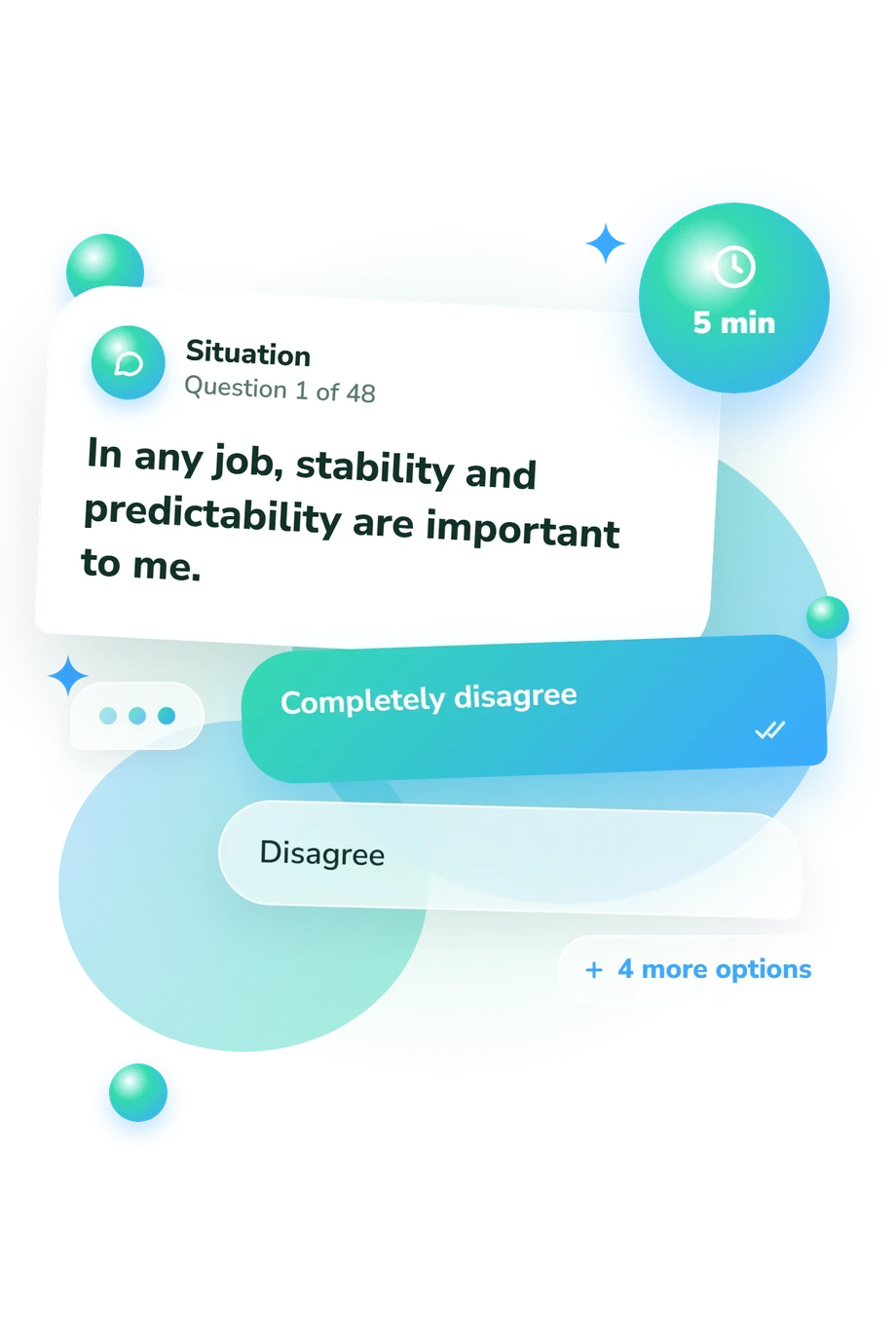
Example Questions From the Test
- Strongly disagree
- Disagree
- Somewhat disagree
- Somewhat agree
- Agree
- Strongly agree
- Strongly disagree
- Disagree
- Somewhat disagree
- Somewhat agree
- Agree
- Completely agree
- Completely disagree
- Disagree
- Slightly disagree
- Slightly agree
- Agree
- Completely agree
Employment, Freelancing, Entrepreneurship Test - Description and methodology of the test
People considering a change in how they work can use the Employment, Freelancing, Entrepreneurship Test to examine whether their preferences align more with autonomy, predictability, variable income, or organizational support. This career path assessment is intended for people reflecting on work choices, not for measuring current competence. It produces a comparative profile that can help organize priorities before a career decision.
What This Assessment Measures
Rather than judging job performance, the questionnaire examines preferred working conditions. It is intended for people comparing possible work arrangements. Its statements cover supervision, stability, benefits, autonomy, variable workloads, risk, leadership, and persistence.
The result contains three dimensions:
- Entrepreneurship (0-40) measures orientation toward independently starting and developing a business, including willingness to take risks, make decisions, and work independently; Low 0-16, Moderate 17-25, High 26-40.
- Freelancing (0-40) measures fit with project work, client-finding, self-organization, and fluctuating workloads; Low freelance fit 0-16, Moderate 17-25, High freelance fit 26-40.
- Salaried Employment (0-40) measures fit with ongoing organizational work, defined duties, supervision, teamwork, and social benefits; Low fit 0-16, Moderate 17-25, High fit 26-40.
As a work preference test, it highlights conditions that may feel sustainable, not fixed abilities.
Methodology and Evidence Base
Each item in this employment options questionnaire uses a six-point agreement scale from strong disagreement to strong agreement, with minor wording variations. Responses produce separate scores for the three scales, and each score is interpreted within its displayed band; the questionnaire does not establish a validated ranking or universal comparison between them.
Conceptually, the questionnaire is consistent with Career Anchors (Schein, 1990), which connects career preferences with values, motives, and desired working conditions. It also relates to Holland’s theory (1997) that vocational satisfaction depends partly on the match between vocational personality and work environment. These links are conceptual; the online questionnaire is not presented as a reproduction of either published instrument.
Danziger, Rachman-Moore, and Valency (2008) evaluated the construct validity of Schein’s published inventory, but that evidence does not validate this online questionnaire. The displayed ranges are catalogue bands for this questionnaire, not universal employment cutoffs.
Self-report results can shift with financial pressure, recent work experiences, confidence, and changing plans. The profile is a reflection aid, not a diagnosis, proof of ability, or forecast of income.
- Schein, Edgar H. (1990). Career Anchors: Discovering Your Real Values. Revised edition. San Diego, CA: University Associates.
- Danziger, Nira, Dalia Rachman-Moore, and Rony Valency. (2008). The construct validity of Schein's career anchors orientation inventory. Career Development International, 13(1), 7-19. 10.1108/13620430810849506.
- Holland, John L. (1997). Making Vocational Choices: A Theory of Vocational Personalities and Work Environments. 3rd ed. Odessa, FL: Psychological Assessment Resources.
Updated: